Council workshops parks impact-fee options; staff recommends trimming outliers (Option 3), first reading proposed Jan. 7
December 15, 2025 | Grand Junction, Mesa County, Colorado
This article was created by AI summarizing key points discussed. AI makes mistakes, so for full details and context, please refer to the video of the full meeting. Please report any errors so we can fix them. Report an error »
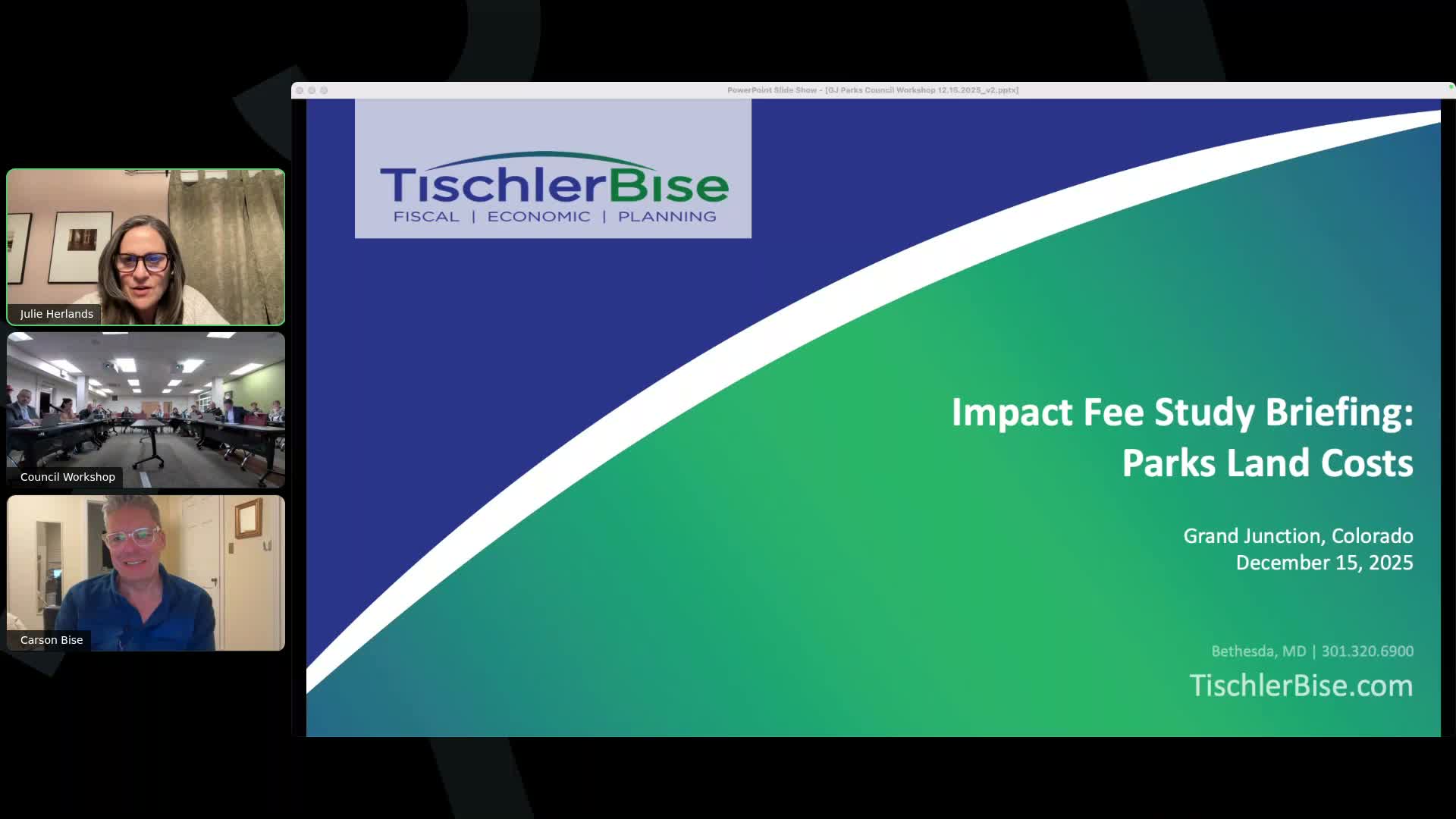
City staff and consultants reviewed revised parks impact-fee calculations at the Dec. 15 workshop and recommended a refined option that trims extreme land-value comparables to reduce the land-cost input used in the fee model.
Consultant Carson (Tishler Heiss) explained the baseline study used a weighted average land sale price of about $147,000 per acre and presented three alternatives: (1) remove downtown parcels (which are disproportionately multifamily/high-value comparables), (2) remove central-city parcels, and (3) remove the three highest and three lowest sale-price outliers. Trimming outliers (Option 3) reduced the land-value input to roughly $108,000–$114,000 per acre depending on truncation and produced lower maximum-supportable fee schedules across unit-size bands.
Council questioned methodology, the study’s policy goal (maintain current level of service vs. a targeted budget), and the affordability impacts. Legal counsel (Jeremiah) explained that the study produces a "maximum legally defensible" fee tied to the city’s current level-of-service calculations but that the council may consciously adopt a lower fraction of that maximum (for example 70%) as a policy decision and remain defensible if that choice is supported by the methodology and rationale.
Jeremiah and staff also outlined procedural options for timing: an emergency ordinance could be adopted immediately but requires unanimity; a regular ordinance could be introduced at first reading Jan. 7 and include rebate language for fees collected during the ordinance pendency. Staff recommended Option 3 following committee feedback and the council expressed informal consensus to move forward; staff will prepare an ordinance for the Jan. 7 first reading and public notice.
Council members discussed incentives and credits for developers that dedicate public parkland within subdivisions (example: Redlands 360 credits/IGA) and noted that credits already exist for qualifying public-park improvements. Council and staff also discussed review intervals for future fee studies (existing code ties review to six- and eight-year touchpoints) and staff recommended retaining review discretion rather than an automatic consultant-mandated schedule.
Next steps: staff to prepare ordinance materials for first reading Jan. 7 (with potential rebate language), publish public notices, and continue outreach to the home-builders association and other stakeholders.
Consultant Carson (Tishler Heiss) explained the baseline study used a weighted average land sale price of about $147,000 per acre and presented three alternatives: (1) remove downtown parcels (which are disproportionately multifamily/high-value comparables), (2) remove central-city parcels, and (3) remove the three highest and three lowest sale-price outliers. Trimming outliers (Option 3) reduced the land-value input to roughly $108,000–$114,000 per acre depending on truncation and produced lower maximum-supportable fee schedules across unit-size bands.
Council questioned methodology, the study’s policy goal (maintain current level of service vs. a targeted budget), and the affordability impacts. Legal counsel (Jeremiah) explained that the study produces a "maximum legally defensible" fee tied to the city’s current level-of-service calculations but that the council may consciously adopt a lower fraction of that maximum (for example 70%) as a policy decision and remain defensible if that choice is supported by the methodology and rationale.
Jeremiah and staff also outlined procedural options for timing: an emergency ordinance could be adopted immediately but requires unanimity; a regular ordinance could be introduced at first reading Jan. 7 and include rebate language for fees collected during the ordinance pendency. Staff recommended Option 3 following committee feedback and the council expressed informal consensus to move forward; staff will prepare an ordinance for the Jan. 7 first reading and public notice.
Council members discussed incentives and credits for developers that dedicate public parkland within subdivisions (example: Redlands 360 credits/IGA) and noted that credits already exist for qualifying public-park improvements. Council and staff also discussed review intervals for future fee studies (existing code ties review to six- and eight-year touchpoints) and staff recommended retaining review discretion rather than an automatic consultant-mandated schedule.
Next steps: staff to prepare ordinance materials for first reading Jan. 7 (with potential rebate language), publish public notices, and continue outreach to the home-builders association and other stakeholders.
View the Full Meeting & All Its Details
This article offers just a summary. Unlock complete video, transcripts, and insights as a Founder Member.
✓
Watch full, unedited meeting videos
✓
Search every word spoken in unlimited transcripts
✓
AI summaries & real-time alerts (all government levels)
✓
Permanent access to expanding government content
30-day money-back guarantee
