Loveland Council approves first readings of 2024 building and energy codes; solar/EV rules draw split votes
January 20, 2026 | Loveland City, Larimer County, Colorado
This article was created by AI summarizing key points discussed. AI makes mistakes, so for full details and context, please refer to the video of the full meeting. Please report any errors so we can fix them. Report an error »
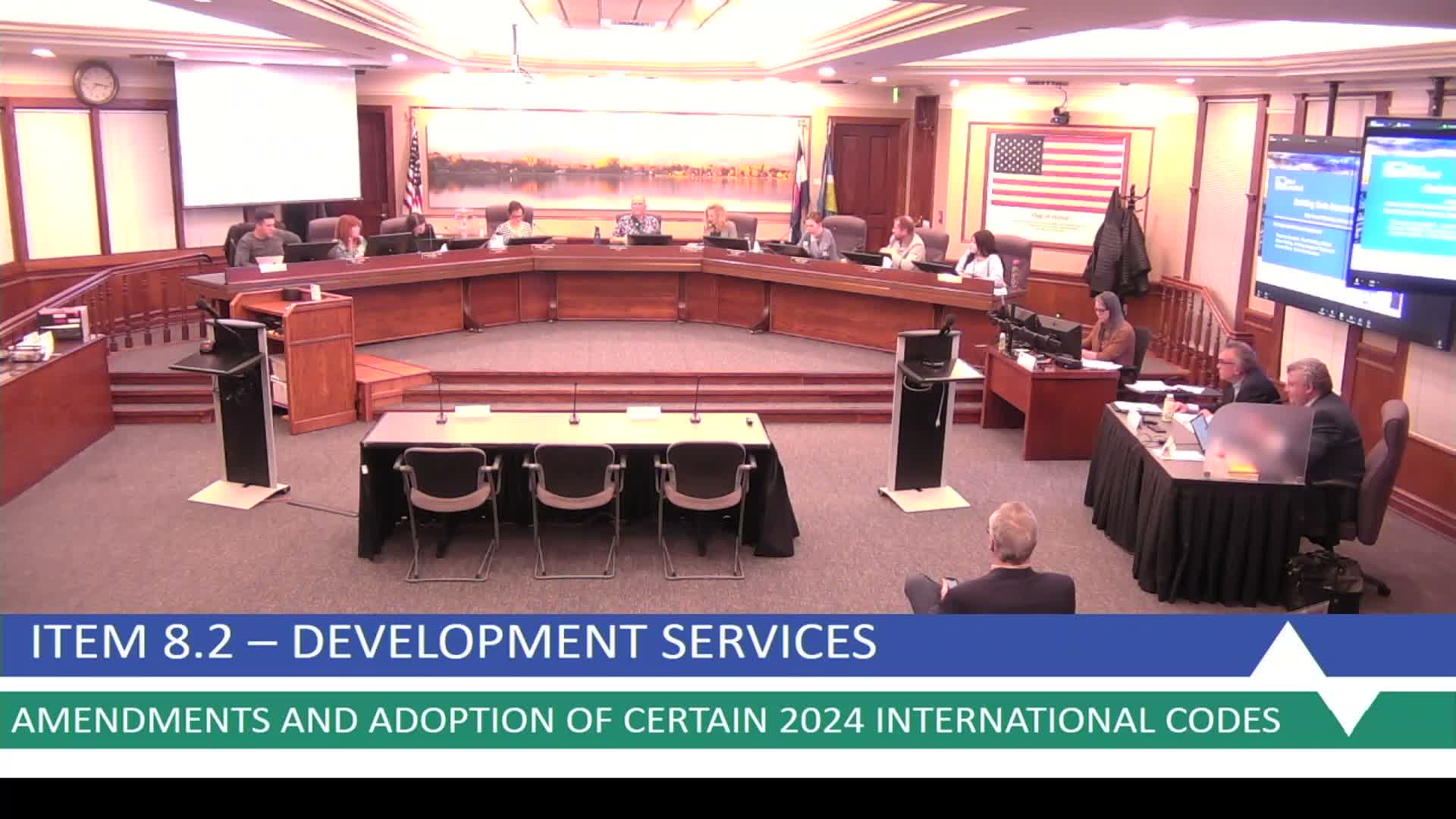
Loveland City Council on Tuesday voted on a package of ordinances to update municipal building and related codes to the International Code Council 2024 editions and to adopt the Colorado model electric-ready and solar-ready code. City staff said adopting the newest codes keeps Loveland consistent with neighboring jurisdictions, satisfies state-mandated elements of the energy code, and can influence the city’s ISO rating.
Theresa Campbell, Loveland’s chief building official, said the updates were developed in collaboration with neighboring jurisdictions, Larimer County and the Home Builders Association to provide consistency for contractors and to maintain public safety. Staff highlighted specific local amendments and said the new codes will take effect after a second reading in February.
The council considered 11 separate first-reading ordinances (numbers shown in the packet). Most passed unanimously on first reading; the ordinance to adopt the Colorado model electric-ready and solar-ready code (Ordinance 68-16) was the closest vote, passing 5–4. Council members asking questions focused on whether the state’s energy and solar/EV rules preempt local action, the cost impact for affordable housing and accessory dwelling units, and the requirement for third‑party energy inspections for new construction.
Darren Barrett told council he worried new requirements would raise the cost of housing and criticized international standards as irrelevant to local needs. “I don’t give a **** about international standards,” he said during public comment. Rob Sabin, a local homebuilder and member of CAB, supported the updates and called the amendments pragmatic and helpful for consistent permitting across jurisdictions.
Staff and the city attorney described the state’s approach: HB 20‑21362 (referred to in staff comments) treats EV-ready and solar-ready provisions as matters of statewide concern, limiting the scope for local deviation. City staff provided preliminary cost context for key elements: a dedicated circuit for a level‑2 EV charger (estimated in testimony at a few hundred dollars per house) and design/rough‑in work to make a roof and electrical system solar-ready (staff estimated roughly $300–$1,000 per home for design/conduit/panel spacing). Staff also said third‑party energy inspections would typically be contractor-paid and would add to construction costs.
Council did not finalize second readings; the ordinances will return for required follow-up and the public hearing on second reading in the February schedule.
Theresa Campbell, Loveland’s chief building official, said the updates were developed in collaboration with neighboring jurisdictions, Larimer County and the Home Builders Association to provide consistency for contractors and to maintain public safety. Staff highlighted specific local amendments and said the new codes will take effect after a second reading in February.
The council considered 11 separate first-reading ordinances (numbers shown in the packet). Most passed unanimously on first reading; the ordinance to adopt the Colorado model electric-ready and solar-ready code (Ordinance 68-16) was the closest vote, passing 5–4. Council members asking questions focused on whether the state’s energy and solar/EV rules preempt local action, the cost impact for affordable housing and accessory dwelling units, and the requirement for third‑party energy inspections for new construction.
Darren Barrett told council he worried new requirements would raise the cost of housing and criticized international standards as irrelevant to local needs. “I don’t give a **** about international standards,” he said during public comment. Rob Sabin, a local homebuilder and member of CAB, supported the updates and called the amendments pragmatic and helpful for consistent permitting across jurisdictions.
Staff and the city attorney described the state’s approach: HB 20‑21362 (referred to in staff comments) treats EV-ready and solar-ready provisions as matters of statewide concern, limiting the scope for local deviation. City staff provided preliminary cost context for key elements: a dedicated circuit for a level‑2 EV charger (estimated in testimony at a few hundred dollars per house) and design/rough‑in work to make a roof and electrical system solar-ready (staff estimated roughly $300–$1,000 per home for design/conduit/panel spacing). Staff also said third‑party energy inspections would typically be contractor-paid and would add to construction costs.
Council did not finalize second readings; the ordinances will return for required follow-up and the public hearing on second reading in the February schedule.
Don't Miss a Word: See the Full Meeting!
Go beyond summaries. Unlock every video, transcript, and key insight with a Founder Membership.
✓
Get instant access to full meeting videos
✓
Search and clip any phrase from complete transcripts
✓
Receive AI-powered summaries & custom alerts
✓
Enjoy lifetime, unrestricted access to government data
30-day money-back guarantee
