Brighton council simplifies fueling‑station rules, votes to limit dispensers; amendment passes unanimously
January 20, 2026 | Brighton, Adams County, Colorado
This article was created by AI summarizing key points discussed. AI makes mistakes, so for full details and context, please refer to the video of the full meeting. Please report any errors so we can fix them. Report an error »
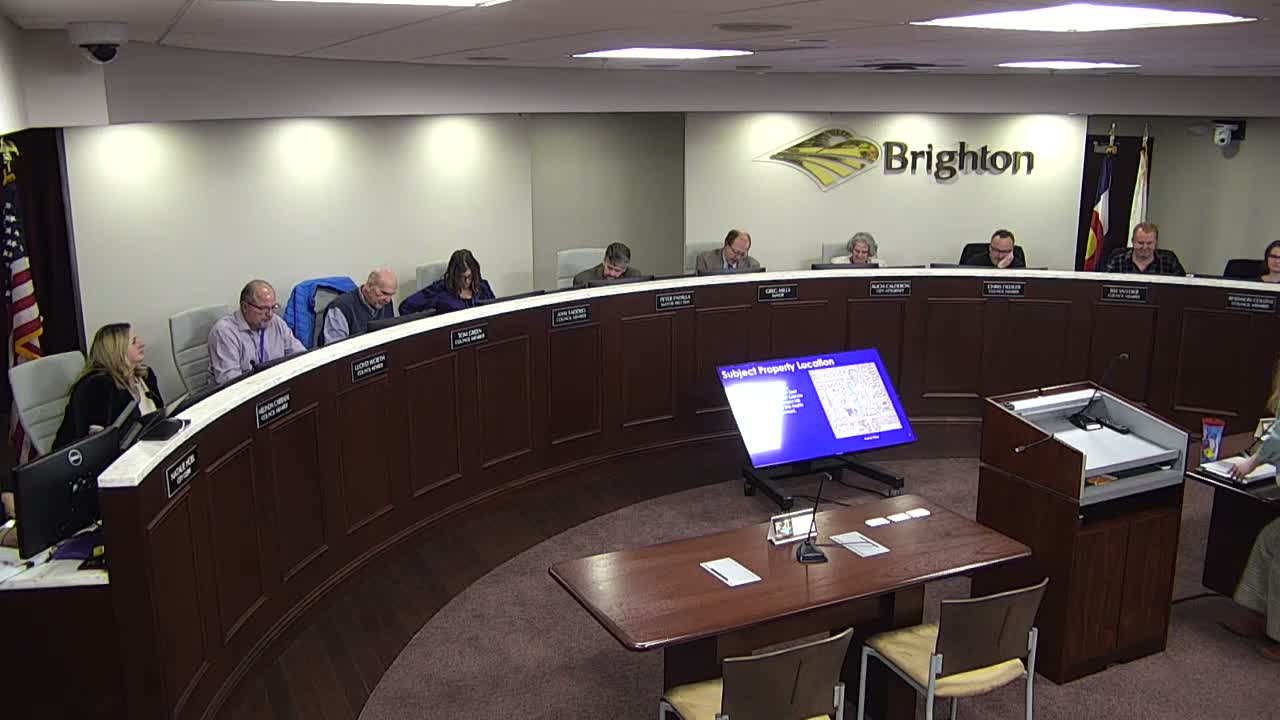
Brighton City Council on Jan. 20 unanimously approved code amendments that simplify fueling‑station definitions and update development standards, and adopted a council amendment that sets dispenser limits for different station types.
Associate planner Amanda Diaz explained staff’s proposal to reduce four gas‑station definitions to two — “fueling stations” for passenger vehicles and “travel centers” for truck‑oriented, full‑service facilities — and to update canopy, dispenser and accessory‑use rules. The changes explicitly recognize electric‑vehicle charging and aim to reduce regulatory barriers developers said were preventing projects.
Council members and staff spent substantial time defining the difference between a fueling station (convenience store, car wash, light vehicle servicing) and a travel center (truck parking, showers, accommodations). Diaz said the proposed code measures capacity by dispensers (islands that serve fuel on both sides), not by individual fuel pumps.
During discussion Councilmember Green proposed an amendment to clarify capacity limits: an in‑town fueling station would be limited to 8 dispensers, those adjacent to a highway up to 16 dispensers, and travel centers could be allowed up to 24 dispensers. Councilmember Taddeo seconded the amendment. Staff said very large or unique projects would likely proceed as a planned unit development (PUD) and undergo site‑specific review.
After clarifying the motion language (allowing “up to” the stated dispenser counts and confirming EV charging points are counted separately), council voted 9–0 to adopt the amendment and approve the ordinance on first reading. Staff and the development review committee had recommended approval and the planning commission unanimously recommended approval on Dec. 11, 2025.
The code amendments will return for subsequent readings and apply to future fueling‑station permits and site plans in Brighton.
Associate planner Amanda Diaz explained staff’s proposal to reduce four gas‑station definitions to two — “fueling stations” for passenger vehicles and “travel centers” for truck‑oriented, full‑service facilities — and to update canopy, dispenser and accessory‑use rules. The changes explicitly recognize electric‑vehicle charging and aim to reduce regulatory barriers developers said were preventing projects.
Council members and staff spent substantial time defining the difference between a fueling station (convenience store, car wash, light vehicle servicing) and a travel center (truck parking, showers, accommodations). Diaz said the proposed code measures capacity by dispensers (islands that serve fuel on both sides), not by individual fuel pumps.
During discussion Councilmember Green proposed an amendment to clarify capacity limits: an in‑town fueling station would be limited to 8 dispensers, those adjacent to a highway up to 16 dispensers, and travel centers could be allowed up to 24 dispensers. Councilmember Taddeo seconded the amendment. Staff said very large or unique projects would likely proceed as a planned unit development (PUD) and undergo site‑specific review.
After clarifying the motion language (allowing “up to” the stated dispenser counts and confirming EV charging points are counted separately), council voted 9–0 to adopt the amendment and approve the ordinance on first reading. Staff and the development review committee had recommended approval and the planning commission unanimously recommended approval on Dec. 11, 2025.
The code amendments will return for subsequent readings and apply to future fueling‑station permits and site plans in Brighton.
Don't Miss a Word: See the Full Meeting!
Go beyond summaries. Unlock every video, transcript, and key insight with a Founder Membership.
✓
Get instant access to full meeting videos
✓
Search and clip any phrase from complete transcripts
✓
Receive AI-powered summaries & custom alerts
✓
Enjoy lifetime, unrestricted access to government data
30-day money-back guarantee
