Needham working group hears Apex traffic update; model predicts limited diversion, local businesses raise concerns
January 22, 2026 | Town of Needham, Norfolk County, Massachusetts
This article was created by AI summarizing key points discussed. AI makes mistakes, so for full details and context, please refer to the video of the full meeting. Please report any errors so we can fix them. Report an error »
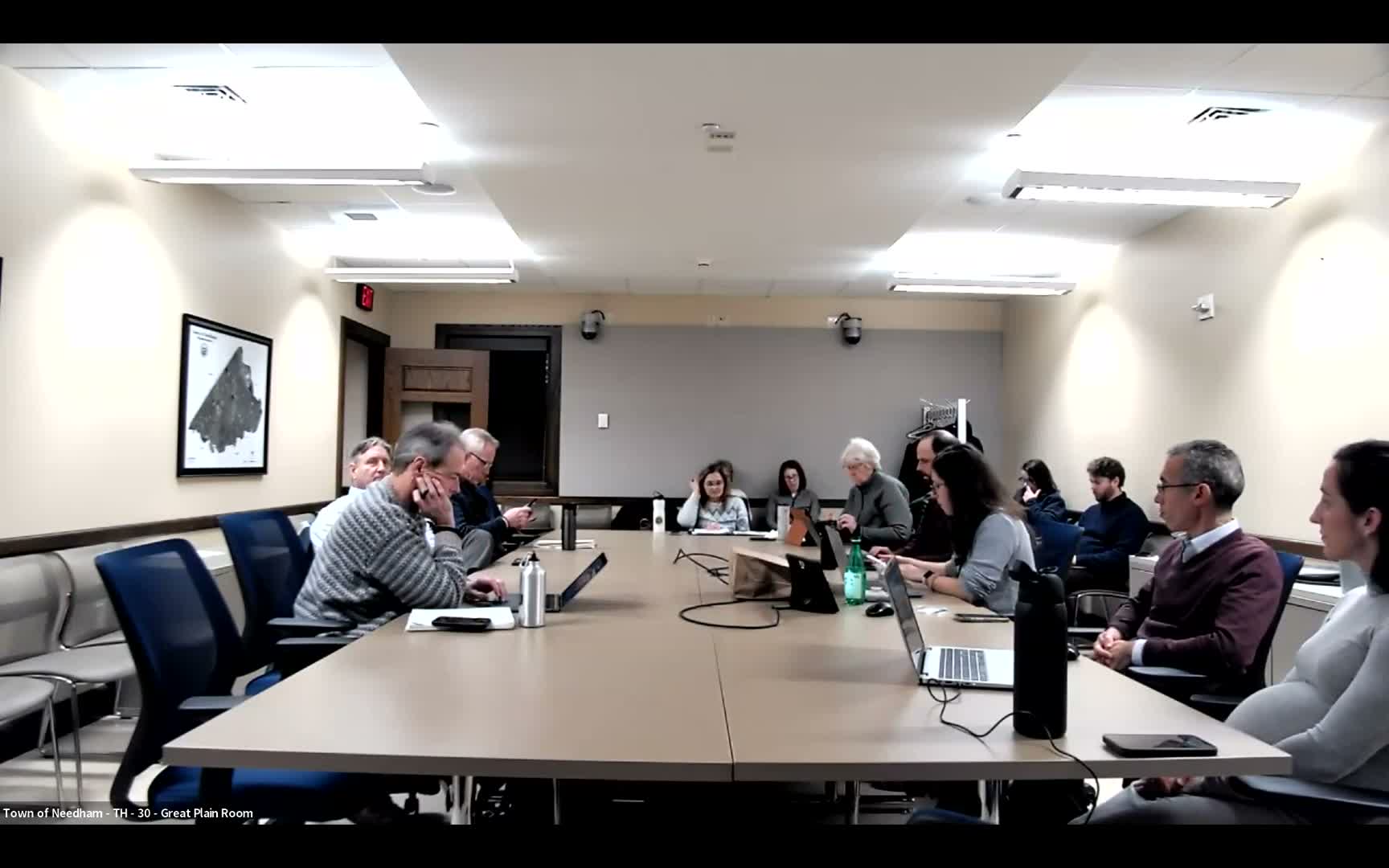
Apex consultants presented an updated traffic analysis to the Envision Needham Center Project Working Group on Jan. 21, saying the firm’s stochastic VISM model — run with September 2025 counts and calibrated Replica origin/destination data — now incorporates diverted trips and new signal‑collected counts. "We're using the traffic counts collected in September 2025," Margo Spiller of Apex said, describing the data and modeling approach.
The model examined three peak periods (AM peak, school dismissal and PM peak) and evaluated two build scenarios: a 2‑lane alternative and a 2‑lane alternative with separate left‑turn lanes. Apex said it used a pragmatic rule that any maneuver showing more than a 2–3 minute increase in travel time would likely cause some motorists to seek alternate routes; those trips were recorded as diverted in repeated VISM simulations. "What we have identified is a 2 to 3 minute threshold of increased travel time," Spiller said.
Under the 2‑lane alternative, Apex reported diversion peaks of roughly 120 vehicles per hour in the morning and up to 200 vehicles per hour in afternoon periods; under the 2‑lane plus left‑turn option diversion peaks were lower (about 100 vehicles/hour during the afternoon window). Apex summarized center‑wide diversion as roughly 0–5% for the 2‑lane plus left option and about 6–11% for the 2‑lane option, depending on the peak period. In nearly all modeled cases, the firm said, increases on local routes (Chestnut, Chapel, Highland) were kept below about one minute, while some regional approaches experienced increases closer to the 2‑3 minute threshold.
Consultants said the Replica data used to estimate retail and commercial origins and destinations is a typical weekday from spring 2025 and is calibrated against counts and spending data. "It is cell phone data, but then they calibrate it with traffic counts," Lucy of Apex said. Apex reported median trip lengths for through trips of about 26 miles (eastbound Great Plain) and 22 miles (northbound Dedham) and said the majority of those through trips are commuting trips, not local retail trips.
Business owners at the meeting pressed for more detail on where diverted vehicles would travel and warned of potential lost retail customers. "Diverting 200 cars, that's a lot of potential clients for any of us as business owners," Liz, identified in the transcript as a business owner, said. Presenters replied that diverted trips are distributed over several arterial alternative routes (for example Route 9, I‑95 ramps and West Street/South Street corridors), not concentrated on a single neighborhood street, and that maps in later slides show the dispersion.
Members also questioned whether the single September 9 traffic count used for the model was representative. Apex and staff said newer, automated signal counts from November and December are available and that those daily counts are generally lower than the September 9 day; staff agreed to clarify public materials to note the Sept. 9 count is a one‑day sample and to cite the November–December signal data used to validate representativeness.
One correction was made during the meeting: a staff member acknowledged a slide misstated train frequency in the presentation. "I can confirm that it was 1 in each direction, and we made a mistake on the presentation," the staff member said; staff confirmed the VISM modeling used one train per direction (the modeling was correct, the slide text was not).
Presenters and committee members discussed how the study results should be shown to the public — including clearly labeling that the 2–3 minute figure is an increase (change) in travel time rather than total travel time — and asked that public materials include current baseline travel times so residents can see the additive effect. Apex also said it will provide an abbreviated set of slides and the configuration animations for the upcoming public information session.
The working group concluded business by approving minutes from the Nov. 19 meeting (as amended to correct one spelling). The committee heard the traffic update and requested clearer labeling in outreach materials and additional maps showing where diverted trips are expected to route. The group plans to use an abbreviated version of the traffic graphics at the public session and to validate the presentation text to clearly identify data sources and dates.
The model examined three peak periods (AM peak, school dismissal and PM peak) and evaluated two build scenarios: a 2‑lane alternative and a 2‑lane alternative with separate left‑turn lanes. Apex said it used a pragmatic rule that any maneuver showing more than a 2–3 minute increase in travel time would likely cause some motorists to seek alternate routes; those trips were recorded as diverted in repeated VISM simulations. "What we have identified is a 2 to 3 minute threshold of increased travel time," Spiller said.
Under the 2‑lane alternative, Apex reported diversion peaks of roughly 120 vehicles per hour in the morning and up to 200 vehicles per hour in afternoon periods; under the 2‑lane plus left‑turn option diversion peaks were lower (about 100 vehicles/hour during the afternoon window). Apex summarized center‑wide diversion as roughly 0–5% for the 2‑lane plus left option and about 6–11% for the 2‑lane option, depending on the peak period. In nearly all modeled cases, the firm said, increases on local routes (Chestnut, Chapel, Highland) were kept below about one minute, while some regional approaches experienced increases closer to the 2‑3 minute threshold.
Consultants said the Replica data used to estimate retail and commercial origins and destinations is a typical weekday from spring 2025 and is calibrated against counts and spending data. "It is cell phone data, but then they calibrate it with traffic counts," Lucy of Apex said. Apex reported median trip lengths for through trips of about 26 miles (eastbound Great Plain) and 22 miles (northbound Dedham) and said the majority of those through trips are commuting trips, not local retail trips.
Business owners at the meeting pressed for more detail on where diverted vehicles would travel and warned of potential lost retail customers. "Diverting 200 cars, that's a lot of potential clients for any of us as business owners," Liz, identified in the transcript as a business owner, said. Presenters replied that diverted trips are distributed over several arterial alternative routes (for example Route 9, I‑95 ramps and West Street/South Street corridors), not concentrated on a single neighborhood street, and that maps in later slides show the dispersion.
Members also questioned whether the single September 9 traffic count used for the model was representative. Apex and staff said newer, automated signal counts from November and December are available and that those daily counts are generally lower than the September 9 day; staff agreed to clarify public materials to note the Sept. 9 count is a one‑day sample and to cite the November–December signal data used to validate representativeness.
One correction was made during the meeting: a staff member acknowledged a slide misstated train frequency in the presentation. "I can confirm that it was 1 in each direction, and we made a mistake on the presentation," the staff member said; staff confirmed the VISM modeling used one train per direction (the modeling was correct, the slide text was not).
Presenters and committee members discussed how the study results should be shown to the public — including clearly labeling that the 2–3 minute figure is an increase (change) in travel time rather than total travel time — and asked that public materials include current baseline travel times so residents can see the additive effect. Apex also said it will provide an abbreviated set of slides and the configuration animations for the upcoming public information session.
The working group concluded business by approving minutes from the Nov. 19 meeting (as amended to correct one spelling). The committee heard the traffic update and requested clearer labeling in outreach materials and additional maps showing where diverted trips are expected to route. The group plans to use an abbreviated version of the traffic graphics at the public session and to validate the presentation text to clearly identify data sources and dates.
View the Full Meeting & All Its Details
This article offers just a summary. Unlock complete video, transcripts, and insights as a Founder Member.
✓
Watch full, unedited meeting videos
✓
Search every word spoken in unlimited transcripts
✓
AI summaries & real-time alerts (all government levels)
✓
Permanent access to expanding government content
30-day money-back guarantee
