Committee reviews bill to create DOC‑operated forensic facility for select insanity and competency cases
January 21, 2026 | Judiciary, SENATE, Committees, Legislative , Vermont
This article was created by AI summarizing key points discussed. AI makes mistakes, so for full details and context, please refer to the video of the full meeting. Please report any errors so we can fix them. Report an error »
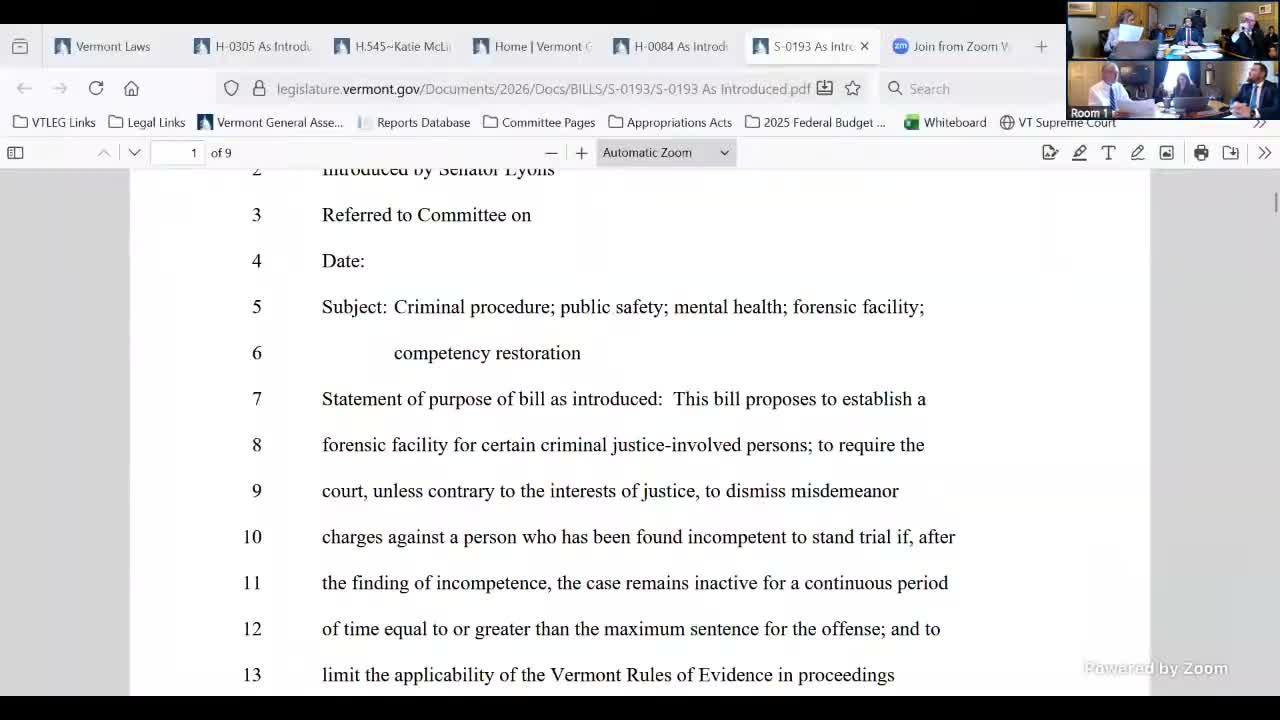
Kate McLenn of the Office of Legislative introduced a bill to create a locked, secure forensic facility that would be operated by the Department of Corrections and accept people ordered there by courts in specific criminal cases. "This is a bill about a creation of a forensic facility," McLenn said, emphasizing this draft differs from prior proposals that envisioned a Health Department–run, treatment‑focused facility.
The bill targets two distinct populations: people found not competent to stand trial for offenses punishable by life, and people acquitted by reason of insanity for such offenses. McLenn said competency determinations for admission are legal findings made by the court and are distinct from the clinical standard used for civil involuntary treatment. "When we're making determinations about competency to stand trial, that's a different determination than if, for example, somebody is needing mental health care and would be a person in need of treatment," she said.
Under the draft, the Department of Corrections would operate the facility and provide competency restoration services overseen by a clinical services director. McLenn described the facility as effectively a "no refusal" site: "If a person is ordered to the facility, the facility has to accept them." The bill includes a public‑records exemption for facility records, with the exception that records must be made available to parties in the underlying criminal case upon request.
Admission, evaluation and oversight
The bill sets procedural limits and review points. For individuals admitted for competency restoration, the statute would require competency evaluations at least every six months, or sooner if the clinical services director determines the person is likely competent; results would be provided to the court and the parties. For persons acquitted by reason of insanity, the criminal division of the superior court must hold a hearing within 40 days of admission; the court must commit the person to the facility unless the person establishes by clear and convincing evidence that they no longer suffer from a mental disease and that release would not create a substantial risk of bodily injury to another person or serious property damage.
Involuntary medication and court approval
The draft allows involuntary medication only by court order and requires the criminal division of the superior court in the underlying case to approve its use as part of a competency restoration plan. "The court can only approve the medication if it's clinically appropriate and likely to aid the person's competency to stand trial," McLenn said. Committee members asked whether the bill provides sufficient procedural steps for courts to evaluate proposed involuntary medication; staff advised that language in Title 18 governing involuntary medication is more detailed and may be worth cross‑referencing.
Separate misdemeanor provision
The draft also contains a separate provision, outside the forensic‑facility framework, addressing misdemeanor cases: if a defendant is found incompetent to stand trial and the case remains continuously inactive for a period equal to or greater than the maximum possible sentence, the case would be dismissed with prejudice unless the court finds dismissal would be contrary to justice. McLenn emphasized this subsection is not an admission criterion for the forensic facility but rather a standalone placement in the statutory code.
Unresolved definitions, monitoring and release
Members raised several points the draft does not define or fully resolve, including the statutory meaning of "mental disease" in this context and whether "serious property damage" is adequately specified. The bill would require Department of Corrections staff to petition the court at regular intervals (the draft references a review at the shorter of five years or upon certification by the clinical services director) and to monitor compliance with any regimen of treatment imposed on someone released to the community; noncompliance would trigger notice to the court and potential return to the facility.
Next steps
Staff told the committee the measure will need additional work and witnesses if pursued. The Judiciary recessed for a 10‑minute break following the presentation.
The bill targets two distinct populations: people found not competent to stand trial for offenses punishable by life, and people acquitted by reason of insanity for such offenses. McLenn said competency determinations for admission are legal findings made by the court and are distinct from the clinical standard used for civil involuntary treatment. "When we're making determinations about competency to stand trial, that's a different determination than if, for example, somebody is needing mental health care and would be a person in need of treatment," she said.
Under the draft, the Department of Corrections would operate the facility and provide competency restoration services overseen by a clinical services director. McLenn described the facility as effectively a "no refusal" site: "If a person is ordered to the facility, the facility has to accept them." The bill includes a public‑records exemption for facility records, with the exception that records must be made available to parties in the underlying criminal case upon request.
Admission, evaluation and oversight
The bill sets procedural limits and review points. For individuals admitted for competency restoration, the statute would require competency evaluations at least every six months, or sooner if the clinical services director determines the person is likely competent; results would be provided to the court and the parties. For persons acquitted by reason of insanity, the criminal division of the superior court must hold a hearing within 40 days of admission; the court must commit the person to the facility unless the person establishes by clear and convincing evidence that they no longer suffer from a mental disease and that release would not create a substantial risk of bodily injury to another person or serious property damage.
Involuntary medication and court approval
The draft allows involuntary medication only by court order and requires the criminal division of the superior court in the underlying case to approve its use as part of a competency restoration plan. "The court can only approve the medication if it's clinically appropriate and likely to aid the person's competency to stand trial," McLenn said. Committee members asked whether the bill provides sufficient procedural steps for courts to evaluate proposed involuntary medication; staff advised that language in Title 18 governing involuntary medication is more detailed and may be worth cross‑referencing.
Separate misdemeanor provision
The draft also contains a separate provision, outside the forensic‑facility framework, addressing misdemeanor cases: if a defendant is found incompetent to stand trial and the case remains continuously inactive for a period equal to or greater than the maximum possible sentence, the case would be dismissed with prejudice unless the court finds dismissal would be contrary to justice. McLenn emphasized this subsection is not an admission criterion for the forensic facility but rather a standalone placement in the statutory code.
Unresolved definitions, monitoring and release
Members raised several points the draft does not define or fully resolve, including the statutory meaning of "mental disease" in this context and whether "serious property damage" is adequately specified. The bill would require Department of Corrections staff to petition the court at regular intervals (the draft references a review at the shorter of five years or upon certification by the clinical services director) and to monitor compliance with any regimen of treatment imposed on someone released to the community; noncompliance would trigger notice to the court and potential return to the facility.
Next steps
Staff told the committee the measure will need additional work and witnesses if pursued. The Judiciary recessed for a 10‑minute break following the presentation.
Don't Miss a Word: See the Full Meeting!
Go beyond summaries. Unlock every video, transcript, and key insight with a Founder Membership.
✓
Get instant access to full meeting videos
✓
Search and clip any phrase from complete transcripts
✓
Receive AI-powered summaries & custom alerts
✓
Enjoy lifetime, unrestricted access to government data
30-day money-back guarantee
