Urbana staff brief council on Placer AI analytics; members press for surveillance policy and data access details
January 20, 2026 | Urbana, Champaign County, Illinois
This article was created by AI summarizing key points discussed. AI makes mistakes, so for full details and context, please refer to the video of the full meeting. Please report any errors so we can fix them. Report an error »
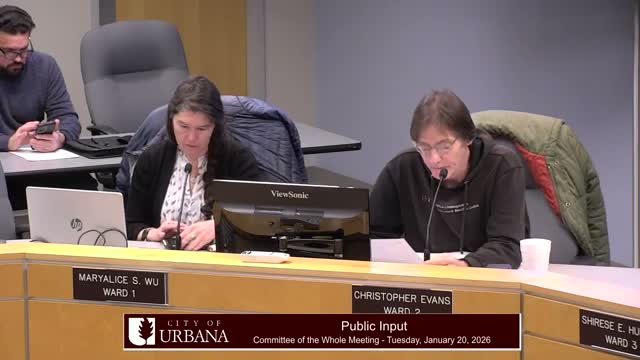
Darius, a city staff presenter, told the Committee of the Whole that Placer AI is a location-analytics platform that "uses anonymized mobile device location data processed with AI and machine learning" to provide foot-traffic and market-trend reports for economic development and civic planning. He said the company "provides only aggregated statistical information and restricts reporting on sensitive locations."
Council members asked a series of technical and policy questions: which apps and partner firms supply the data; what percentage of local residents the platform typically captures; whether Urbana’s purchased reports are exclusive to the city or can be accessed by private buyers; and whether the platform links visit counts to demographic estimates. Darius said the product is sold on an annual-subscription basis, that the data are collected by third-party partners and scrubbed (partners strip persistent device identifiers before data reach Placer AI), and that the city does not currently opt into demographic overlays for its reports.
On privacy, Darius repeatedly flagged the platform’s safeguards: "To protect individual privacy, the beginning points shown for each route are approximations and do not represent actual home locations," and Placer AI applies statistical noise and blocks reporting for sensitive locations such as places of worship, pre-K–12 schools and health-care facilities. He also said the company restricts paid access to vetted civic and commercial customers and does not provide its paid platform to law-enforcement agencies or advocacy groups in ordinary practice (as presented).
Council members sought clarity about data ownership and public records. One member asked whether Urbana’s Placer AI dashboard could be FOIAed or purchased by a private actor; Darius said he would confirm Placer AI’s access and resale rules but explained that the city maps its geographic area to pull reports and that data remain in Placer AI’s system even if a jurisdiction later "opts out."
Members also questioned accuracy and methodology: how the platform distinguishes a drive-by from a visit, what minimum dwell-time thresholds it uses to register a stop, and whether reported demographic attributes are inferred from census overlay or tied to individual devices. Darius said counts are approximations, that stay-duration thresholds are used in practice, and that demographic outputs are optional and based on census-derived estimates when the city requests them.
Multiple councillors said the presentation reinforced the need for cross-departmental surveillance-policy standards and public transparency. Jaya and others urged staff to return with a brief on procurement terms, a list of Placer AI partners or data suppliers, the subscription cost, and clear guidance about what reports the city would share publicly and what the public may be able to request by FOIA.
The committee did not take formal action on Placer AI during this meeting; council members directed staff to gather additional documentation and technical details and to continue work on surveillance-technology policy and oversight.
Council members asked a series of technical and policy questions: which apps and partner firms supply the data; what percentage of local residents the platform typically captures; whether Urbana’s purchased reports are exclusive to the city or can be accessed by private buyers; and whether the platform links visit counts to demographic estimates. Darius said the product is sold on an annual-subscription basis, that the data are collected by third-party partners and scrubbed (partners strip persistent device identifiers before data reach Placer AI), and that the city does not currently opt into demographic overlays for its reports.
On privacy, Darius repeatedly flagged the platform’s safeguards: "To protect individual privacy, the beginning points shown for each route are approximations and do not represent actual home locations," and Placer AI applies statistical noise and blocks reporting for sensitive locations such as places of worship, pre-K–12 schools and health-care facilities. He also said the company restricts paid access to vetted civic and commercial customers and does not provide its paid platform to law-enforcement agencies or advocacy groups in ordinary practice (as presented).
Council members sought clarity about data ownership and public records. One member asked whether Urbana’s Placer AI dashboard could be FOIAed or purchased by a private actor; Darius said he would confirm Placer AI’s access and resale rules but explained that the city maps its geographic area to pull reports and that data remain in Placer AI’s system even if a jurisdiction later "opts out."
Members also questioned accuracy and methodology: how the platform distinguishes a drive-by from a visit, what minimum dwell-time thresholds it uses to register a stop, and whether reported demographic attributes are inferred from census overlay or tied to individual devices. Darius said counts are approximations, that stay-duration thresholds are used in practice, and that demographic outputs are optional and based on census-derived estimates when the city requests them.
Multiple councillors said the presentation reinforced the need for cross-departmental surveillance-policy standards and public transparency. Jaya and others urged staff to return with a brief on procurement terms, a list of Placer AI partners or data suppliers, the subscription cost, and clear guidance about what reports the city would share publicly and what the public may be able to request by FOIA.
The committee did not take formal action on Placer AI during this meeting; council members directed staff to gather additional documentation and technical details and to continue work on surveillance-technology policy and oversight.
Don't Miss a Word: See the Full Meeting!
Go beyond summaries. Unlock every video, transcript, and key insight with a Founder Membership.
✓
Get instant access to full meeting videos
✓
Search and clip any phrase from complete transcripts
✓
Receive AI-powered summaries & custom alerts
✓
Enjoy lifetime, unrestricted access to government data
30-day money-back guarantee
