Sen. Scott Beck presents CTE-focused school-district map as task force declines to endorse it
January 21, 2026 | Education, SENATE, Committees, Legislative , Vermont
This article was created by AI summarizing key points discussed. AI makes mistakes, so for full details and context, please refer to the video of the full meeting. Please report any errors so we can fix them. Report an error »
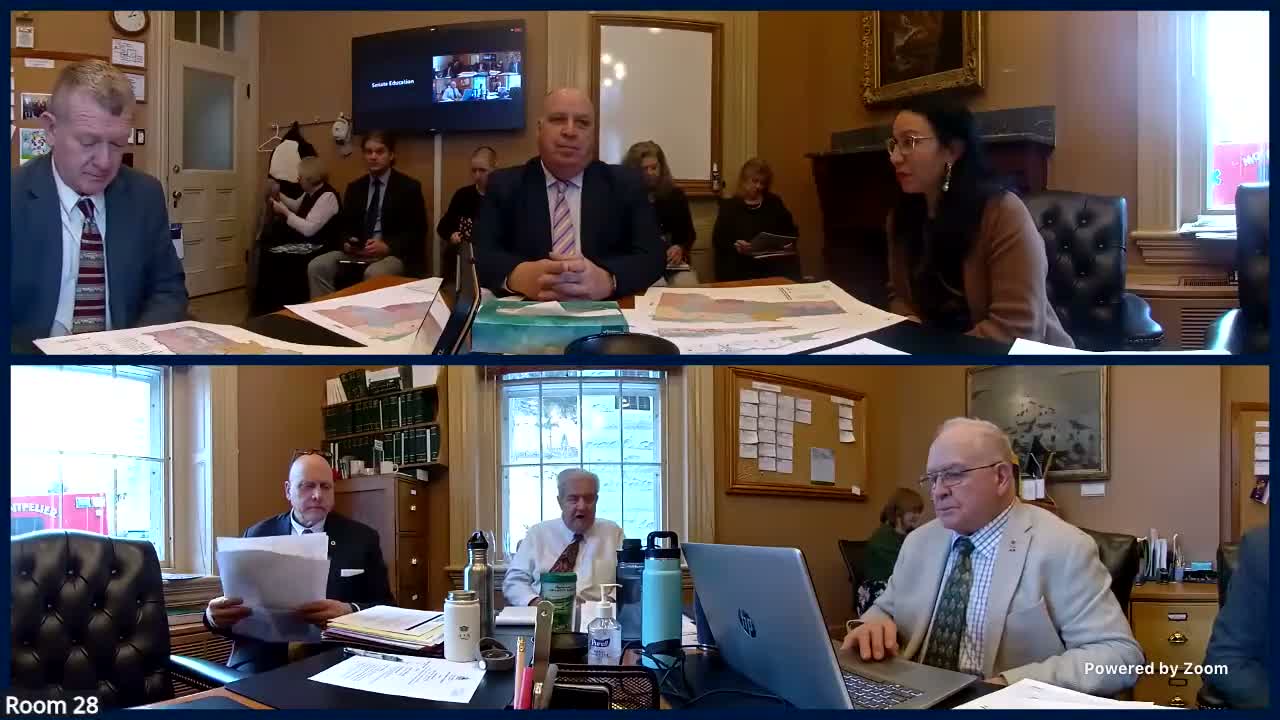
Senator Scott Beck introduced a school-district map he and David Wolf drew, saying the design aimed to make it “very easy for every child and every student in Vermont to access a career and technical education center.” Beck told the task force the map was tested against tuitioning patterns and regional advisory-board lines to place towns where students already travel for CTE programs.
Beck said the map did not split any existing school-district boundaries because doing so would create legal and financial friction — “split up assets and bank accounts and liabilities,” he said — and that the plan intentionally left some supervisory units intact. He highlighted Grand Isle as a stand-alone supervisory district of roughly 850 students and described Chittenden County as a deliberately large unit (he said it would contain about 22,000 students and eight public high schools) because members were not prepared to propose a credible division.
The task force discussed whether the map would produce cost savings. Beck and other speakers cautioned that under the state’s foundation funding formula, the statewide total of education dollars would not automatically fall simply by drawing new lines. Beck said the mapping exercise was intended to improve program access and administrative efficiency (for example, reducing the number of superintendent and business-office units) rather than to guarantee immediate statewide budget reductions.
Committee members also pressed practical issues the map would not automatically solve: transportation for intra-district choice, gaps in CTE program availability (some centers do not offer every trade), and the mechanics of allowable tuition when students attend independent schools. Beck acknowledged those limits and said the map should be viewed as a starting point for further testing and detail work — including program-by-program analysis of whether additional CTE sites or program expansions would be required.
The task force noted that, after reviewing the proposal and related material, it had voted 8–3 not to recommend this particular set of lines as part of the task-force report; Beck emphasized the map remained part of the public process and merited further local testing. The committee agreed to continue public feedback and further CTE-focused analysis in coming sessions.
Beck said the map did not split any existing school-district boundaries because doing so would create legal and financial friction — “split up assets and bank accounts and liabilities,” he said — and that the plan intentionally left some supervisory units intact. He highlighted Grand Isle as a stand-alone supervisory district of roughly 850 students and described Chittenden County as a deliberately large unit (he said it would contain about 22,000 students and eight public high schools) because members were not prepared to propose a credible division.
The task force discussed whether the map would produce cost savings. Beck and other speakers cautioned that under the state’s foundation funding formula, the statewide total of education dollars would not automatically fall simply by drawing new lines. Beck said the mapping exercise was intended to improve program access and administrative efficiency (for example, reducing the number of superintendent and business-office units) rather than to guarantee immediate statewide budget reductions.
Committee members also pressed practical issues the map would not automatically solve: transportation for intra-district choice, gaps in CTE program availability (some centers do not offer every trade), and the mechanics of allowable tuition when students attend independent schools. Beck acknowledged those limits and said the map should be viewed as a starting point for further testing and detail work — including program-by-program analysis of whether additional CTE sites or program expansions would be required.
The task force noted that, after reviewing the proposal and related material, it had voted 8–3 not to recommend this particular set of lines as part of the task-force report; Beck emphasized the map remained part of the public process and merited further local testing. The committee agreed to continue public feedback and further CTE-focused analysis in coming sessions.
View the Full Meeting & All Its Details
This article offers just a summary. Unlock complete video, transcripts, and insights as a Founder Member.
✓
Watch full, unedited meeting videos
✓
Search every word spoken in unlimited transcripts
✓
AI summaries & real-time alerts (all government levels)
✓
Permanent access to expanding government content
30-day money-back guarantee
