Bel Air adopts revised setbacks for taverns, liquor stores and cannabis businesses to match state law
January 21, 2026 | Bel Air, Harford County, Maryland
This article was created by AI summarizing key points discussed. AI makes mistakes, so for full details and context, please refer to the video of the full meeting. Please report any errors so we can fix them. Report an error »
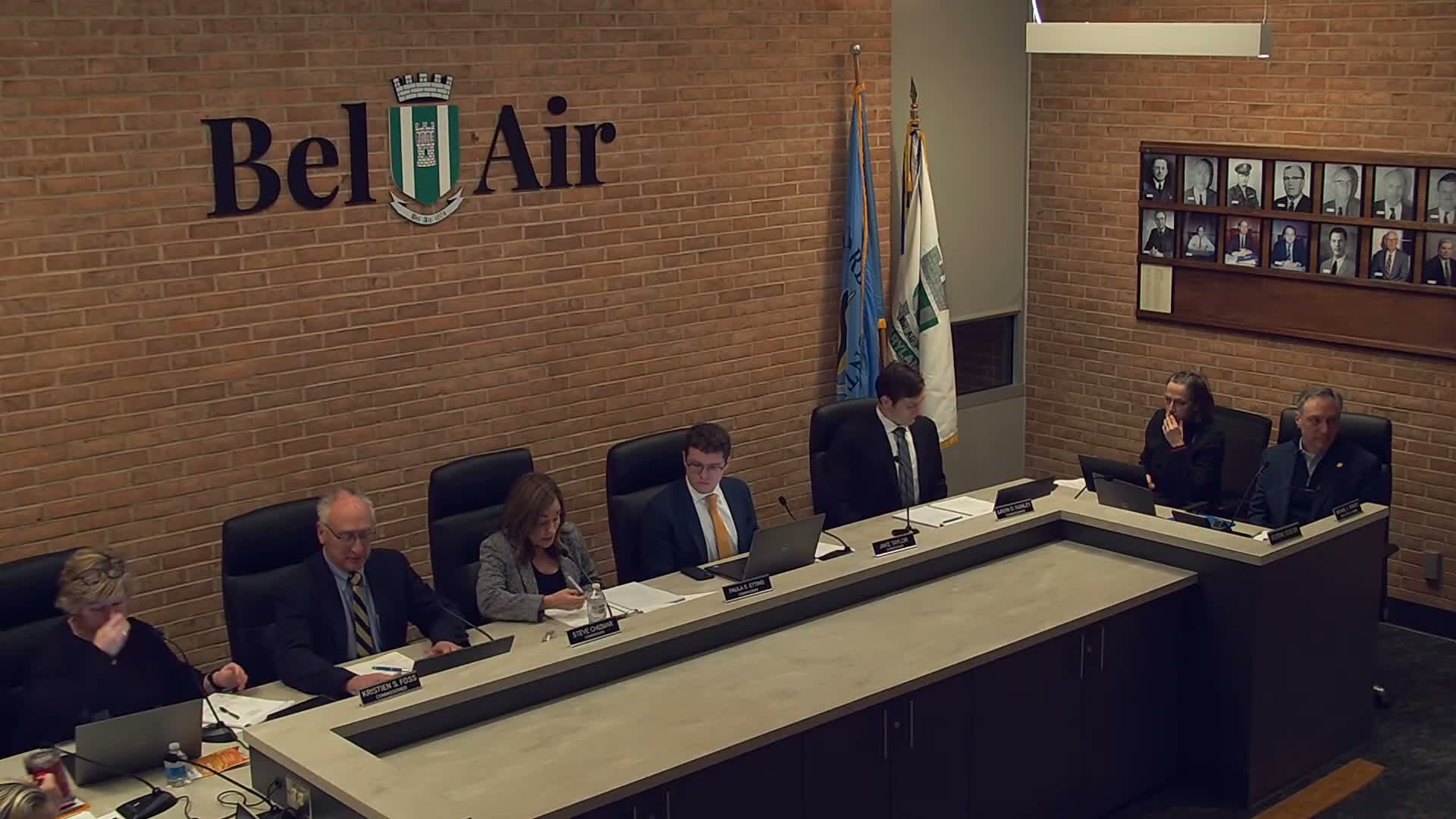
The Bel Air Board of Town Commissioners voted unanimously Jan. 20 to approve Ordinance 8 51-25, version 2, revising the town development regulations that govern taverns, microbreweries, distilleries, liquor stores and cannabis businesses.
The ordinance updates Chapter 165, Article 7, Section 1‑65‑53 of the Bel Air Town Code to conform with Maryland state statutes, staff said. Kevin Small, town planning staff, told the board that state law (Annotated Code of Maryland titles governing alcoholic beverages and cannabis) requires different measurement methods: cannabis setbacks are measured property line to property line and must maintain 500‑foot separation from certain sensitive uses, while taverns and liquor stores are measured building‑to‑building and must maintain 300‑foot separation from houses of worship and schools.
Small said the revised local rule reduces the town's previous residential separation for cannabis from 500 feet to 100 feet in order to match the state‑required baseline and avoid creating an excessive number of nonconforming uses. He told commissioners the updates also add places of worship into the alcohol setback calculations to match state guidance and preserve local businesses’ ability to expand under state law.
Several downtown business owners and prospective tenants spoke during a public hearing before the vote. Tricia Miller, owner of Crabby Ave Sewing (331 Baltimore Pike), asked whether the ordinance’s distances would be measured door‑to‑door or from property line to property line and said she planned to add a kitchen and seek a café liquor license. Brooke Voss, a prospective Main Street tenant, said she was concerned that businesses with grandfathered liquor privileges could gain an unfair competitive advantage. Philip Rudy of Independent Brewing Company and others praised the revised draft as more business‑friendly than the original proposal.
Commissioner Taylor thanked the business community for input and asked staff to confirm whether specific pending tenants would be adversely affected; Small confirmed that some uses cited (for example, an amusement use) would not be considered a tavern and that staff would follow up on specific tenant plans. Commissioners emphasized the changes were driven by state statutes and said the goal was to comply with state law without unduly hindering new restaurants or breweries.
The motion to adopt Ordinance 8 51-25, version 2, was introduced by Commissioner Faust and seconded (second speaker not specified in the record). The clerk recorded affirmative votes from Commissioner Foss, Commissioner Chismar, Commissioner Taylor, Commissioner Hanley and Chair Eddings; the ordinance was approved.
The town acknowledged a written letter submitted by Michelle Cardellini on behalf of Charlie Caitlin LLC and said it will be considered as part of the record. Staff also reminded potential applicants that, where applicable, waiver processes through the county liquor board may still be available for certain setbacks.
Next steps: the ordinance takes effect as provided by town code and staff will continue to work with prospective tenants and the liquor board to address site‑specific questions.
The ordinance updates Chapter 165, Article 7, Section 1‑65‑53 of the Bel Air Town Code to conform with Maryland state statutes, staff said. Kevin Small, town planning staff, told the board that state law (Annotated Code of Maryland titles governing alcoholic beverages and cannabis) requires different measurement methods: cannabis setbacks are measured property line to property line and must maintain 500‑foot separation from certain sensitive uses, while taverns and liquor stores are measured building‑to‑building and must maintain 300‑foot separation from houses of worship and schools.
Small said the revised local rule reduces the town's previous residential separation for cannabis from 500 feet to 100 feet in order to match the state‑required baseline and avoid creating an excessive number of nonconforming uses. He told commissioners the updates also add places of worship into the alcohol setback calculations to match state guidance and preserve local businesses’ ability to expand under state law.
Several downtown business owners and prospective tenants spoke during a public hearing before the vote. Tricia Miller, owner of Crabby Ave Sewing (331 Baltimore Pike), asked whether the ordinance’s distances would be measured door‑to‑door or from property line to property line and said she planned to add a kitchen and seek a café liquor license. Brooke Voss, a prospective Main Street tenant, said she was concerned that businesses with grandfathered liquor privileges could gain an unfair competitive advantage. Philip Rudy of Independent Brewing Company and others praised the revised draft as more business‑friendly than the original proposal.
Commissioner Taylor thanked the business community for input and asked staff to confirm whether specific pending tenants would be adversely affected; Small confirmed that some uses cited (for example, an amusement use) would not be considered a tavern and that staff would follow up on specific tenant plans. Commissioners emphasized the changes were driven by state statutes and said the goal was to comply with state law without unduly hindering new restaurants or breweries.
The motion to adopt Ordinance 8 51-25, version 2, was introduced by Commissioner Faust and seconded (second speaker not specified in the record). The clerk recorded affirmative votes from Commissioner Foss, Commissioner Chismar, Commissioner Taylor, Commissioner Hanley and Chair Eddings; the ordinance was approved.
The town acknowledged a written letter submitted by Michelle Cardellini on behalf of Charlie Caitlin LLC and said it will be considered as part of the record. Staff also reminded potential applicants that, where applicable, waiver processes through the county liquor board may still be available for certain setbacks.
Next steps: the ordinance takes effect as provided by town code and staff will continue to work with prospective tenants and the liquor board to address site‑specific questions.
View the Full Meeting & All Its Details
This article offers just a summary. Unlock complete video, transcripts, and insights as a Founder Member.
✓
Watch full, unedited meeting videos
✓
Search every word spoken in unlimited transcripts
✓
AI summaries & real-time alerts (all government levels)
✓
Permanent access to expanding government content
30-day money-back guarantee
