St. Pete Beach advisers review Raftelis fee study, prioritize resident access and utilization
January 21, 2026 | St. Pete Beach, Pinellas County, Florida
This article was created by AI summarizing key points discussed. AI makes mistakes, so for full details and context, please refer to the video of the full meeting. Please report any errors so we can fix them. Report an error »
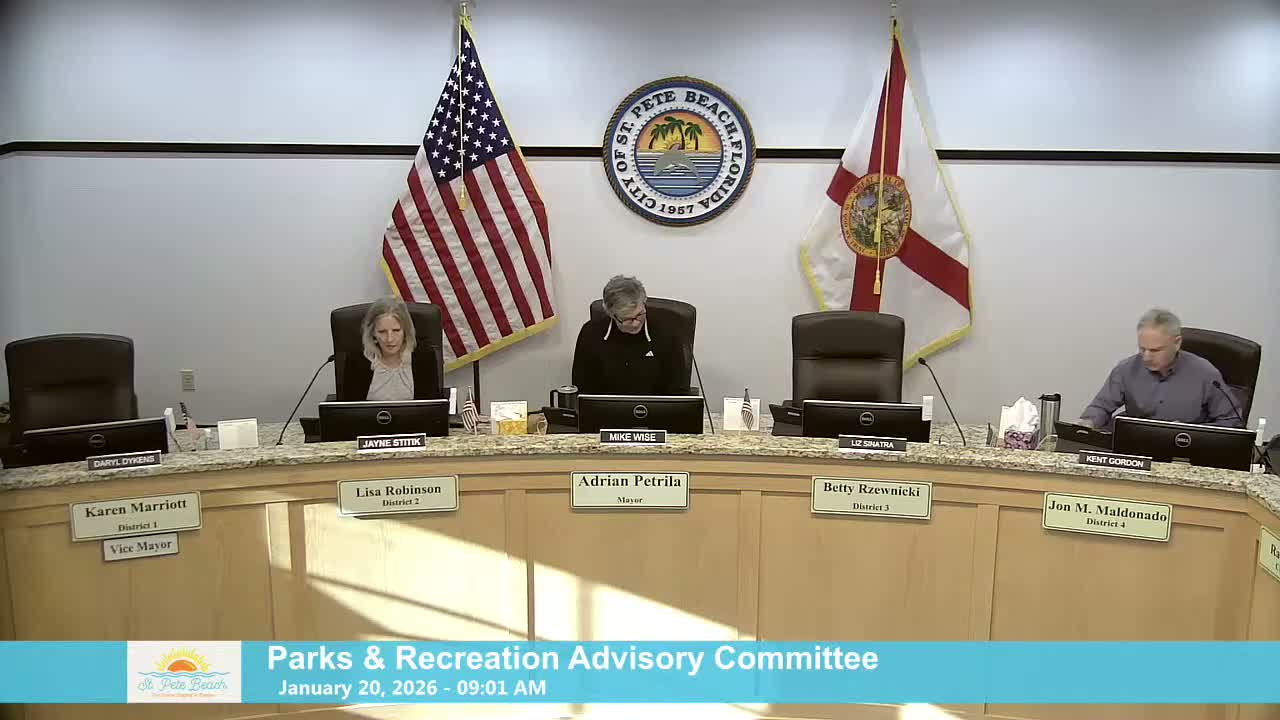
St. Pete Beach Parks & Recreation advisory committee members reviewed a fee study for the recreation and aquatics program presented by consultant Christina Pinchilla of Raftelis and gave staff direction to focus on utilization and resident protections rather than immediate across-the-board rate increases.
Pinchilla told the committee the project's objective is to "right size" fees by linking each fee to the true cost of service and applying an industry-standard tiered cost-recovery model drawn from the American Planning Association and the National Recreation and Park Association. The study groups fees into seven service categories — pool, recreation programs, camp, gym, facility rentals, special events and beach weddings — and assigns them to three tiers: Tier 1 (0–20% cost recovery) for broad community benefits such as parks and playgrounds; Tier 2 (study target 70%) for mixed-benefit services such as day passes, camps and pool fees; and Tier 3 (target 100% in the model) for individual-benefit items such as facility rentals and private lessons.
To limit "sticker shock," the model includes phased approaches and six options for each fee: immediate full cost recovery; a phased-in increase (default three years); a benchmark-max cap tied to peer rates; an override percent increase for local judgment; maintaining the current rate; or consolidating/removing obsolete fees. Pinchilla said the model preserves the existing resident-to-nonresident ratio by default but allows staff to increase nonresident rates to recover more costs from out-of-area users.
Board members asked whether higher fees at peer agencies correlated with lower participation. Pinchilla said many peer municipalities publish rates but not consistent usage statistics, so the study can benchmark prices but cannot reliably tie price changes to participation without local usage data. Staff indicated they do track participation for some programs and provided a ballpark that many enrollments for classes are more nonresident than resident, while pool attendance is a mix of both.
Members emphasized keeping utilization high. For programs that are likely to hit licensing or capacity limits — specifically summer camps and certain childcare programs — the advisory committee supported resident-priority registration to preserve local access. Staff said prior resident/nonresident distinctions for classes had reduced participation and that combining rates for classes previously increased enrollment; the committee asked staff and the consultant to weigh utilization impacts alongside revenue targets.
Pinchilla and staff noted that pools typically operate at a loss and that achieving 100% cost recovery is not appropriate for every program given community benefits. Staff requested final feedback from the board by the end of the week so the consultant can finalize models; staff intends to bring a consolidated fee update and ordinance to the City Commission in early March for consideration.
No fee changes were adopted at the meeting. Staff will return to the advisory committee and then forward the final recommendations to the City Commission.
Pinchilla told the committee the project's objective is to "right size" fees by linking each fee to the true cost of service and applying an industry-standard tiered cost-recovery model drawn from the American Planning Association and the National Recreation and Park Association. The study groups fees into seven service categories — pool, recreation programs, camp, gym, facility rentals, special events and beach weddings — and assigns them to three tiers: Tier 1 (0–20% cost recovery) for broad community benefits such as parks and playgrounds; Tier 2 (study target 70%) for mixed-benefit services such as day passes, camps and pool fees; and Tier 3 (target 100% in the model) for individual-benefit items such as facility rentals and private lessons.
To limit "sticker shock," the model includes phased approaches and six options for each fee: immediate full cost recovery; a phased-in increase (default three years); a benchmark-max cap tied to peer rates; an override percent increase for local judgment; maintaining the current rate; or consolidating/removing obsolete fees. Pinchilla said the model preserves the existing resident-to-nonresident ratio by default but allows staff to increase nonresident rates to recover more costs from out-of-area users.
Board members asked whether higher fees at peer agencies correlated with lower participation. Pinchilla said many peer municipalities publish rates but not consistent usage statistics, so the study can benchmark prices but cannot reliably tie price changes to participation without local usage data. Staff indicated they do track participation for some programs and provided a ballpark that many enrollments for classes are more nonresident than resident, while pool attendance is a mix of both.
Members emphasized keeping utilization high. For programs that are likely to hit licensing or capacity limits — specifically summer camps and certain childcare programs — the advisory committee supported resident-priority registration to preserve local access. Staff said prior resident/nonresident distinctions for classes had reduced participation and that combining rates for classes previously increased enrollment; the committee asked staff and the consultant to weigh utilization impacts alongside revenue targets.
Pinchilla and staff noted that pools typically operate at a loss and that achieving 100% cost recovery is not appropriate for every program given community benefits. Staff requested final feedback from the board by the end of the week so the consultant can finalize models; staff intends to bring a consolidated fee update and ordinance to the City Commission in early March for consideration.
No fee changes were adopted at the meeting. Staff will return to the advisory committee and then forward the final recommendations to the City Commission.
Don't Miss a Word: See the Full Meeting!
Go beyond summaries. Unlock every video, transcript, and key insight with a Founder Membership.
✓
Get instant access to full meeting videos
✓
Search and clip any phrase from complete transcripts
✓
Receive AI-powered summaries & custom alerts
✓
Enjoy lifetime, unrestricted access to government data
30-day money-back guarantee
