Milwaukie council advances tougher tree-preservation rules, sets second reading for Feb. 3
January 21, 2026 | Milwaukie, Clackamas County, Oregon
This article was created by AI summarizing key points discussed. AI makes mistakes, so for full details and context, please refer to the video of the full meeting. Please report any errors so we can fix them. Report an error »
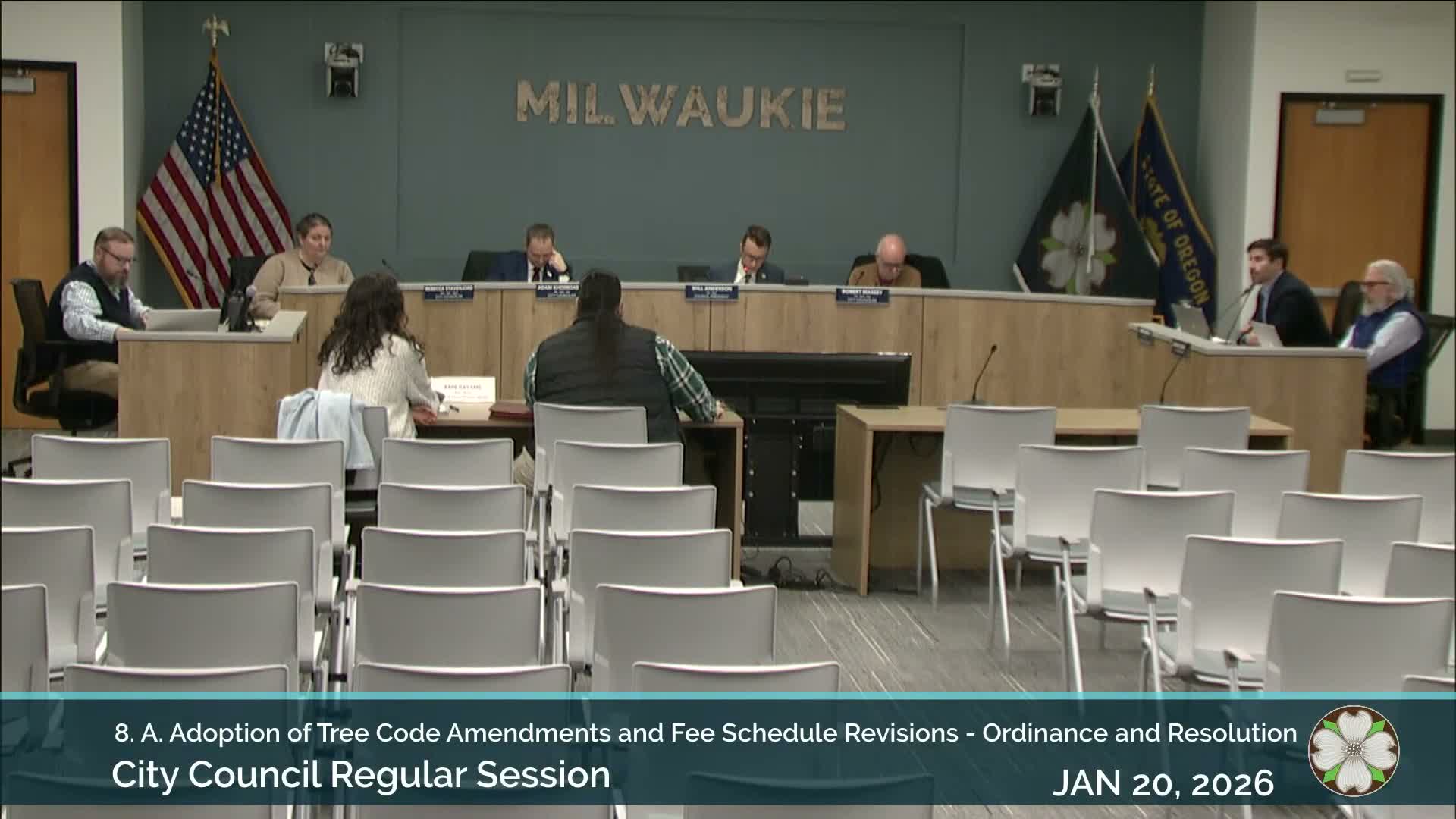
Milwaukie’s City Council moved on Jan. 20 to advance changes to the city’s tree code aimed at preserving mature trees during development, voting in favor of a title-only first reading and declaring an emergency so the ordinance will be final after a required second reading on Feb. 3, 2026.
Staff presented a package of revisions that would raise canopy-mitigation requirements and increase fees intended to deter removal of large trees. Katie Dores, the city’s climate and financial resources manager, and Alfred/Erwin Forrester (staff presenter) detailed a proposed increase in the canopy mitigation starting point from 30% to 40% and tiered fees if a site reduces canopy below thresholds; staff said fees could range from several thousand dollars up to as much as $40,000 depending on the reduction. The proposal also included a new significant-tree removal fee schedule (staff described $150 per inch for trees roughly 30–35.99 inches DBH and $200 per inch for 36 inches and larger) and an additional fee of $350 per GBH for unpermitted removals. Staff also proposed adopting an administratively maintained list of rare and threatened tree species.
Councilors asked how the new fees would affect housing costs. Multiple members warned that very large fees risk being passed through to buyers or could push developers to alter plans in ways that still result in canopy loss. One councilor outlined a recent example in which a 36-inch Douglas fir had been processed under the prior schedule with a $400 charge, and contrasted that with the proposed fees that could be many thousands of dollars. Staff responded that in some cases higher fees lead developers to redesign projects to retain trees, and that the city’s existing affordable-housing fee caps (reduced fees for qualifying affordable projects) would remain in place.
Council also discussed the administrative and legal tradeoffs of creating a heritage-tree program that would prohibit removal of designated trees. Staff said heritage-tree programs impose significant administrative burdens and can skew protections toward neighborhoods where property owners apply; they also noted potential legal complexity about restricting an owner’s right to remove trees on private property. Councilors asked staff to revisit whether particular trees should be categorically protected and asked for further analysis on fee scales and legal constraints.
After discussion, the council approved a motion for the first and second reading by title only of an ordinance to amend Municipal Code chapter 16.32 (tree code) and declared an emergency so the changes would be effective upon adoption; the second reading and formal adoption were scheduled for Feb. 3, 2026. Council also moved on a resolution to update the consolidated fee schedule for FY2026, but the body clarified that fee adoption is procedurally tied to final approval of the code amendments and therefore will be reconciled at second reading.
Next steps: staff will return to the Feb. 3 council meeting for the required second reading and a final vote. Staff also indicated they will continue to refine the rare/species list and provide additional analysis on fee impacts and affordable-housing carve-outs.
Staff presented a package of revisions that would raise canopy-mitigation requirements and increase fees intended to deter removal of large trees. Katie Dores, the city’s climate and financial resources manager, and Alfred/Erwin Forrester (staff presenter) detailed a proposed increase in the canopy mitigation starting point from 30% to 40% and tiered fees if a site reduces canopy below thresholds; staff said fees could range from several thousand dollars up to as much as $40,000 depending on the reduction. The proposal also included a new significant-tree removal fee schedule (staff described $150 per inch for trees roughly 30–35.99 inches DBH and $200 per inch for 36 inches and larger) and an additional fee of $350 per GBH for unpermitted removals. Staff also proposed adopting an administratively maintained list of rare and threatened tree species.
Councilors asked how the new fees would affect housing costs. Multiple members warned that very large fees risk being passed through to buyers or could push developers to alter plans in ways that still result in canopy loss. One councilor outlined a recent example in which a 36-inch Douglas fir had been processed under the prior schedule with a $400 charge, and contrasted that with the proposed fees that could be many thousands of dollars. Staff responded that in some cases higher fees lead developers to redesign projects to retain trees, and that the city’s existing affordable-housing fee caps (reduced fees for qualifying affordable projects) would remain in place.
Council also discussed the administrative and legal tradeoffs of creating a heritage-tree program that would prohibit removal of designated trees. Staff said heritage-tree programs impose significant administrative burdens and can skew protections toward neighborhoods where property owners apply; they also noted potential legal complexity about restricting an owner’s right to remove trees on private property. Councilors asked staff to revisit whether particular trees should be categorically protected and asked for further analysis on fee scales and legal constraints.
After discussion, the council approved a motion for the first and second reading by title only of an ordinance to amend Municipal Code chapter 16.32 (tree code) and declared an emergency so the changes would be effective upon adoption; the second reading and formal adoption were scheduled for Feb. 3, 2026. Council also moved on a resolution to update the consolidated fee schedule for FY2026, but the body clarified that fee adoption is procedurally tied to final approval of the code amendments and therefore will be reconciled at second reading.
Next steps: staff will return to the Feb. 3 council meeting for the required second reading and a final vote. Staff also indicated they will continue to refine the rare/species list and provide additional analysis on fee impacts and affordable-housing carve-outs.
View the Full Meeting & All Its Details
This article offers just a summary. Unlock complete video, transcripts, and insights as a Founder Member.
✓
Watch full, unedited meeting videos
✓
Search every word spoken in unlimited transcripts
✓
AI summaries & real-time alerts (all government levels)
✓
Permanent access to expanding government content
30-day money-back guarantee
