Astoria council narrows guiding principles for two-site housing RFEI, directs staff to analyze proposals
December 15, 2025 | Astoria City, Clatsop County, Oregon
This article was created by AI summarizing key points discussed. AI makes mistakes, so for full details and context, please refer to the video of the full meeting. Please report any errors so we can fix them. Report an error »
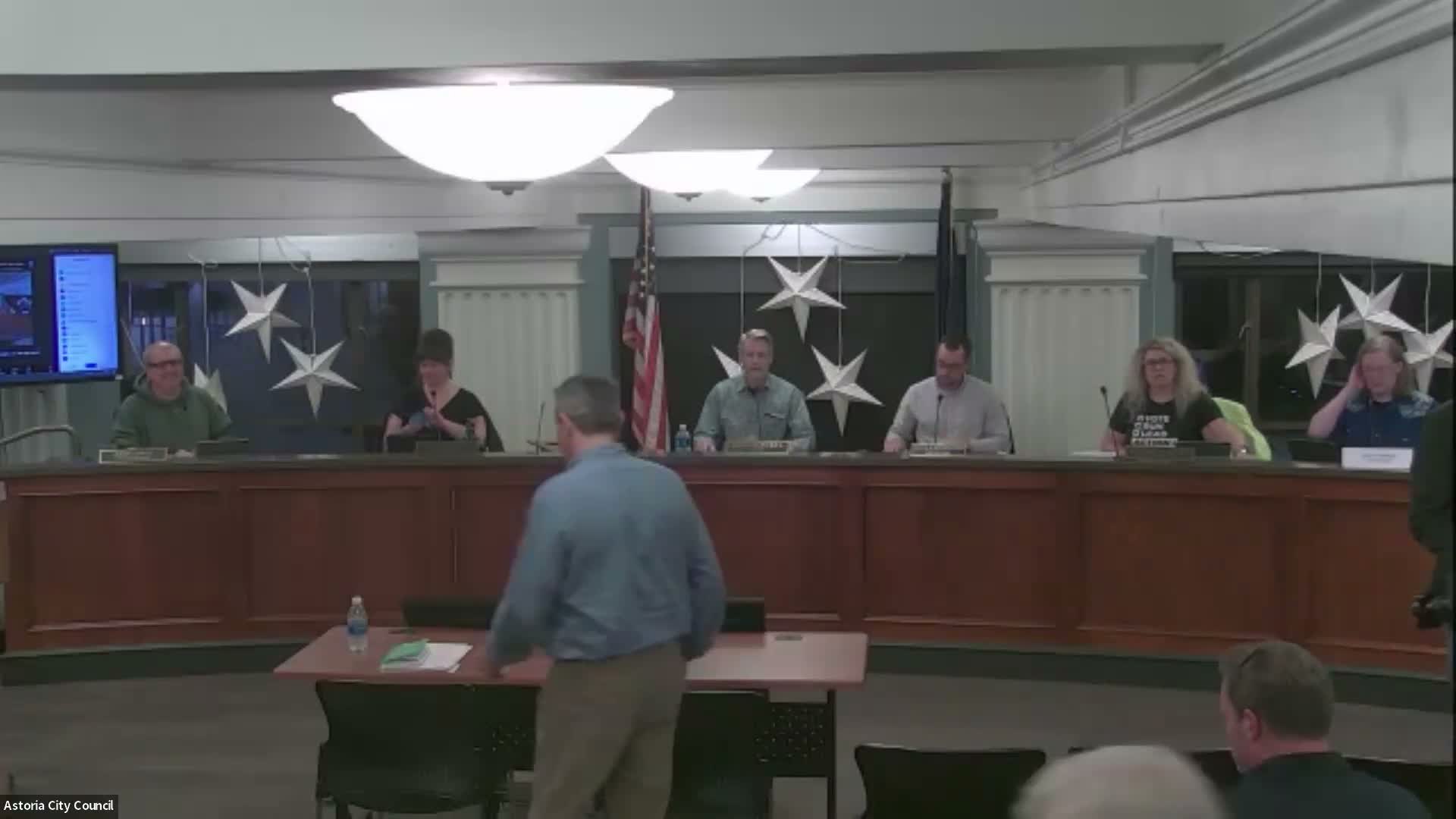
The Astoria City Council on Dec. 15 reviewed six development proposals submitted in response to a Request for Expressions of Interest for two city sites — the Customs House parcel and the county-owned Derry Gold site — and directed staff to perform a detailed comparative analysis.
Community Development Director John Roberts told the council the RFEI returned a broad set of ideas: Customs House concepts ranged from about 12 to 23 units, often duplex/triplex/cottage-cluster typologies, while Derry Gold proposals ranged roughly from 60 to 120 units and included studio-through-three-bedroom configurations. Staff estimated a likely ballpark cost of roughly $8–$10 million for Customs House projects and $20–$30 million for Derry Gold concepts, though many submittals supplied percentage breakdowns rather than total hard costs.
Councilors debated trade-offs among proposals and identified a short list of priorities they wanted staff to use in a follow-up analysis. Councilor Davis — who moved the motion instructing staff to proceed — said financial feasibility and a clear capital-funding strategy are his top concerns. Other priorities the council coalesced around were housing-type diversity and tenure (including interest in community land trust or ownership pathways for portions of the Customs House site), site-by-site compatibility and realism, and community engagement and visioning to build buy-in.
Several councilors praised Edelen and Company’s Customs House concepts (noting cottage clusters and an ownership emphasis) and identified Related Northwest, Urban/Skylab and Compass Communities among the firms with attractive elements for Derry Gold. Councilors also flagged potential implementation issues: some proposals targeted 60% area median income (AMI) affordable housing while staff had asked for 80–120% AMI workforce housing; parking on the county-owned Derry Gold site required coordination with the county and a more precise inventory; and some financing approaches may need gap funding or tax-credit strategies to be viable.
Staff said the RFEI was intentionally lighter-touch than an RFP to surface realistic options and innovations. Roberts told the council staff would apply the council’s stated guiding principles, perform a strengths/weaknesses/funding-feasibility analysis across all six responses, and return to the council in mid-to-late January. The council moved and approved a direction for staff to produce a ranked analysis and recommendations; Councilor Davis made the motion and Councilor Mozzarella seconded. The motion carried by voice vote.
What’s next: staff will compile a comparative analysis (financial viability, alignment with council guiding principles, site constraints and public benefits) and present findings to the council in January, with a possible Jan. 26 work session or regular meeting scheduled for further action.
Community Development Director John Roberts told the council the RFEI returned a broad set of ideas: Customs House concepts ranged from about 12 to 23 units, often duplex/triplex/cottage-cluster typologies, while Derry Gold proposals ranged roughly from 60 to 120 units and included studio-through-three-bedroom configurations. Staff estimated a likely ballpark cost of roughly $8–$10 million for Customs House projects and $20–$30 million for Derry Gold concepts, though many submittals supplied percentage breakdowns rather than total hard costs.
Councilors debated trade-offs among proposals and identified a short list of priorities they wanted staff to use in a follow-up analysis. Councilor Davis — who moved the motion instructing staff to proceed — said financial feasibility and a clear capital-funding strategy are his top concerns. Other priorities the council coalesced around were housing-type diversity and tenure (including interest in community land trust or ownership pathways for portions of the Customs House site), site-by-site compatibility and realism, and community engagement and visioning to build buy-in.
Several councilors praised Edelen and Company’s Customs House concepts (noting cottage clusters and an ownership emphasis) and identified Related Northwest, Urban/Skylab and Compass Communities among the firms with attractive elements for Derry Gold. Councilors also flagged potential implementation issues: some proposals targeted 60% area median income (AMI) affordable housing while staff had asked for 80–120% AMI workforce housing; parking on the county-owned Derry Gold site required coordination with the county and a more precise inventory; and some financing approaches may need gap funding or tax-credit strategies to be viable.
Staff said the RFEI was intentionally lighter-touch than an RFP to surface realistic options and innovations. Roberts told the council staff would apply the council’s stated guiding principles, perform a strengths/weaknesses/funding-feasibility analysis across all six responses, and return to the council in mid-to-late January. The council moved and approved a direction for staff to produce a ranked analysis and recommendations; Councilor Davis made the motion and Councilor Mozzarella seconded. The motion carried by voice vote.
What’s next: staff will compile a comparative analysis (financial viability, alignment with council guiding principles, site constraints and public benefits) and present findings to the council in January, with a possible Jan. 26 work session or regular meeting scheduled for further action.
View the Full Meeting & All Its Details
This article offers just a summary. Unlock complete video, transcripts, and insights as a Founder Member.
✓
Watch full, unedited meeting videos
✓
Search every word spoken in unlimited transcripts
✓
AI summaries & real-time alerts (all government levels)
✓
Permanent access to expanding government content
30-day money-back guarantee
