Regional planners warn towns to rewrite zoning as state housing law adds 'summary review' and limits parking requirements
January 17, 2026 | Town of Naugatuck, New Haven County, Connecticut
This article was created by AI summarizing key points discussed. AI makes mistakes, so for full details and context, please refer to the video of the full meeting. Please report any errors so we can fix them. Report an error »
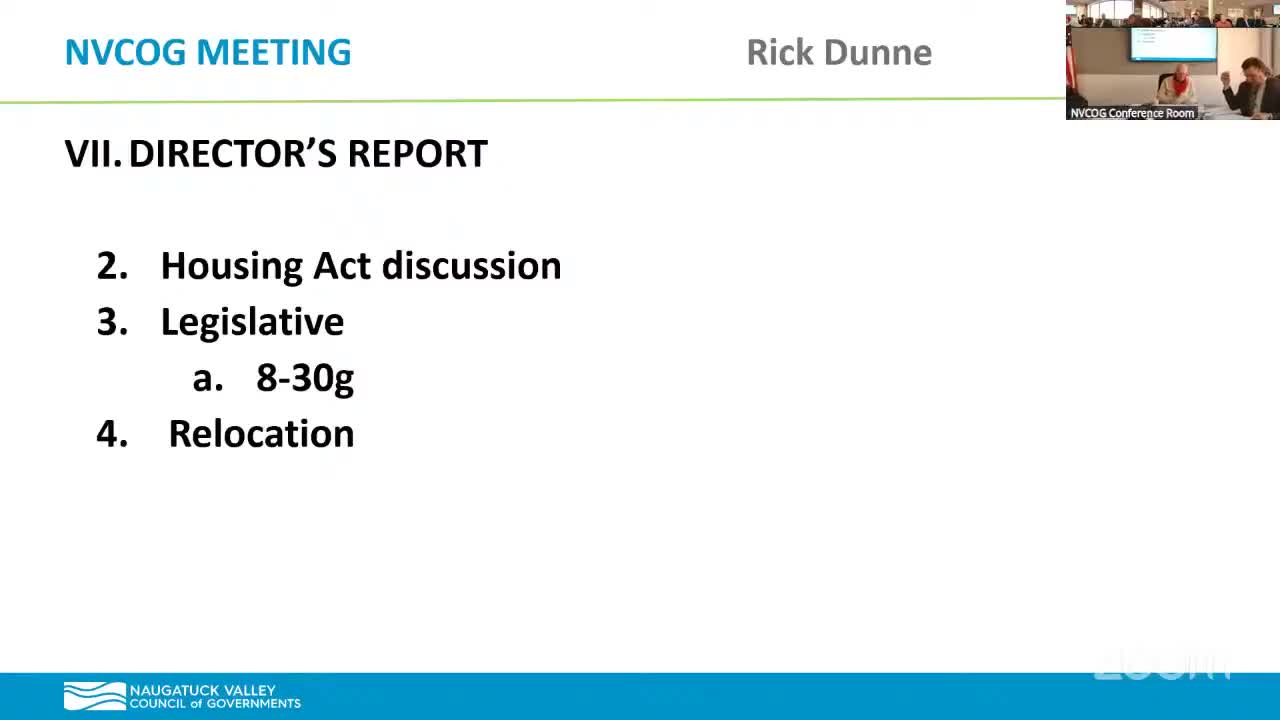
NVCOG staff spent the bulk of the meeting briefing member towns on the special session housing law and what local officials must do before July 1. The new law establishes a summary review process that can allow certain housing and mixed‑use developments to be approved administratively—without a public hearing—if they meet prescribed area and bulk standards and if the commission determines public health and safety will not be substantially impacted, staff said.
The Council’s community planning director, identified in the meeting as SN, said summary review ‘‘cannot require a public hearing’’ and is intended to be an administrative or ministerial approval pathway, not a variance or special exception. SN cautioned that the statute assigns area and bulk standards to summary review but leaves unclear whether municipalities can impose other design or aesthetic standards; she recommended that towns consult their attorneys and planners to craft defensible local language.
Why it matters: municipal zoning administrators and planning commissions will begin to receive summary review applications after July 1, SN said, and those applications could bypass public hearings. Towns that do not prepare their regulations risk losing local control over process and timing for certain housing projects.
Parking changes and the ‘‘lesser of’’ rule
The law also restricts local parking minimums for residential development. Under the amendment to section 8‑2 (discussed as part of sections 18–19), municipalities generally may not require minimum off‑street parking for residential developments, with two exceptions: local requirements may still apply for developments of 17 or more units, and municipalities may create conservation and traffic mitigation districts that allow parking minimums for smaller projects.
SN explained that if a developer submits a parking needs assessment, the municipality must require the lesser of the parking assessment’s recommendation or a default standard—one off‑street space per studio/one‑bedroom unit and two spaces per two‑plus‑bedroom unit. She warned the board that mandating the ‘lesser of’ could clash with lender or pro‑forma expectations in suburban contexts and urged towns to adopt third‑party review language so developer‑funded assessments are vetted by qualified experts.
Ambiguities and implementation risks
Staff highlighted several drafting and interpretation problems: the statute’s reference to lots ‘‘zoned for commercial or mixed use’’ could be read narrowly (districts whose stated purpose is commercial/mixed) or broadly (any district where commercial uses are allowed in the use table). SN said this ambiguity will materially affect where summary review applies and advised towns to seek legal guidance and monitor OPM guidance.
Another drafting error leaves uncertainty about residential developments of exactly 16 units (the law references 17 and over and under‑16 rules), a gap staff expects to be fixed legislatively or clarified by court decisions. Utilities (sewer/wastewater capacity) and wetlands approvals remain required and could form the basis of health and safety denials if a project lacks necessary permits, SN said.
NVCOG assistance and timeline
The COG is preparing an annotated legislative summary and model regulatory language and expects to circulate a summary before February. SN and director Rick said NVCOG will hold statewide trainings for planning commissions and chief elected officials and provide model language and a land‑use brief to help towns amend regulations before the July 1 deadlines. The COG emphasized that third‑party review requirements should be put into regulations so developer‑paid technical reviews are not charged to the municipality.
Staff quotes and attributions in this article are from the transcript of the NVCOG meeting where SN presented the overview and guidance. The board asked questions about qualifications for who may produce parking needs assessments and about how utility capacity will be treated; SN responded that qualifications are not specified in the statute and that local regulation should address qualifications and third‑party review requirements.
What’s next: NVCOG will circulate the annotated summary and model language, run trainings, and be available to assist towns in amending zoning regs to implement summary review and the new parking rules.
The Council’s community planning director, identified in the meeting as SN, said summary review ‘‘cannot require a public hearing’’ and is intended to be an administrative or ministerial approval pathway, not a variance or special exception. SN cautioned that the statute assigns area and bulk standards to summary review but leaves unclear whether municipalities can impose other design or aesthetic standards; she recommended that towns consult their attorneys and planners to craft defensible local language.
Why it matters: municipal zoning administrators and planning commissions will begin to receive summary review applications after July 1, SN said, and those applications could bypass public hearings. Towns that do not prepare their regulations risk losing local control over process and timing for certain housing projects.
Parking changes and the ‘‘lesser of’’ rule
The law also restricts local parking minimums for residential development. Under the amendment to section 8‑2 (discussed as part of sections 18–19), municipalities generally may not require minimum off‑street parking for residential developments, with two exceptions: local requirements may still apply for developments of 17 or more units, and municipalities may create conservation and traffic mitigation districts that allow parking minimums for smaller projects.
SN explained that if a developer submits a parking needs assessment, the municipality must require the lesser of the parking assessment’s recommendation or a default standard—one off‑street space per studio/one‑bedroom unit and two spaces per two‑plus‑bedroom unit. She warned the board that mandating the ‘lesser of’ could clash with lender or pro‑forma expectations in suburban contexts and urged towns to adopt third‑party review language so developer‑funded assessments are vetted by qualified experts.
Ambiguities and implementation risks
Staff highlighted several drafting and interpretation problems: the statute’s reference to lots ‘‘zoned for commercial or mixed use’’ could be read narrowly (districts whose stated purpose is commercial/mixed) or broadly (any district where commercial uses are allowed in the use table). SN said this ambiguity will materially affect where summary review applies and advised towns to seek legal guidance and monitor OPM guidance.
Another drafting error leaves uncertainty about residential developments of exactly 16 units (the law references 17 and over and under‑16 rules), a gap staff expects to be fixed legislatively or clarified by court decisions. Utilities (sewer/wastewater capacity) and wetlands approvals remain required and could form the basis of health and safety denials if a project lacks necessary permits, SN said.
NVCOG assistance and timeline
The COG is preparing an annotated legislative summary and model regulatory language and expects to circulate a summary before February. SN and director Rick said NVCOG will hold statewide trainings for planning commissions and chief elected officials and provide model language and a land‑use brief to help towns amend regulations before the July 1 deadlines. The COG emphasized that third‑party review requirements should be put into regulations so developer‑paid technical reviews are not charged to the municipality.
Staff quotes and attributions in this article are from the transcript of the NVCOG meeting where SN presented the overview and guidance. The board asked questions about qualifications for who may produce parking needs assessments and about how utility capacity will be treated; SN responded that qualifications are not specified in the statute and that local regulation should address qualifications and third‑party review requirements.
What’s next: NVCOG will circulate the annotated summary and model language, run trainings, and be available to assist towns in amending zoning regs to implement summary review and the new parking rules.
View the Full Meeting & All Its Details
This article offers just a summary. Unlock complete video, transcripts, and insights as a Founder Member.
✓
Watch full, unedited meeting videos
✓
Search every word spoken in unlimited transcripts
✓
AI summaries & real-time alerts (all government levels)
✓
Permanent access to expanding government content
30-day money-back guarantee
