OHA trustees approve funds for 262 waitlisted federal applicants after Hawaiian Council briefing on emergency aid
January 17, 2026 | Task Force Created by Act 170, Executive , Hawaii
This article was created by AI summarizing key points discussed. AI makes mistakes, so for full details and context, please refer to the video of the full meeting. Please report any errors so we can fix them. Report an error »
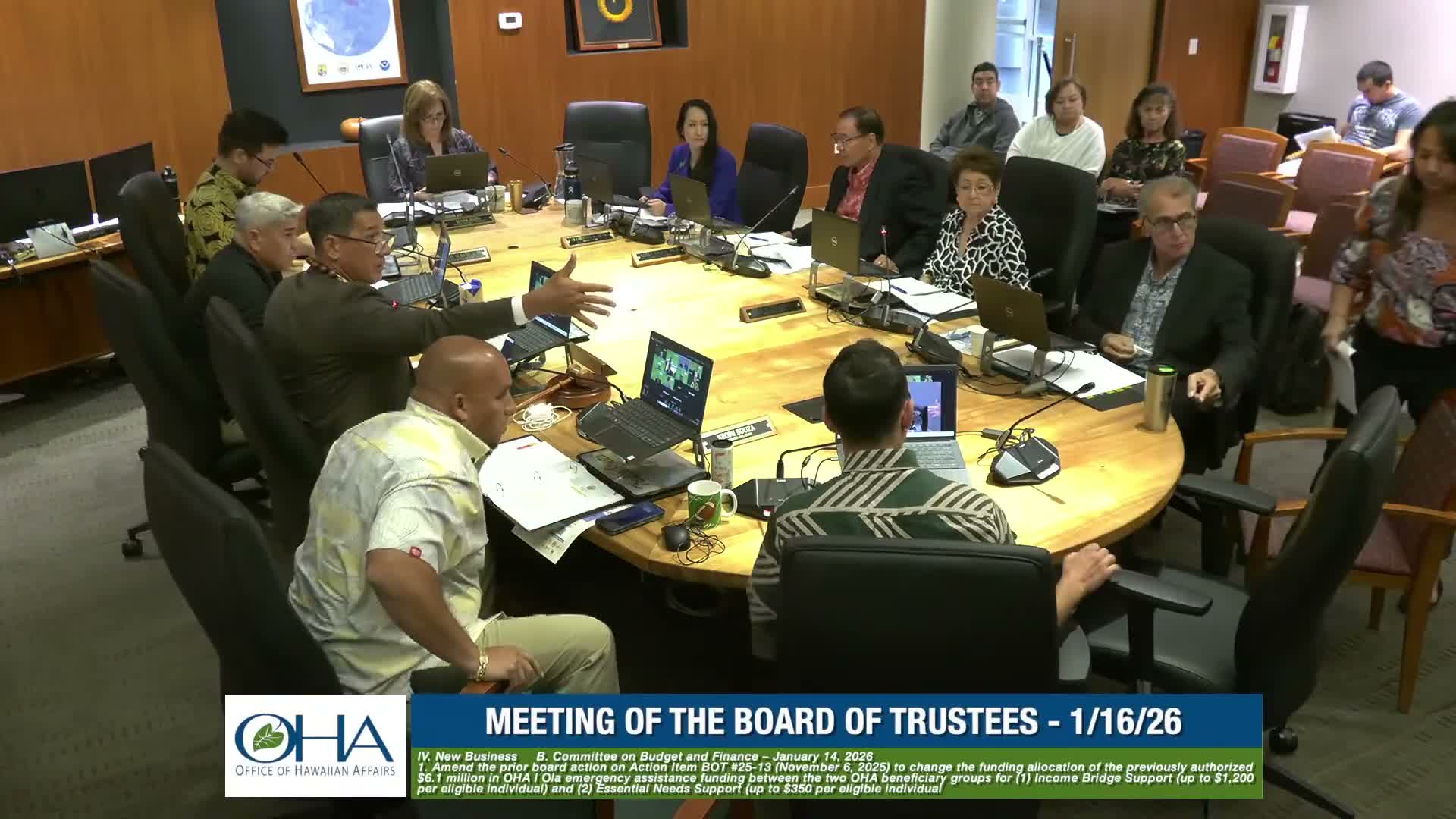
The Office of Hawaiian Affairs (OHA) Board of Trustees voted to approve funding for an additional 262 waitlisted federal‑employee applicants in the agency’s EOLA emergency assistance program after a detailed presentation from the Hawaiian Council on program administration.
Nick Carroll, chief of staff for the Hawaiian Council, told trustees the council had processed applications for two streams — a $1,200 income‑bridge payment for furloughed federal civilian employees and a $350 essential‑needs grocery option for certain SNAP recipients — and that the council had received "3,227 applications for both programs" and dispersed "about $1,600,000" as of Jan. 14. Carroll also said, "We've awarded $1,200,000 for this program," referring to the federal stream, and acknowledged that an internal review found one additional approved federal application beyond the original 1,000 cap.
Trustees pressed staff and Hawaiian Council representatives for precise accounting and legal clarity before changing allocations. Trustee Merida flagged numeric discrepancies between reports and asked staff to reconcile updated figures; staff confirmed a secondary report had been issued to populate fields that were incomplete in an earlier report. Trustee Merida said she did not hear clear accounting in the presentation and asked for the specific dollar splits between the $1,200 and $350 streams.
Trustee Aquino questioned the effectiveness of the SNAP outreach campaign and urged pausing a reallocation until assumptions and marketing reach had been re‑examined. "We're not pausing and asking those questions," Aquino said in explaining a prior vote not to reallocate without additional review. Hawaiian Council representatives acknowledged outreach challenges for the narrowly targeted SNAP population (eligible Native Hawaiian SNAP households without dependents) and said cross‑verification with the State Department of Human Services could improve reach.
Board counsel advised trustees that the original motion language constrained administrative discretion and that any change to the preapproved allocation required board action to avoid a potential violation of the state’s open‑records or procedural rules. After a brief recess to clarify language with counsel, Trustee Alapa moved to amend the prior board action to (1) allow OHA administration to determine the funding allocation of the $6,100,000 EOLA appropriation and (2) add funding to cover an additional 262 previously approved income‑bridge applicants on the federal waitlist. The amendment was seconded and, after discussion and a withdrawn sub‑amendment about removing administrative authority, passed by roll call with nine yes votes.
Trustees and staff said clearing the 261–262 waitlisted federal applicants would cost roughly $313,200 and, if approved, would be processed immediately; staff stated that once checks for the federal category are completed, the program administration would turn its full effort toward the SNAP stream. Trustees emphasized the action did not change the ongoing SNAP distribution contract or its eligibility criteria; rather, it addressed applicants already vetted and awaiting payment.
The board also asked staff to ensure accurate reporting to avoid future discrepancies and to continue outreach with partner organizations and DHS to increase SNAP uptake. Hawaiian Council representatives reiterated the practical limits of outreach for a small, targeted client base, noting that some eligible kupuna and persons with disabilities are harder to reach even with in‑person and in‑store campaigns.
The trustees’ amendment and vote mean the Hawaiian Council can proceed to fund the additional previously approved federal applicants immediately, and the SNAP stream remains open for further outreach and evaluation.
The board reconvened discussion with a public comment period and later moved into an executive session; no action was reported from the executive session. The board set its next meeting for Jan. 29, 2026.
Nick Carroll, chief of staff for the Hawaiian Council, told trustees the council had processed applications for two streams — a $1,200 income‑bridge payment for furloughed federal civilian employees and a $350 essential‑needs grocery option for certain SNAP recipients — and that the council had received "3,227 applications for both programs" and dispersed "about $1,600,000" as of Jan. 14. Carroll also said, "We've awarded $1,200,000 for this program," referring to the federal stream, and acknowledged that an internal review found one additional approved federal application beyond the original 1,000 cap.
Trustees pressed staff and Hawaiian Council representatives for precise accounting and legal clarity before changing allocations. Trustee Merida flagged numeric discrepancies between reports and asked staff to reconcile updated figures; staff confirmed a secondary report had been issued to populate fields that were incomplete in an earlier report. Trustee Merida said she did not hear clear accounting in the presentation and asked for the specific dollar splits between the $1,200 and $350 streams.
Trustee Aquino questioned the effectiveness of the SNAP outreach campaign and urged pausing a reallocation until assumptions and marketing reach had been re‑examined. "We're not pausing and asking those questions," Aquino said in explaining a prior vote not to reallocate without additional review. Hawaiian Council representatives acknowledged outreach challenges for the narrowly targeted SNAP population (eligible Native Hawaiian SNAP households without dependents) and said cross‑verification with the State Department of Human Services could improve reach.
Board counsel advised trustees that the original motion language constrained administrative discretion and that any change to the preapproved allocation required board action to avoid a potential violation of the state’s open‑records or procedural rules. After a brief recess to clarify language with counsel, Trustee Alapa moved to amend the prior board action to (1) allow OHA administration to determine the funding allocation of the $6,100,000 EOLA appropriation and (2) add funding to cover an additional 262 previously approved income‑bridge applicants on the federal waitlist. The amendment was seconded and, after discussion and a withdrawn sub‑amendment about removing administrative authority, passed by roll call with nine yes votes.
Trustees and staff said clearing the 261–262 waitlisted federal applicants would cost roughly $313,200 and, if approved, would be processed immediately; staff stated that once checks for the federal category are completed, the program administration would turn its full effort toward the SNAP stream. Trustees emphasized the action did not change the ongoing SNAP distribution contract or its eligibility criteria; rather, it addressed applicants already vetted and awaiting payment.
The board also asked staff to ensure accurate reporting to avoid future discrepancies and to continue outreach with partner organizations and DHS to increase SNAP uptake. Hawaiian Council representatives reiterated the practical limits of outreach for a small, targeted client base, noting that some eligible kupuna and persons with disabilities are harder to reach even with in‑person and in‑store campaigns.
The trustees’ amendment and vote mean the Hawaiian Council can proceed to fund the additional previously approved federal applicants immediately, and the SNAP stream remains open for further outreach and evaluation.
The board reconvened discussion with a public comment period and later moved into an executive session; no action was reported from the executive session. The board set its next meeting for Jan. 29, 2026.
View the Full Meeting & All Its Details
This article offers just a summary. Unlock complete video, transcripts, and insights as a Founder Member.
✓
Watch full, unedited meeting videos
✓
Search every word spoken in unlimited transcripts
✓
AI summaries & real-time alerts (all government levels)
✓
Permanent access to expanding government content
30-day money-back guarantee
