Manassas council approves two airport hangar franchise agreements, citing job and investment potential
January 12, 2026 | Manassas, Prince William County, Virginia
This article was created by AI summarizing key points discussed. AI makes mistakes, so for full details and context, please refer to the video of the full meeting. Please report any errors so we can fix them. Report an error »
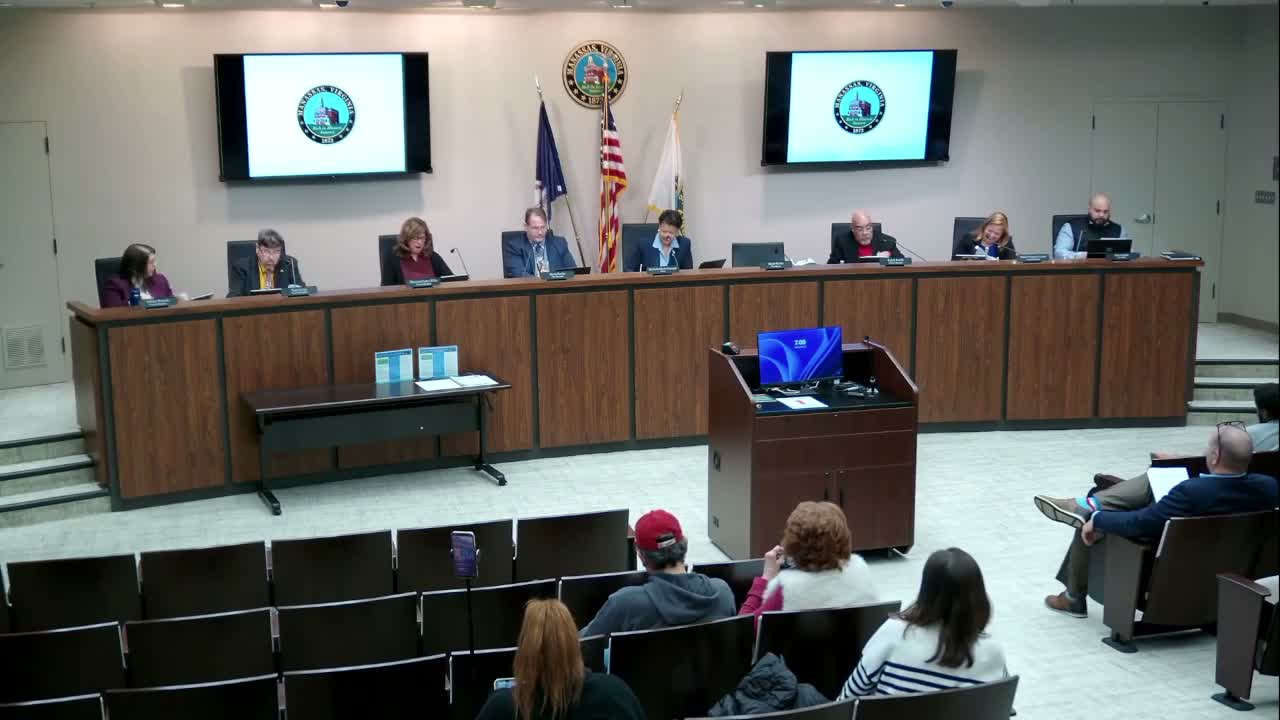
Manassas — The Manassas City Council voted to approve two franchise lease ordinances on first reading on Jan. 12 that authorize private developers to build multiple aircraft hangars and supporting office space at the Manassas Regional Airport.
City staff and airport representatives described the two agreements as targeted investments to expand maintenance, repair and flight‑training support on the airport’s west side. The council approved a 30‑year lease with HEF JPC Hangar LLC for Lot W1, a roughly 1‑acre parcel where the tenant will construct an approximately 6,400‑square‑foot box hangar with about 3,600 square feet of adjoining office space. City staff estimated the first year’s rent at $32,670 and the total private investment at about $2 million.
Council also approved a 40‑year franchise with High Flying Hangars of Virginia LLC for Lot W2, a 5.1‑acre parcel planned to accommodate a minimum of 39 box hangars (a mix of 50×40 and 60×60 units). Staff estimated first‑year rent at $1,188,832.60, a 2.9% annual escalation clause and a project investment of roughly $15 million.
"This falls right in line with our plan strategically placing single‑engine and light twin operations on the west side of the airport," Airport staff member Rivera said, describing the parcels and required improvements, which include ramps, automobile parking and completion within 18 months of permit issuance (extensions may be approved). Rivera told council the Airport Commission recommended approval.
Councilmembers asked about operational impacts and job creation. Rivera said ATP, a large flight‑training organization, will sublease maintenance consolidation at W1, and that W2’s concentrated maintenance work could create several aircraft maintenance mechanic positions. "By consolidating maintenance here at Manassas, that would create job opportunities for maintenance mechanics," Rivera said; he estimated several mechanics though could not provide an exact headcount.
Council members also discussed financing and timing. City staff said while approval is not legally required at this meeting, delaying first reading would create financing uncertainty for the developers; staff encouraged a first vote at this meeting and a second vote at a subsequent meeting to allow project scheduling to proceed.
Both ordinances include rent escalation language (2.9% annually) and terms tied to required construction standards. A roll call vote approved both measures unanimously on first reading. The city will return the finalized franchise agreements for signature and to include final escalator calculations and payment schedules.
The council’s next step will be the required subsequent reading and final vote at a later meeting, after which developers may proceed with permitting and construction.
City staff and airport representatives described the two agreements as targeted investments to expand maintenance, repair and flight‑training support on the airport’s west side. The council approved a 30‑year lease with HEF JPC Hangar LLC for Lot W1, a roughly 1‑acre parcel where the tenant will construct an approximately 6,400‑square‑foot box hangar with about 3,600 square feet of adjoining office space. City staff estimated the first year’s rent at $32,670 and the total private investment at about $2 million.
Council also approved a 40‑year franchise with High Flying Hangars of Virginia LLC for Lot W2, a 5.1‑acre parcel planned to accommodate a minimum of 39 box hangars (a mix of 50×40 and 60×60 units). Staff estimated first‑year rent at $1,188,832.60, a 2.9% annual escalation clause and a project investment of roughly $15 million.
"This falls right in line with our plan strategically placing single‑engine and light twin operations on the west side of the airport," Airport staff member Rivera said, describing the parcels and required improvements, which include ramps, automobile parking and completion within 18 months of permit issuance (extensions may be approved). Rivera told council the Airport Commission recommended approval.
Councilmembers asked about operational impacts and job creation. Rivera said ATP, a large flight‑training organization, will sublease maintenance consolidation at W1, and that W2’s concentrated maintenance work could create several aircraft maintenance mechanic positions. "By consolidating maintenance here at Manassas, that would create job opportunities for maintenance mechanics," Rivera said; he estimated several mechanics though could not provide an exact headcount.
Council members also discussed financing and timing. City staff said while approval is not legally required at this meeting, delaying first reading would create financing uncertainty for the developers; staff encouraged a first vote at this meeting and a second vote at a subsequent meeting to allow project scheduling to proceed.
Both ordinances include rent escalation language (2.9% annually) and terms tied to required construction standards. A roll call vote approved both measures unanimously on first reading. The city will return the finalized franchise agreements for signature and to include final escalator calculations and payment schedules.
The council’s next step will be the required subsequent reading and final vote at a later meeting, after which developers may proceed with permitting and construction.
View the Full Meeting & All Its Details
This article offers just a summary. Unlock complete video, transcripts, and insights as a Founder Member.
✓
Watch full, unedited meeting videos
✓
Search every word spoken in unlimited transcripts
✓
AI summaries & real-time alerts (all government levels)
✓
Permanent access to expanding government content
30-day money-back guarantee
