Committee hears competing views on a 20‑year depreciation schedule for pipelines and utility infrastructure
January 12, 2026 | 2026 Legislature MO, Missouri
This article was created by AI summarizing key points discussed. AI makes mistakes, so for full details and context, please refer to the video of the full meeting. Please report any errors so we can fix them. Report an error »
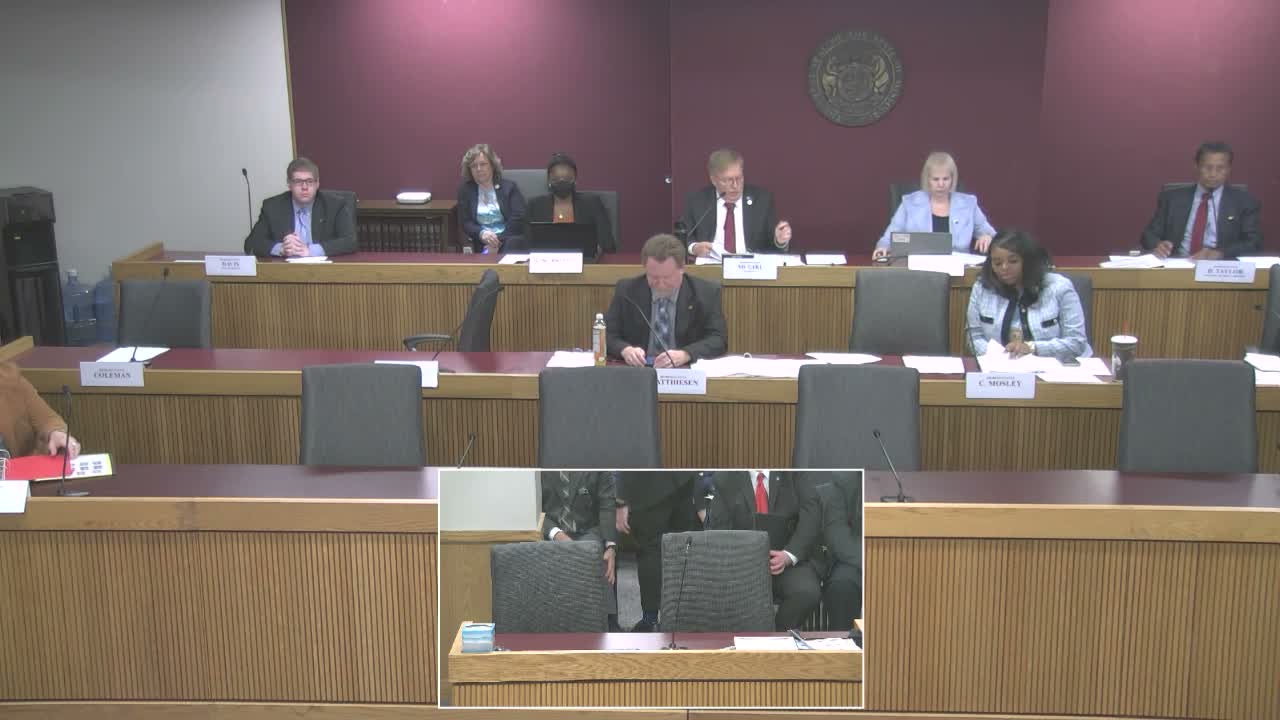
Rep. Wendy Hausman presented HB 18‑92, a bill intended to standardize how assessors depreciate certain permanent infrastructure such as underground pipes and utility systems. The sponsor said the lack of consistent valuation creates unpredictability for assessors and taxpayers and proposed a 20‑year modified accelerated recovery schedule to bring uniformity across counties.
Industry and utility witnesses — including Ray McCarty of Associated Industries of Missouri, a representative of Missouri American Water, Missouri Chamber, the Missouri Natural Gas Association, and Spire — supported the bill. They argued a consistent schedule prevents arbitrary county‑by‑county valuation differences and noted that tax costs are typically passed through to customers.
County assessors led the opposition. Kenny Moore (Boone County assessor) and Jeff Porter (Montgomery County assessor) cautioned that pipelines and similar assets are long‑lived and that many rate‑making proceedings with the Public Service Commission use 50‑year or longer schedules. Moore provided county estimates of revenue loss under a change to the 20‑year approach, saying Boone County could lose roughly $2.2 million annually and Cape Girardeau about $750,000 — figures he derived by comparing original cost reports under different depreciation tables.
Committee members pressed both sides on the technical distinctions between depreciation for tax assessment and depreciation used for utility rate cases, the transition rules for existing assets, and how replacements and capital improvements should be handled. Witnesses and members agreed to collect additional county‑level data; the Department of Revenue and interested parties were asked to provide more detailed analyses to the committee. The hearing was closed without a committee vote.
Industry and utility witnesses — including Ray McCarty of Associated Industries of Missouri, a representative of Missouri American Water, Missouri Chamber, the Missouri Natural Gas Association, and Spire — supported the bill. They argued a consistent schedule prevents arbitrary county‑by‑county valuation differences and noted that tax costs are typically passed through to customers.
County assessors led the opposition. Kenny Moore (Boone County assessor) and Jeff Porter (Montgomery County assessor) cautioned that pipelines and similar assets are long‑lived and that many rate‑making proceedings with the Public Service Commission use 50‑year or longer schedules. Moore provided county estimates of revenue loss under a change to the 20‑year approach, saying Boone County could lose roughly $2.2 million annually and Cape Girardeau about $750,000 — figures he derived by comparing original cost reports under different depreciation tables.
Committee members pressed both sides on the technical distinctions between depreciation for tax assessment and depreciation used for utility rate cases, the transition rules for existing assets, and how replacements and capital improvements should be handled. Witnesses and members agreed to collect additional county‑level data; the Department of Revenue and interested parties were asked to provide more detailed analyses to the committee. The hearing was closed without a committee vote.
Don't Miss a Word: See the Full Meeting!
Go beyond summaries. Unlock every video, transcript, and key insight with a Founder Membership.
✓
Get instant access to full meeting videos
✓
Search and clip any phrase from complete transcripts
✓
Receive AI-powered summaries & custom alerts
✓
Enjoy lifetime, unrestricted access to government data
30-day money-back guarantee
