Environmental commissioners question proposed UDO change to allow up to 80% impervious coverage for affordable-housing projects
January 19, 2026 | Monroe County, Indiana
This article was created by AI summarizing key points discussed. AI makes mistakes, so for full details and context, please refer to the video of the full meeting. Please report any errors so we can fix them. Report an error »
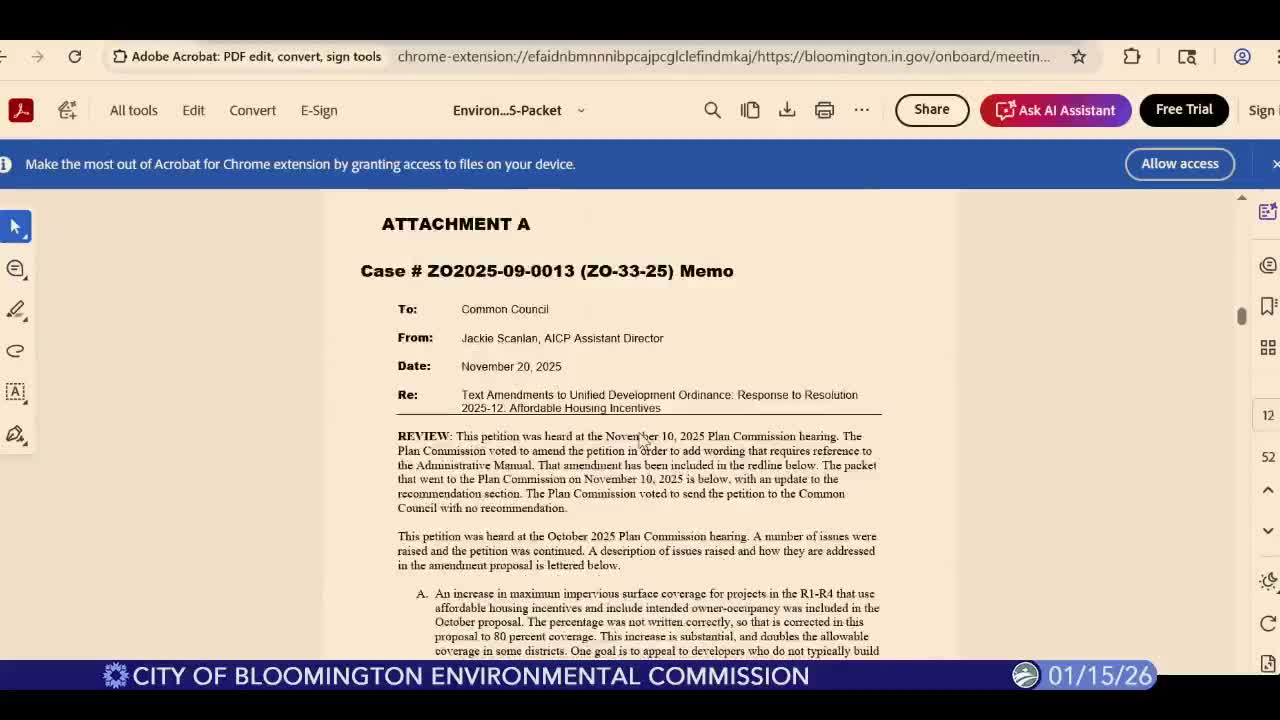
City planning staff presented proposed updates to Title 20 of the Unified Development Ordinance that would expand incentives for developments that include affordable-housing units and raise allowable impervious-surface coverage for those projects.
"In the current UDO ... one of the changes that is being proposed to council has to do with the maximum impervious surface coverage and increasing that to 80% for developments that are using affordable housing," Jamie Kreindler, the city's senior zoning planner, told the Environmental Commission. Kreindler said the change is intended to incentivize developers and that language in the proposal would favor owner-occupied units.
Commissioners pressed staff for details about environmental tradeoffs and implementation. "Are we incentivizing the use of it being more parking lots, more, you know, non green spaces?" Commissioner Carrie O'Bryte asked, reflecting a broader concern about tree canopy, stormwater management and long-term neighborhood quality.
Staff explained the mechanics in broad terms: current maximum impervious-surface allowances vary by residential zone (R‑1: 30%, R‑2: 40%, R‑3: 45%, R‑4: 50%), and the incentive package would offer dimensional flexibility for projects that meet the affordable-housing thresholds. Kreindler said she did not author the memo and suggested commissioners direct detailed technical and timing questions to Jackie Scanlon, the planning assistant director.
Commissioners asked how the incentive interacts with lot size and density, whether communal green space could be required when lot-level impervious coverage increases, and whether the city has sufficient detention or retention capacity on small parcels. Several commissioners noted the possible interaction with a Tier 2 affordability bonus that, as described in the packet, could add another 10% allowance in some cases.
Kreindler said the council continued consideration of the item and expected it back for discussion in early February; the planning/engineering schedule in the packet indicates the item will also be discussed at the plan commission later in the spring. Commissioners agreed to assemble questions for staff, requested written clarification from Scanlon, and tentatively scheduled an Environmental Commission working session to draft a memo for the council and plan commission packet.
Why it matters: The change would lower constraints on built area for developments that include required affordable units. Supporters say it is intended to encourage density and increase housing production; critics told commissioners they fear higher impervious coverage could reduce tree canopy, increase localized flooding risk, and concentrate paved surfaces in lower-income developments unless accompanied by strong stormwater and landscaping requirements.
Next steps: City staff advised the commission to submit comments roughly 10 days before the plan-commission packet distribution; commissioners set a tentative EC meeting to draft a formal comment and planned to follow up with Scanlon for technical answers.
(Reporting note: direct quotes and timing references come from the meeting presentation by Jamie Kreindler and the commissioners’ Q&A.)
"In the current UDO ... one of the changes that is being proposed to council has to do with the maximum impervious surface coverage and increasing that to 80% for developments that are using affordable housing," Jamie Kreindler, the city's senior zoning planner, told the Environmental Commission. Kreindler said the change is intended to incentivize developers and that language in the proposal would favor owner-occupied units.
Commissioners pressed staff for details about environmental tradeoffs and implementation. "Are we incentivizing the use of it being more parking lots, more, you know, non green spaces?" Commissioner Carrie O'Bryte asked, reflecting a broader concern about tree canopy, stormwater management and long-term neighborhood quality.
Staff explained the mechanics in broad terms: current maximum impervious-surface allowances vary by residential zone (R‑1: 30%, R‑2: 40%, R‑3: 45%, R‑4: 50%), and the incentive package would offer dimensional flexibility for projects that meet the affordable-housing thresholds. Kreindler said she did not author the memo and suggested commissioners direct detailed technical and timing questions to Jackie Scanlon, the planning assistant director.
Commissioners asked how the incentive interacts with lot size and density, whether communal green space could be required when lot-level impervious coverage increases, and whether the city has sufficient detention or retention capacity on small parcels. Several commissioners noted the possible interaction with a Tier 2 affordability bonus that, as described in the packet, could add another 10% allowance in some cases.
Kreindler said the council continued consideration of the item and expected it back for discussion in early February; the planning/engineering schedule in the packet indicates the item will also be discussed at the plan commission later in the spring. Commissioners agreed to assemble questions for staff, requested written clarification from Scanlon, and tentatively scheduled an Environmental Commission working session to draft a memo for the council and plan commission packet.
Why it matters: The change would lower constraints on built area for developments that include required affordable units. Supporters say it is intended to encourage density and increase housing production; critics told commissioners they fear higher impervious coverage could reduce tree canopy, increase localized flooding risk, and concentrate paved surfaces in lower-income developments unless accompanied by strong stormwater and landscaping requirements.
Next steps: City staff advised the commission to submit comments roughly 10 days before the plan-commission packet distribution; commissioners set a tentative EC meeting to draft a formal comment and planned to follow up with Scanlon for technical answers.
(Reporting note: direct quotes and timing references come from the meeting presentation by Jamie Kreindler and the commissioners’ Q&A.)
View the Full Meeting & All Its Details
This article offers just a summary. Unlock complete video, transcripts, and insights as a Founder Member.
✓
Watch full, unedited meeting videos
✓
Search every word spoken in unlimited transcripts
✓
AI summaries & real-time alerts (all government levels)
✓
Permanent access to expanding government content
30-day money-back guarantee
