Consensus panel adopts lower revenue forecasts after updated economic data and policy changes
January 17, 2026 | 2025-2026 House Legislature MI, Michigan
This article was created by AI summarizing key points discussed. AI makes mistakes, so for full details and context, please refer to the video of the full meeting. Please report any errors so we can fix them. Report an error »
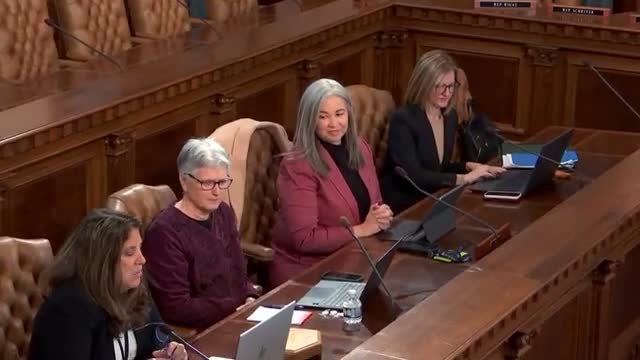
Michigan revenue officials on Jan. 15 adopted a revised set of revenue forecasts that put combined general fund and school aid fund receipts below the May 2025 consensus as agencies incorporated recent tax policy changes and newer economic data.
The conference, convened under MCL 18.1367 b, heard presentations from the University of Michigan’s Research Seminar in Quantitative Economics and fiscal staff from the Senate Fiscal Agency, House Fiscal Agency and the State Treasury before agreeing to the new tables. Staff told the panel that preliminary FY25 collections for five major tax lines trailed the May consensus by about $328 million, and that a set of enacted policy changes (including a motor‑fuel sales tax exemption enacted in the roads package and other fund shifts) reduce net available GF/SAF revenue in FY26 and FY27.
“Combined revenue would be about $33.3 billion for FY26 under this proposal,” David Zinn (Senate Fiscal Agency staff) said during the presentation, and staff later noted the policy shifts reduce FY26 revenue by roughly $800 million and FY27 by about $1.1 billion relative to the prior consensus. Agency forecasts still project modest nominal revenue growth over the 2026–2028 window but at rates that generally fall short of anticipated inflation, leaving the state below its constitutional revenue limit throughout the forecast horizon.
Agencies highlighted key drivers and sources of volatility. Withholding remained a strong growth driver—preliminary withholding growth for FY25 was reported around 5.5%—but refunds rose (preliminary FY25 refunds near $4.0 billion), and corporate income tax collections showed pronounced volatility; preliminary CIT data reflected a large year‑over‑year decline in parts of FY25. The net sales and use tax baseline was lowered principally by the motor fuel exemption, which staff estimated reduces collections by roughly $800–900 million on a full‑year basis.
The panel took formal action on two items tied to budget mechanics. Members moved and approved the updated K–12 pupil membership counts presented by legislative and budget staff and then voted to adopt the revised consensus revenue estimates. Both motions were approved by voice vote.
The agencies presented scenarios that diverge modestly: the administration’s estimates tended to sit toward the higher end of withholding growth and lower end of refund liabilities, while the House and Senate fiscal agency projections produced slightly different net outcomes driven by differing assumptions about refunds, CIT timing and non‑tax revenues. All agencies cautioned that non‑tax receipts (common cash interest, transfers and one‑time receipts) remain a volatile component of near‑term results.
Next steps: the adopted consensus tables will be used in statutory budget processes and for planning, and staff said they will monitor benchmark revisions to payroll employment and late CIT receipts that could alter the near‑term picture. The conference materials and full slide decks are posted on the fiscal agencies’ websites.
The conference, convened under MCL 18.1367 b, heard presentations from the University of Michigan’s Research Seminar in Quantitative Economics and fiscal staff from the Senate Fiscal Agency, House Fiscal Agency and the State Treasury before agreeing to the new tables. Staff told the panel that preliminary FY25 collections for five major tax lines trailed the May consensus by about $328 million, and that a set of enacted policy changes (including a motor‑fuel sales tax exemption enacted in the roads package and other fund shifts) reduce net available GF/SAF revenue in FY26 and FY27.
“Combined revenue would be about $33.3 billion for FY26 under this proposal,” David Zinn (Senate Fiscal Agency staff) said during the presentation, and staff later noted the policy shifts reduce FY26 revenue by roughly $800 million and FY27 by about $1.1 billion relative to the prior consensus. Agency forecasts still project modest nominal revenue growth over the 2026–2028 window but at rates that generally fall short of anticipated inflation, leaving the state below its constitutional revenue limit throughout the forecast horizon.
Agencies highlighted key drivers and sources of volatility. Withholding remained a strong growth driver—preliminary withholding growth for FY25 was reported around 5.5%—but refunds rose (preliminary FY25 refunds near $4.0 billion), and corporate income tax collections showed pronounced volatility; preliminary CIT data reflected a large year‑over‑year decline in parts of FY25. The net sales and use tax baseline was lowered principally by the motor fuel exemption, which staff estimated reduces collections by roughly $800–900 million on a full‑year basis.
The panel took formal action on two items tied to budget mechanics. Members moved and approved the updated K–12 pupil membership counts presented by legislative and budget staff and then voted to adopt the revised consensus revenue estimates. Both motions were approved by voice vote.
The agencies presented scenarios that diverge modestly: the administration’s estimates tended to sit toward the higher end of withholding growth and lower end of refund liabilities, while the House and Senate fiscal agency projections produced slightly different net outcomes driven by differing assumptions about refunds, CIT timing and non‑tax revenues. All agencies cautioned that non‑tax receipts (common cash interest, transfers and one‑time receipts) remain a volatile component of near‑term results.
Next steps: the adopted consensus tables will be used in statutory budget processes and for planning, and staff said they will monitor benchmark revisions to payroll employment and late CIT receipts that could alter the near‑term picture. The conference materials and full slide decks are posted on the fiscal agencies’ websites.
Don't Miss a Word: See the Full Meeting!
Go beyond summaries. Unlock every video, transcript, and key insight with a Founder Membership.
✓
Get instant access to full meeting videos
✓
Search and clip any phrase from complete transcripts
✓
Receive AI-powered summaries & custom alerts
✓
Enjoy lifetime, unrestricted access to government data
30-day money-back guarantee
