Oak Harbor consultants warn marina revenues fall short of costs for major repairs; redevelopment could require $30'$40 million
January 17, 2026 | Oak Harbor, Island County, Washington
This article was created by AI summarizing key points discussed. AI makes mistakes, so for full details and context, please refer to the video of the full meeting. Please report any errors so we can fix them. Report an error »
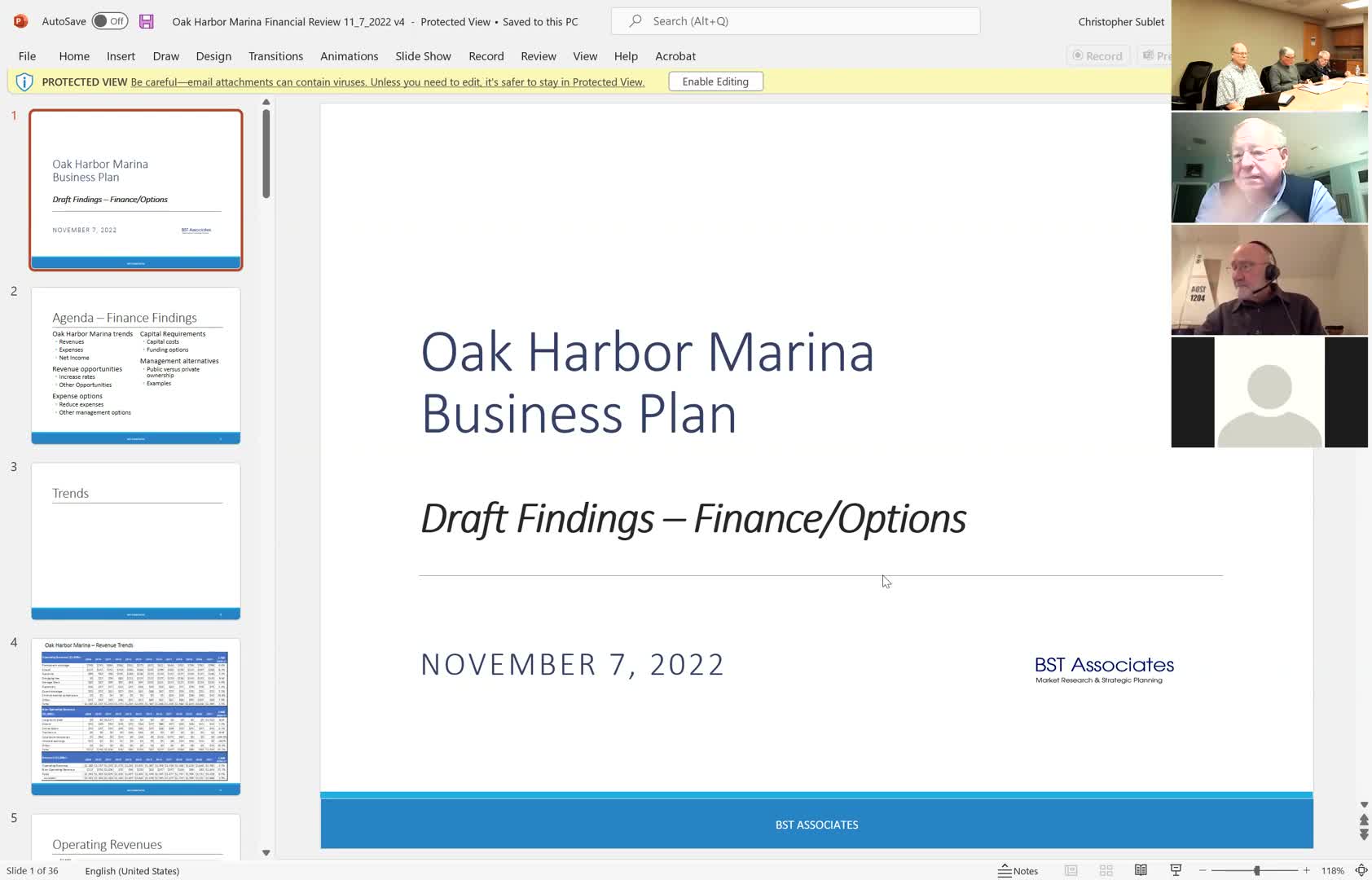
Oak Harbor's marina lacks the operating cash flow to pay for large-scale repairs and redevelopment, a consultant told the committee, outlining options that range from phased repairs to privatization or seeking federal and state grants.
Paul, the consultant presenting the committee's business plan and financial review, said the marina's largest revenue stream'permanent moorage fees'grew only about 0.6% per year on average from 2009 through 2021 while operating expenses rose roughly 4.9% annually. "The existing funds are not sufficient to fund marina development," Paul said, urging the committee to consider a mix of rate changes, cost savings and grant or partnership strategies.
The presentation included several specific figures: Paul said the dredging fee has increased from roughly $22,000 in 2010 to about $140,000 most recently, and that net operating income (excluding debt) averaged about $188,000 per year and has declined slightly over the study period. He estimated dredging the basin at roughly $4.5 million (using $5 million as a planning proxy for the channel) and gave a redevelopment range of $30 million to $40 million if the marina were fully redeveloped, with 30-year bond debt service at a 4% interest rate producing roughly $1.5 million to $2.0 million per year.
Those numbers, Paul said, exceed the marina's current net revenue available for debt service (he estimated roughly $100,000 in net revenue available after existing obligations), meaning the city would need to rely on outside grants, additional municipal backing or different financing approaches to make a major rebuild feasible.
Committee members pressed on rate options and local impacts. Paul outlined three typical rate-setting approaches: benchmarking to comparable marinas, CPI-based indexing, or setting rates to cover operating and capital needs. On market comparisons, he said Oak Harbor is priced below many regional marinas. "Oak Harbor is the red line," Paul said while showing comparative data, adding that Oak Harbor rates often run $8'10 per foot compared with $12'18 per foot at peers, creating a 30% or larger gap at the average.
Members also raised equity and access concerns: one committee member said the "biggest fear" is that rate increases or dredging-related fees could price longtime local tenants out of the marina. Paul acknowledged that a substantial, immediate rate increase would be politically and practically difficult and recommended a portfolio approach of modest rate adjustments, targeted cost savings and aggressive pursuit of grants and partnerships.
Paul and members discussed funding sources that have supported similar projects elsewhere, including Recreational and Conservation Office (RCO) and Department of Transportation'linked maritime grants, Economic Development Administration programs and competitive port-infrastructure grants. He also described models other cities have used, including public'private partnerships and tenant cooperatives, and cautioned that private operators frequently avoid taking on breakwater or major dredging liabilities unless the public sponsor addresses those elements.
The committee discussed next steps: Paul proposed further study and outreach, including a tenant survey and phased planning tied to an upcoming dredging contract. Committee members said they will bring a business-plan summary to the city council, continue grant research, and explore potential contract amendments to add reconfiguration or redesign work once dredging contractors are on board.
The meeting produced no formal decision on redevelopment funding; instead, the committee endorsed continuing study, pursuing grants, and preparing a council briefing and public outreach campaign. The chair said the consultants will refine the financing scenarios and return with more detailed options and timelines.
Minutes approval note: the committee formally moved and approved acceptance of the previous meeting's minutes earlier in the session.
Paul, the consultant presenting the committee's business plan and financial review, said the marina's largest revenue stream'permanent moorage fees'grew only about 0.6% per year on average from 2009 through 2021 while operating expenses rose roughly 4.9% annually. "The existing funds are not sufficient to fund marina development," Paul said, urging the committee to consider a mix of rate changes, cost savings and grant or partnership strategies.
The presentation included several specific figures: Paul said the dredging fee has increased from roughly $22,000 in 2010 to about $140,000 most recently, and that net operating income (excluding debt) averaged about $188,000 per year and has declined slightly over the study period. He estimated dredging the basin at roughly $4.5 million (using $5 million as a planning proxy for the channel) and gave a redevelopment range of $30 million to $40 million if the marina were fully redeveloped, with 30-year bond debt service at a 4% interest rate producing roughly $1.5 million to $2.0 million per year.
Those numbers, Paul said, exceed the marina's current net revenue available for debt service (he estimated roughly $100,000 in net revenue available after existing obligations), meaning the city would need to rely on outside grants, additional municipal backing or different financing approaches to make a major rebuild feasible.
Committee members pressed on rate options and local impacts. Paul outlined three typical rate-setting approaches: benchmarking to comparable marinas, CPI-based indexing, or setting rates to cover operating and capital needs. On market comparisons, he said Oak Harbor is priced below many regional marinas. "Oak Harbor is the red line," Paul said while showing comparative data, adding that Oak Harbor rates often run $8'10 per foot compared with $12'18 per foot at peers, creating a 30% or larger gap at the average.
Members also raised equity and access concerns: one committee member said the "biggest fear" is that rate increases or dredging-related fees could price longtime local tenants out of the marina. Paul acknowledged that a substantial, immediate rate increase would be politically and practically difficult and recommended a portfolio approach of modest rate adjustments, targeted cost savings and aggressive pursuit of grants and partnerships.
Paul and members discussed funding sources that have supported similar projects elsewhere, including Recreational and Conservation Office (RCO) and Department of Transportation'linked maritime grants, Economic Development Administration programs and competitive port-infrastructure grants. He also described models other cities have used, including public'private partnerships and tenant cooperatives, and cautioned that private operators frequently avoid taking on breakwater or major dredging liabilities unless the public sponsor addresses those elements.
The committee discussed next steps: Paul proposed further study and outreach, including a tenant survey and phased planning tied to an upcoming dredging contract. Committee members said they will bring a business-plan summary to the city council, continue grant research, and explore potential contract amendments to add reconfiguration or redesign work once dredging contractors are on board.
The meeting produced no formal decision on redevelopment funding; instead, the committee endorsed continuing study, pursuing grants, and preparing a council briefing and public outreach campaign. The chair said the consultants will refine the financing scenarios and return with more detailed options and timelines.
Minutes approval note: the committee formally moved and approved acceptance of the previous meeting's minutes earlier in the session.
Don't Miss a Word: See the Full Meeting!
Go beyond summaries. Unlock every video, transcript, and key insight with a Founder Membership.
✓
Get instant access to full meeting videos
✓
Search and clip any phrase from complete transcripts
✓
Receive AI-powered summaries & custom alerts
✓
Enjoy lifetime, unrestricted access to government data
30-day money-back guarantee
