Regional grid operators tell North Dakota committee that load growth outpaces transmission and generation
December 15, 2025 | Legislative, North Dakota
This article was created by AI summarizing key points discussed. AI makes mistakes, so for full details and context, please refer to the video of the full meeting. Please report any errors so we can fix them. Report an error »
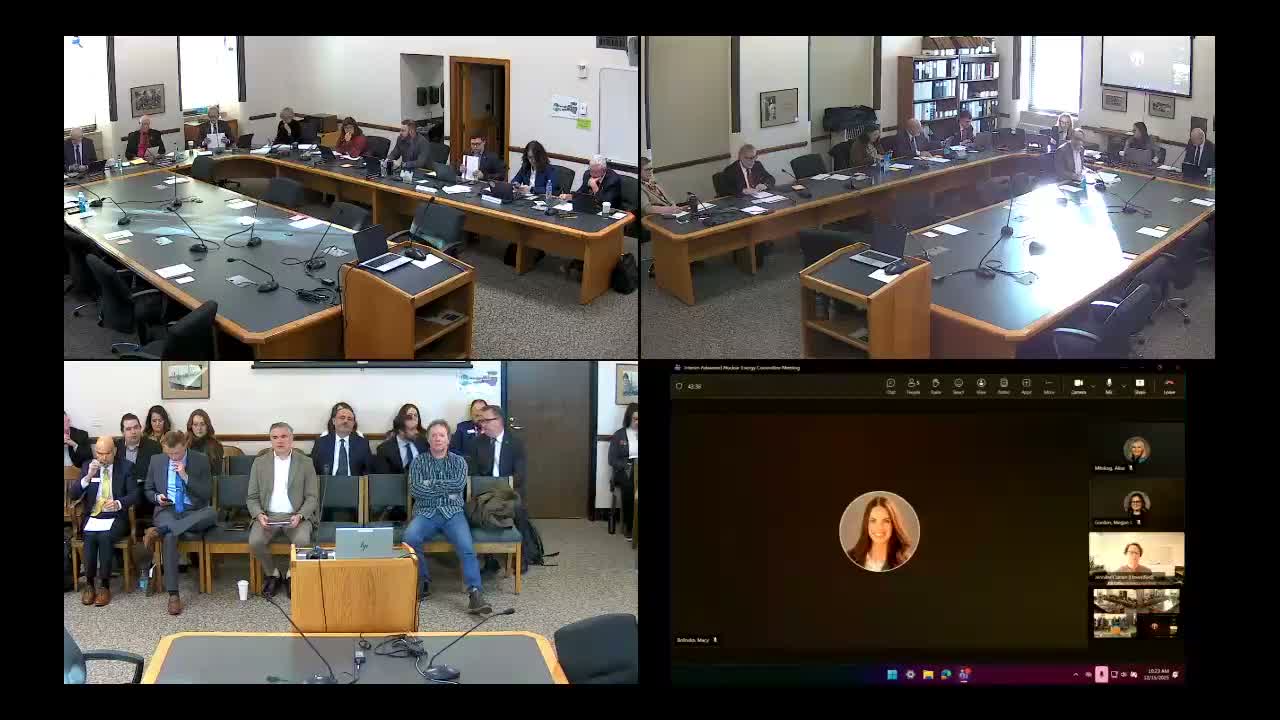
Representatives from MISO and the Southwest Power Pool told the Advanced Nuclear Energy Committee that rapid, localized load growth is stressing regional transmission planning and operations and that faster processes will be needed to keep pace.
Jennifer Curran, Senior Vice President of Planning and Operations at MISO, said states and load‑serving entities retain responsibility for resource adequacy while MISO provides transparency for regional supply‑demand balance. She warned of significant spot‑load requests and said, “In '22 through 2024, we received requests for 630 megawatts as spot loads in North Dakota,” citing data center and manufacturing interest. Curran described three reforms MISO has implemented to shorten interconnection timelines: an Expedited Resource Addition Study for targeted projects, a cap on the interconnection queue to limit backlog, and automation that has reduced early‑phase interconnection times from one to two years to roughly 90 days.
Casey Kathy, vice president of engineering at SPP, said SPP is experiencing similar pressures and described a ‘‘generational challenge’’ of retirements and rising load that shrinks reserve margins. Kathy highlighted SPP policy innovations including a consolidated annual planning study being filed with FERC and a high‑impact large‑load 90‑day study (HILGA) to evaluate combined generation and load configurations quickly. Kathy told members SPP had 5.7 gigawatts of active generation interconnection requests for North Dakota, and said regions on SPP’s long‑range plan (tranche 1 and tranche 2) provide backbone transmission but take years to build.
Jordan Kanyainen of the Office of the Industrial Commission summarized North Dakota Transmission Authority work and a state large‑load capacity study modeled for 2026, 2029 and 2034 that added hypothetical large loads — including a modeled 200‑MW addition at Coal Creek — and identified top thermal and voltage binding constraints that would require targeted upgrades.
All presenters emphasized the timing mismatch: large loads can be built and begin operating within 18–36 months, generation can take roughly four years (interconnection permitting permitting assumed), and regional high‑voltage transmission projects can take seven to ten years. Panelists agreed the combination of expedited study processes, queue reforms, targeted transmission projects and early state‑level planning will be required to avoid congestion and rising locational marginal prices for consumers.
The committee heard repeated calls for early public engagement and cross‑jurisdictional coordination to ensure new generation and transmission are “used and useful.”
Jennifer Curran, Senior Vice President of Planning and Operations at MISO, said states and load‑serving entities retain responsibility for resource adequacy while MISO provides transparency for regional supply‑demand balance. She warned of significant spot‑load requests and said, “In '22 through 2024, we received requests for 630 megawatts as spot loads in North Dakota,” citing data center and manufacturing interest. Curran described three reforms MISO has implemented to shorten interconnection timelines: an Expedited Resource Addition Study for targeted projects, a cap on the interconnection queue to limit backlog, and automation that has reduced early‑phase interconnection times from one to two years to roughly 90 days.
Casey Kathy, vice president of engineering at SPP, said SPP is experiencing similar pressures and described a ‘‘generational challenge’’ of retirements and rising load that shrinks reserve margins. Kathy highlighted SPP policy innovations including a consolidated annual planning study being filed with FERC and a high‑impact large‑load 90‑day study (HILGA) to evaluate combined generation and load configurations quickly. Kathy told members SPP had 5.7 gigawatts of active generation interconnection requests for North Dakota, and said regions on SPP’s long‑range plan (tranche 1 and tranche 2) provide backbone transmission but take years to build.
Jordan Kanyainen of the Office of the Industrial Commission summarized North Dakota Transmission Authority work and a state large‑load capacity study modeled for 2026, 2029 and 2034 that added hypothetical large loads — including a modeled 200‑MW addition at Coal Creek — and identified top thermal and voltage binding constraints that would require targeted upgrades.
All presenters emphasized the timing mismatch: large loads can be built and begin operating within 18–36 months, generation can take roughly four years (interconnection permitting permitting assumed), and regional high‑voltage transmission projects can take seven to ten years. Panelists agreed the combination of expedited study processes, queue reforms, targeted transmission projects and early state‑level planning will be required to avoid congestion and rising locational marginal prices for consumers.
The committee heard repeated calls for early public engagement and cross‑jurisdictional coordination to ensure new generation and transmission are “used and useful.”
View the Full Meeting & All Its Details
This article offers just a summary. Unlock complete video, transcripts, and insights as a Founder Member.
✓
Watch full, unedited meeting videos
✓
Search every word spoken in unlimited transcripts
✓
AI summaries & real-time alerts (all government levels)
✓
Permanent access to expanding government content
30-day money-back guarantee
