Georgia regulator tells North Dakota committee Plant Vogtle shows nuclear can deliver long‑term clean baseload — with strong oversight
December 15, 2025 | Legislative, North Dakota
This article was created by AI summarizing key points discussed. AI makes mistakes, so for full details and context, please refer to the video of the full meeting. Please report any errors so we can fix them. Report an error »
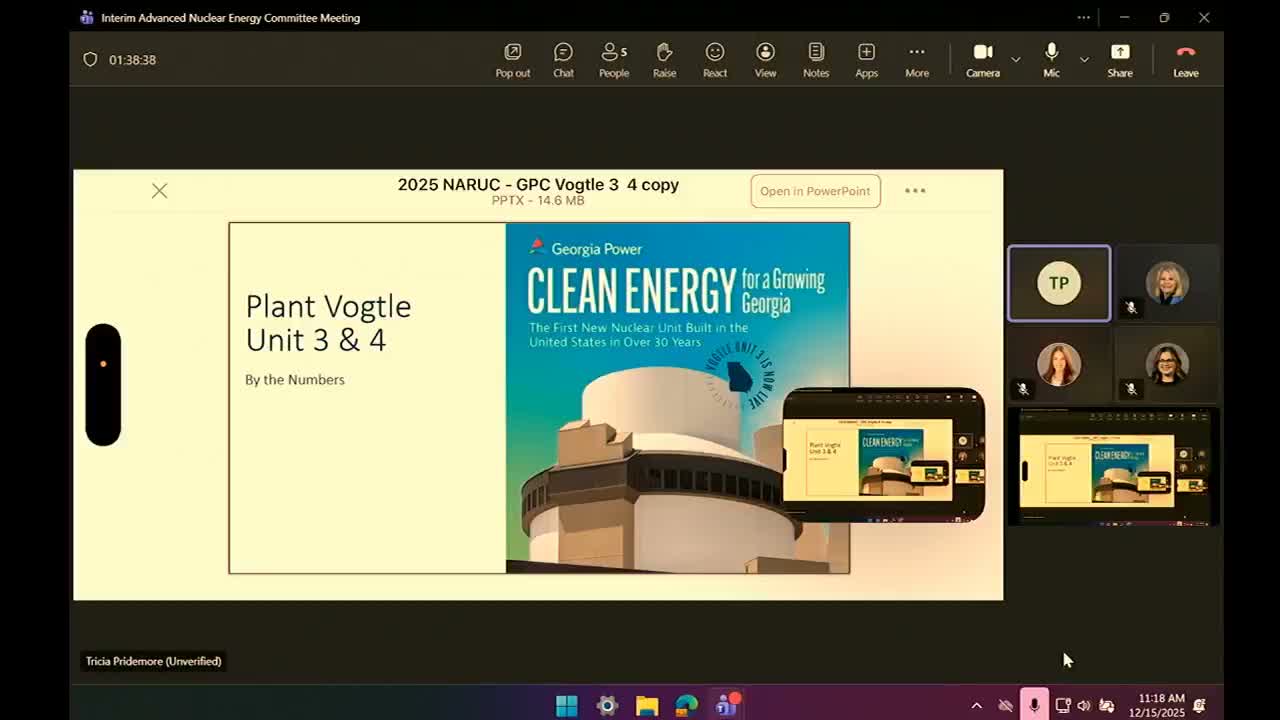
Commissioner Trisha Pridemore of the Georgia Public Service Commission told North Dakota’s Advanced Nuclear Energy Committee that Plant Vogtle Units 3 and 4 provide a practical model of how large nuclear projects can be completed when regulators impose sustained oversight and transparency.
Pridemore described Vogtle’s history: AP1000 technology, CWIP financing enacted by the Georgia legislature, a peak construction workforce of more than 9,000 and an operating workforce of roughly 800, and several “black swan” events — notably the Westinghouse parent bankruptcy and COVID‑19 disruptions — that delayed construction. She said the commission required ongoing construction monitoring (VCM) with hearings twice a year and independent technical consultants, which increased transparency for the public and allowed repeated regulatory check‑ins.
Pridemore said that transparency and a steady regulatory approach helped the project reach commercial operation (COD) for Units 3 and 4 in April 2024. She provided a program cost figure used by the Georgia commission’s oversight: a total prudent construction and capital cost of about $10,100,000,000 for the program and described how Westinghouse settlements and customer bill treatments helped manage the financial impact. “The AP1000 is a really exceptional technology in my opinion,” she said, and argued economies of scale (building multiple units) and a regulatory finance plan are critical to capturing schedule and cost efficiencies.
On lessons for North Dakota, Pridemore recommended: adopt a strategy that runs from initial financing through COD; create a regulatory monitoring structure (regular stop/start decisions); invest in community and workforce development; establish relationships with the Nuclear Regulatory Commission; and evaluate financing tools (including CWIP) while recognizing they are politically and administratively sensitive.
Committee members asked about site selection, stakeholder concerns and the role of economic development in securing industrial investment; Pridemore said transparency and local workforce engagement were essential to overcoming public opposition and attracting on‑shoring of manufacturing.
Pridemore described Vogtle’s history: AP1000 technology, CWIP financing enacted by the Georgia legislature, a peak construction workforce of more than 9,000 and an operating workforce of roughly 800, and several “black swan” events — notably the Westinghouse parent bankruptcy and COVID‑19 disruptions — that delayed construction. She said the commission required ongoing construction monitoring (VCM) with hearings twice a year and independent technical consultants, which increased transparency for the public and allowed repeated regulatory check‑ins.
Pridemore said that transparency and a steady regulatory approach helped the project reach commercial operation (COD) for Units 3 and 4 in April 2024. She provided a program cost figure used by the Georgia commission’s oversight: a total prudent construction and capital cost of about $10,100,000,000 for the program and described how Westinghouse settlements and customer bill treatments helped manage the financial impact. “The AP1000 is a really exceptional technology in my opinion,” she said, and argued economies of scale (building multiple units) and a regulatory finance plan are critical to capturing schedule and cost efficiencies.
On lessons for North Dakota, Pridemore recommended: adopt a strategy that runs from initial financing through COD; create a regulatory monitoring structure (regular stop/start decisions); invest in community and workforce development; establish relationships with the Nuclear Regulatory Commission; and evaluate financing tools (including CWIP) while recognizing they are politically and administratively sensitive.
Committee members asked about site selection, stakeholder concerns and the role of economic development in securing industrial investment; Pridemore said transparency and local workforce engagement were essential to overcoming public opposition and attracting on‑shoring of manufacturing.
Don't Miss a Word: See the Full Meeting!
Go beyond summaries. Unlock every video, transcript, and key insight with a Founder Membership.
✓
Get instant access to full meeting videos
✓
Search and clip any phrase from complete transcripts
✓
Receive AI-powered summaries & custom alerts
✓
Enjoy lifetime, unrestricted access to government data
30-day money-back guarantee
