Ecology warns EITE allowance allocations could clash with cap; Quebec presents 'consignment' funding model
January 12, 2026 | Legislative Sessions, Washington
This article was created by AI summarizing key points discussed. AI makes mistakes, so for full details and context, please refer to the video of the full meeting. Please report any errors so we can fix them. Report an error »
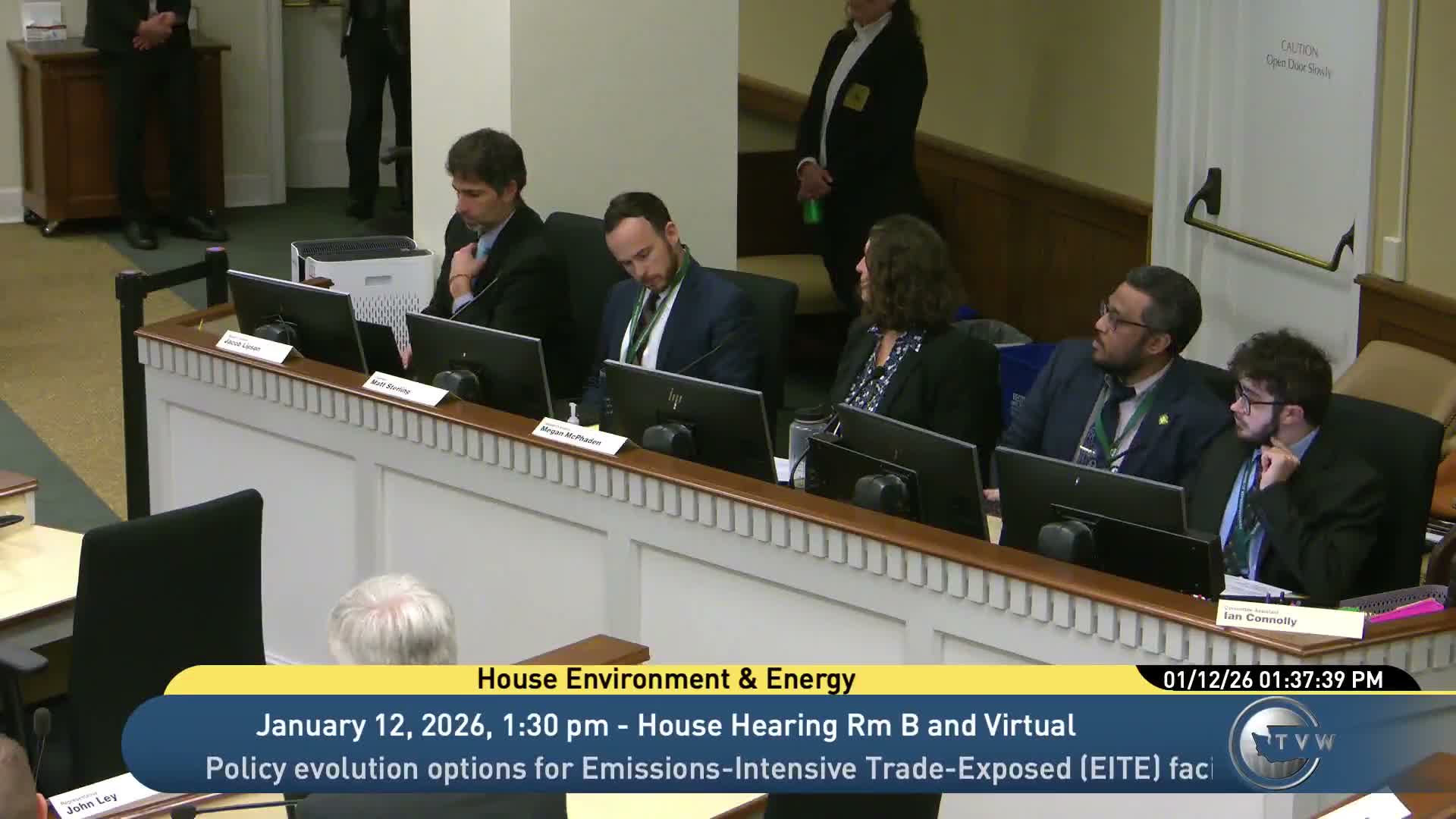
Representative Dolio invited staff from the Department of Ecology and a delegation from Quebec to discuss how Washington treats emissions‑intensive trade‑exposed facilities under the Climate Commitment Act.
Joel Creswell, manager of the Climate Pollution Reduction Program at the Department of Ecology, summarized the Cap and Invest program and how no‑cost allowances are allocated to EITEs. Creswell said the CCA covers entities emitting more than 25,000 metric tons of CO2 annually and noted that EITEs currently receive most of their allowances at no cost. By statute, Creswell said, EITEs receive 100% of their allocation baseline for the 2023–26 compliance period, 97% for 2027–30 and 94% for 2031–34.
"Under existing policies, EITE allocation alone could conflict with the cap around 2046 or '47," Creswell said, urging the committee to consider allocation adjustments between 2035 and 2050 to avoid allocating more allowances than the cap allows and eliminating auction revenue that funds program administration and other state programs.
Creswell described four categories of recommendations in Ecology's report: continue adjusted no‑cost allocation to mitigate leakage while aligning with the cap; evaluate policy enhancements (such as allocation tied to electricity purchases); assess economic and environmental‑justice impacts at the facility level; and pursue complementary measures (energy efficiency, electrification, low‑carbon fuels, and carbon capture) outside the Cap and Invest program. He noted the Legislature set a December 2027 deadline to adopt EITE policy for 2035–50 and that Ecology submitted an early report to inform the 2026 debate.
Quebec officials detailed their provincial approach, which since 2024 has reduced free allocations and consigned a portion of allowances to be sold at auction. Jean‑Yves Benoit, who said Quebec retains proceeds in facility‑specific contracts, described rules that require facilities to submit technical and economic studies of mitigation opportunities and use consigned funds for eligible projects such as equipment upgrades, carbon capture and storage, and research and development. "We sign a contract with each individual facility…When we put the money aside, the money is theirs," Benoit said, adding that facilities have five years to use the funds or the money reverts to Quebec's green fund.
Committee members pressed on whether free allocations have caused plant closures. Creswell said Ecology has not received petitions from new EITEs and does not believe any designated facilities have closed, though one industry from the baseline period is currently curtailed. Benoit said Quebec has not seen business closures because of its carbon pricing and cited industrial output growth alongside a reported 22.6% decline in industrial sector emissions since 1990 (excluding one very large cement plant).
Why it matters: Ecology flagged a structural funding risk in Washington's Cap and Invest design and presented policy options that would preserve leakage protections without undermining the cap or auction revenue streams. Quebec’s consignment model offers one approach to direct auction value into facility decarbonization while retaining protections against funds being repurposed by future governments.
What's next: Ecology noted it will pursue public rulemaking and that the Legislature must act by December 2027 to adopt allocation policy for 2035–50. The committee reserved time for questions and moved on to the day's bill hearings.
Joel Creswell, manager of the Climate Pollution Reduction Program at the Department of Ecology, summarized the Cap and Invest program and how no‑cost allowances are allocated to EITEs. Creswell said the CCA covers entities emitting more than 25,000 metric tons of CO2 annually and noted that EITEs currently receive most of their allowances at no cost. By statute, Creswell said, EITEs receive 100% of their allocation baseline for the 2023–26 compliance period, 97% for 2027–30 and 94% for 2031–34.
"Under existing policies, EITE allocation alone could conflict with the cap around 2046 or '47," Creswell said, urging the committee to consider allocation adjustments between 2035 and 2050 to avoid allocating more allowances than the cap allows and eliminating auction revenue that funds program administration and other state programs.
Creswell described four categories of recommendations in Ecology's report: continue adjusted no‑cost allocation to mitigate leakage while aligning with the cap; evaluate policy enhancements (such as allocation tied to electricity purchases); assess economic and environmental‑justice impacts at the facility level; and pursue complementary measures (energy efficiency, electrification, low‑carbon fuels, and carbon capture) outside the Cap and Invest program. He noted the Legislature set a December 2027 deadline to adopt EITE policy for 2035–50 and that Ecology submitted an early report to inform the 2026 debate.
Quebec officials detailed their provincial approach, which since 2024 has reduced free allocations and consigned a portion of allowances to be sold at auction. Jean‑Yves Benoit, who said Quebec retains proceeds in facility‑specific contracts, described rules that require facilities to submit technical and economic studies of mitigation opportunities and use consigned funds for eligible projects such as equipment upgrades, carbon capture and storage, and research and development. "We sign a contract with each individual facility…When we put the money aside, the money is theirs," Benoit said, adding that facilities have five years to use the funds or the money reverts to Quebec's green fund.
Committee members pressed on whether free allocations have caused plant closures. Creswell said Ecology has not received petitions from new EITEs and does not believe any designated facilities have closed, though one industry from the baseline period is currently curtailed. Benoit said Quebec has not seen business closures because of its carbon pricing and cited industrial output growth alongside a reported 22.6% decline in industrial sector emissions since 1990 (excluding one very large cement plant).
Why it matters: Ecology flagged a structural funding risk in Washington's Cap and Invest design and presented policy options that would preserve leakage protections without undermining the cap or auction revenue streams. Quebec’s consignment model offers one approach to direct auction value into facility decarbonization while retaining protections against funds being repurposed by future governments.
What's next: Ecology noted it will pursue public rulemaking and that the Legislature must act by December 2027 to adopt allocation policy for 2035–50. The committee reserved time for questions and moved on to the day's bill hearings.
View the Full Meeting & All Its Details
This article offers just a summary. Unlock complete video, transcripts, and insights as a Founder Member.
✓
Watch full, unedited meeting videos
✓
Search every word spoken in unlimited transcripts
✓
AI summaries & real-time alerts (all government levels)
✓
Permanent access to expanding government content
30-day money-back guarantee
