Panel split over safety and access as committee hears bill to legalize plug‑in 'balcony' solar and meter‑mounted devices
January 12, 2026 | Legislative Sessions, Washington
This article was created by AI summarizing key points discussed. AI makes mistakes, so for full details and context, please refer to the video of the full meeting. Please report any errors so we can fix them. Report an error »
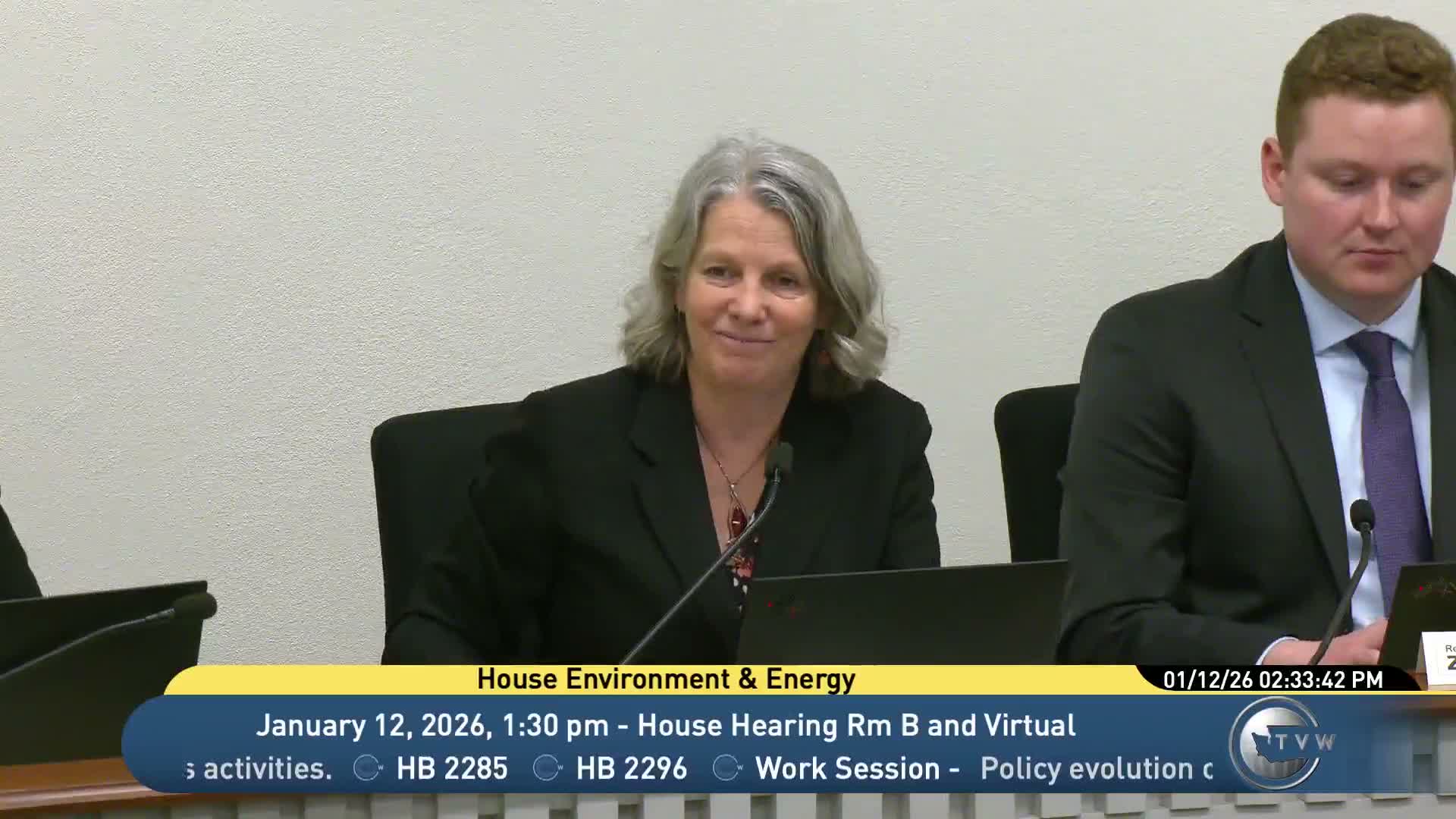
The Environment and Energy Committee held a hearing on House Bill 2296, a bill that would expand the legal use of small, plug‑in solar devices and allow a single meter‑mounted device per electric customer under certain conditions.
Staff briefing: Megan McFadden, committee staff, outlined the bill’s two parts: portable solar generation devices — moveable units that connect to a standard 120‑volt outlet and are intended to offset household electricity use — and meter‑mounted devices installed between a meter and meter socket. McFadden said the bill would prohibit utilities, local governments or landlords from requiring customers to get approval or pay a fee before using portable devices, exempt portable devices from interconnection agreements and net‑metering laws, and make it a violation of the Consumer Protection Act to sell devices that do not meet the bill’s specified safety standards. For meter‑mounted devices, the bill requires installation by a licensed electrical contractor, coordination with the servicing utility, and allows utilities to charge for service work and remove devices that impair service or meter reading.
Sponsor and supporters: Representative Zach Hall, the bill sponsor, described the measure as lowering cost and regulatory barriers so renters and homeowners can more easily adopt small‑scale solar and electrification measures. Wesley Schrock of BrightSaver, a nonprofit promoting plug‑in solar adoption, testified that the approach is market‑driven, does not require public subsidies, and is widely adopted in other jurisdictions.
Safety and utility concerns: Regulatory agencies, utilities and unions raised caution. Maggie Douglas of the Public Staff Commission told the committee there are currently no U.S. safety standards for balcony solar and cited a recent UL report opposing unconstrained deployment without mitigations. Matthew Heppner of the certified electrical workers (IBEW) and Tammy Phelan of the Department of Labor and Industries explained that existing electrical safety codes and inspection regimes do not yet cover these plug‑in systems, creating risks including breakers and GFCIs failing to detect backfeeding and unknown customer generation energizing lines when workers are present. Heppner cautioned that L&I lacks authority and resources now to regulate portable, non‑fixed electrical equipment at scale.
Utility perspectives: Avista and public utility districts said piecemeal changes to net‑metering and device approval could strand utilities with regulatory and operational challenges. Small utilities asked for streamlined interconnection that preserves a utility’s ability to deny installations that create safety or operational problems and flagged a 90‑day equipment‑certification timeline that may be unrealistic for small staffs.
Industry and solar advocates: The Washington Solar Energy Industries Association supported the bill’s goal to lower regulatory layering and said small systems are broadly safe when properly standardized, but urged parallel interconnection reforms to avoid preserving current barriers in a new pathway.
Why it matters: The hearing highlighted a policy tradeoff: expand access to low‑cost distributed solar for renters and multifamily residents, or ensure a cautious rollout to avoid worker risk, fire hazards, and system reliability problems. The committee heard repeated requests to reconcile device safety standards, certification timelines, and interconnection processes before adopting a broad waiver pathway.
What's next: The committee closed the HB 2296 hearing after multiple panels and said members will continue stakeholder work on safety, interconnection, and certification requirements.
Staff briefing: Megan McFadden, committee staff, outlined the bill’s two parts: portable solar generation devices — moveable units that connect to a standard 120‑volt outlet and are intended to offset household electricity use — and meter‑mounted devices installed between a meter and meter socket. McFadden said the bill would prohibit utilities, local governments or landlords from requiring customers to get approval or pay a fee before using portable devices, exempt portable devices from interconnection agreements and net‑metering laws, and make it a violation of the Consumer Protection Act to sell devices that do not meet the bill’s specified safety standards. For meter‑mounted devices, the bill requires installation by a licensed electrical contractor, coordination with the servicing utility, and allows utilities to charge for service work and remove devices that impair service or meter reading.
Sponsor and supporters: Representative Zach Hall, the bill sponsor, described the measure as lowering cost and regulatory barriers so renters and homeowners can more easily adopt small‑scale solar and electrification measures. Wesley Schrock of BrightSaver, a nonprofit promoting plug‑in solar adoption, testified that the approach is market‑driven, does not require public subsidies, and is widely adopted in other jurisdictions.
Safety and utility concerns: Regulatory agencies, utilities and unions raised caution. Maggie Douglas of the Public Staff Commission told the committee there are currently no U.S. safety standards for balcony solar and cited a recent UL report opposing unconstrained deployment without mitigations. Matthew Heppner of the certified electrical workers (IBEW) and Tammy Phelan of the Department of Labor and Industries explained that existing electrical safety codes and inspection regimes do not yet cover these plug‑in systems, creating risks including breakers and GFCIs failing to detect backfeeding and unknown customer generation energizing lines when workers are present. Heppner cautioned that L&I lacks authority and resources now to regulate portable, non‑fixed electrical equipment at scale.
Utility perspectives: Avista and public utility districts said piecemeal changes to net‑metering and device approval could strand utilities with regulatory and operational challenges. Small utilities asked for streamlined interconnection that preserves a utility’s ability to deny installations that create safety or operational problems and flagged a 90‑day equipment‑certification timeline that may be unrealistic for small staffs.
Industry and solar advocates: The Washington Solar Energy Industries Association supported the bill’s goal to lower regulatory layering and said small systems are broadly safe when properly standardized, but urged parallel interconnection reforms to avoid preserving current barriers in a new pathway.
Why it matters: The hearing highlighted a policy tradeoff: expand access to low‑cost distributed solar for renters and multifamily residents, or ensure a cautious rollout to avoid worker risk, fire hazards, and system reliability problems. The committee heard repeated requests to reconcile device safety standards, certification timelines, and interconnection processes before adopting a broad waiver pathway.
What's next: The committee closed the HB 2296 hearing after multiple panels and said members will continue stakeholder work on safety, interconnection, and certification requirements.
View the Full Meeting & All Its Details
This article offers just a summary. Unlock complete video, transcripts, and insights as a Founder Member.
✓
Watch full, unedited meeting videos
✓
Search every word spoken in unlimited transcripts
✓
AI summaries & real-time alerts (all government levels)
✓
Permanent access to expanding government content
30-day money-back guarantee
