OFM outlines governor's proposed 2026 supplemental budget, emphasizes targeted cuts and BSA drawdown
January 12, 2026 | Legislative Sessions, Washington
This article was created by AI summarizing key points discussed. AI makes mistakes, so for full details and context, please refer to the video of the full meeting. Please report any errors so we can fix them. Report an error »
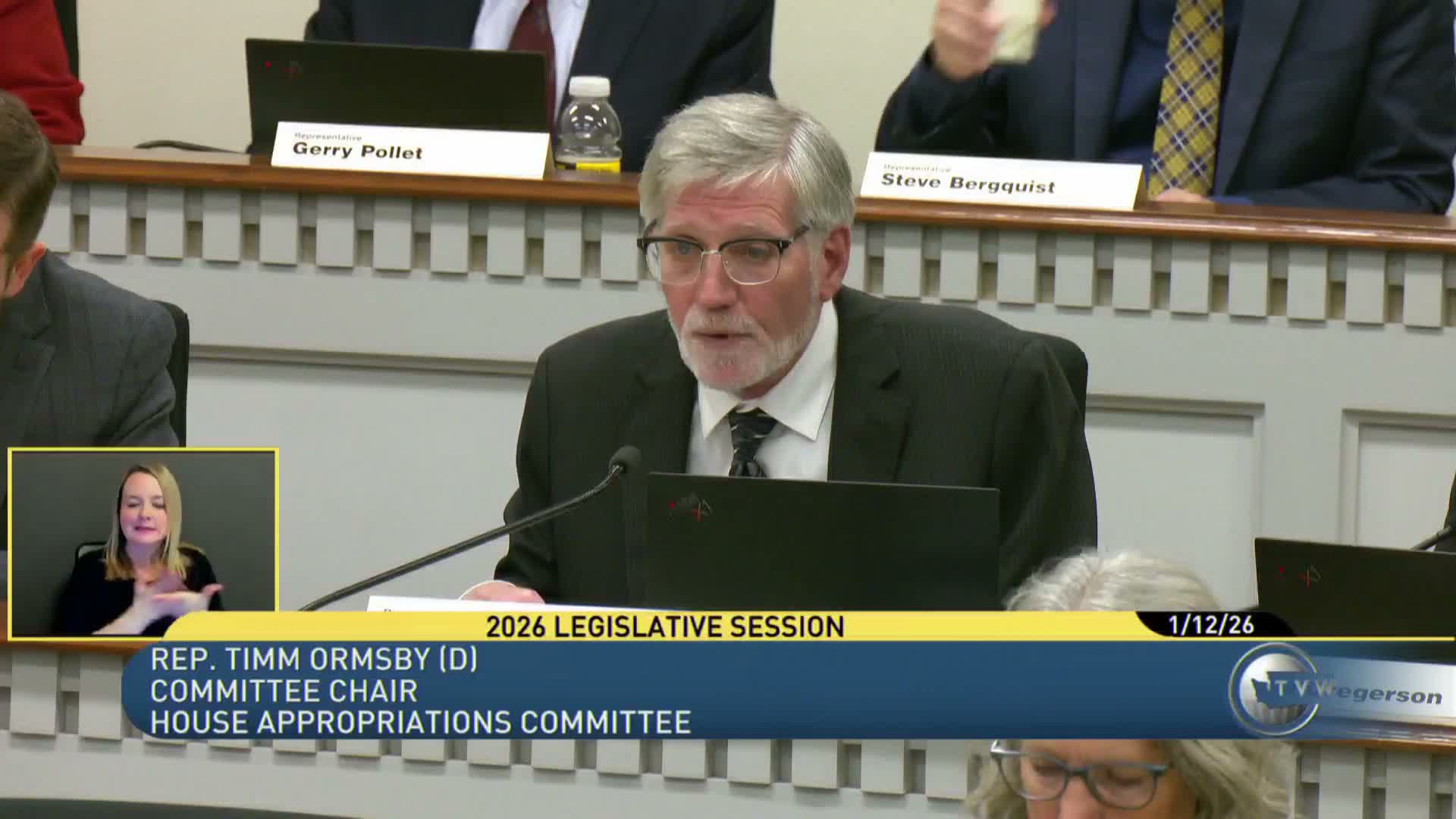
The House Appropriations Committee heard a briefing on the governor's proposed 2026 supplemental operating budget Thursday, with Katie Chapman, director of the Office of Financial Management, laying out the fiscal framework and the administration's policy choices.
Chapman told the committee that since enactment of the biennial budget the state has seen rising enrollments and caseloads in long‑term care, childcare and special education and a near‑general‑fund decline of about $390 million for the 2025–27 period. "We've continued to see increases in enrollments and caseloads across many of our programs," she said, describing inflationary and federal policy pressures as drivers of added costs.
The governor's supplemental proposal addresses an approximately $2.3 billion two‑year gap. Chapman said roughly $1.1 billion comes from caseload and maintenance‑level changes, about $155 million from federal changes tied to HR1, and the remainder from a mixture of targeted new investments the governor prioritized and revenue shortfalls. To limit immediate program cuts, the proposal uses a mix of spending reductions (about $800 million in near‑general‑fund reductions), revenue shifts and fund transfers and a drawdown from the Budget Stabilization Account (BSA), including two transfers totalling roughly $880 million across FY26 and FY27.
Chapman described several specific adjustments: directing an additional $75 million of the capital gains excise tax to the Education Legacy Trust Account for this biennium; transferring $75 million from the Public Works Assistance account to the general fund; and using about $1 billion from the BSA in steps to cover fire costs and other obligations. She cautioned the chart she presented compresses resources and expenditures on the same line and noted data system limitations in how costs and fund shifts are displayed.
On programmatic choices, the proposal would cap Working Connections Childcare at 33,000 families with exceptions for child‑welfare cases, hold childcare subsidy rates at the 70th percentile (delaying a scheduled increase to the 80th), limit Apple Health expansion enrollments to current caseloads, and reduce slot counts in Transition to Kindergarten programs. Chapman said the governor sought to "maintain critical services and...try and plan and look at programs where a reduction would be causing the least harm."
Committee members asked about credit‑rating risks from not fully balancing the four‑year outlook. Chapman said Washington's four‑year balanced budget law is generally a credit strength but that rating effects depend on future legislative choices.
The committee paused question time to hear from statewide elected officials and more than 120 public testifiers. The public hearing will continue Wednesday at 4 p.m. for those who could not testify. The committee adjourned at the scheduled time without taking formal votes on the supplemental proposal.
Chapman told the committee that since enactment of the biennial budget the state has seen rising enrollments and caseloads in long‑term care, childcare and special education and a near‑general‑fund decline of about $390 million for the 2025–27 period. "We've continued to see increases in enrollments and caseloads across many of our programs," she said, describing inflationary and federal policy pressures as drivers of added costs.
The governor's supplemental proposal addresses an approximately $2.3 billion two‑year gap. Chapman said roughly $1.1 billion comes from caseload and maintenance‑level changes, about $155 million from federal changes tied to HR1, and the remainder from a mixture of targeted new investments the governor prioritized and revenue shortfalls. To limit immediate program cuts, the proposal uses a mix of spending reductions (about $800 million in near‑general‑fund reductions), revenue shifts and fund transfers and a drawdown from the Budget Stabilization Account (BSA), including two transfers totalling roughly $880 million across FY26 and FY27.
Chapman described several specific adjustments: directing an additional $75 million of the capital gains excise tax to the Education Legacy Trust Account for this biennium; transferring $75 million from the Public Works Assistance account to the general fund; and using about $1 billion from the BSA in steps to cover fire costs and other obligations. She cautioned the chart she presented compresses resources and expenditures on the same line and noted data system limitations in how costs and fund shifts are displayed.
On programmatic choices, the proposal would cap Working Connections Childcare at 33,000 families with exceptions for child‑welfare cases, hold childcare subsidy rates at the 70th percentile (delaying a scheduled increase to the 80th), limit Apple Health expansion enrollments to current caseloads, and reduce slot counts in Transition to Kindergarten programs. Chapman said the governor sought to "maintain critical services and...try and plan and look at programs where a reduction would be causing the least harm."
Committee members asked about credit‑rating risks from not fully balancing the four‑year outlook. Chapman said Washington's four‑year balanced budget law is generally a credit strength but that rating effects depend on future legislative choices.
The committee paused question time to hear from statewide elected officials and more than 120 public testifiers. The public hearing will continue Wednesday at 4 p.m. for those who could not testify. The committee adjourned at the scheduled time without taking formal votes on the supplemental proposal.
View the Full Meeting & All Its Details
This article offers just a summary. Unlock complete video, transcripts, and insights as a Founder Member.
✓
Watch full, unedited meeting videos
✓
Search every word spoken in unlimited transcripts
✓
AI summaries & real-time alerts (all government levels)
✓
Permanent access to expanding government content
30-day money-back guarantee
