Educators and advocates tell Appropriations Committee childcare caps, TTK cuts will harm families and providers
January 12, 2026 | Legislative Sessions, Washington
This article was created by AI summarizing key points discussed. AI makes mistakes, so for full details and context, please refer to the video of the full meeting. Please report any errors so we can fix them. Report an error »
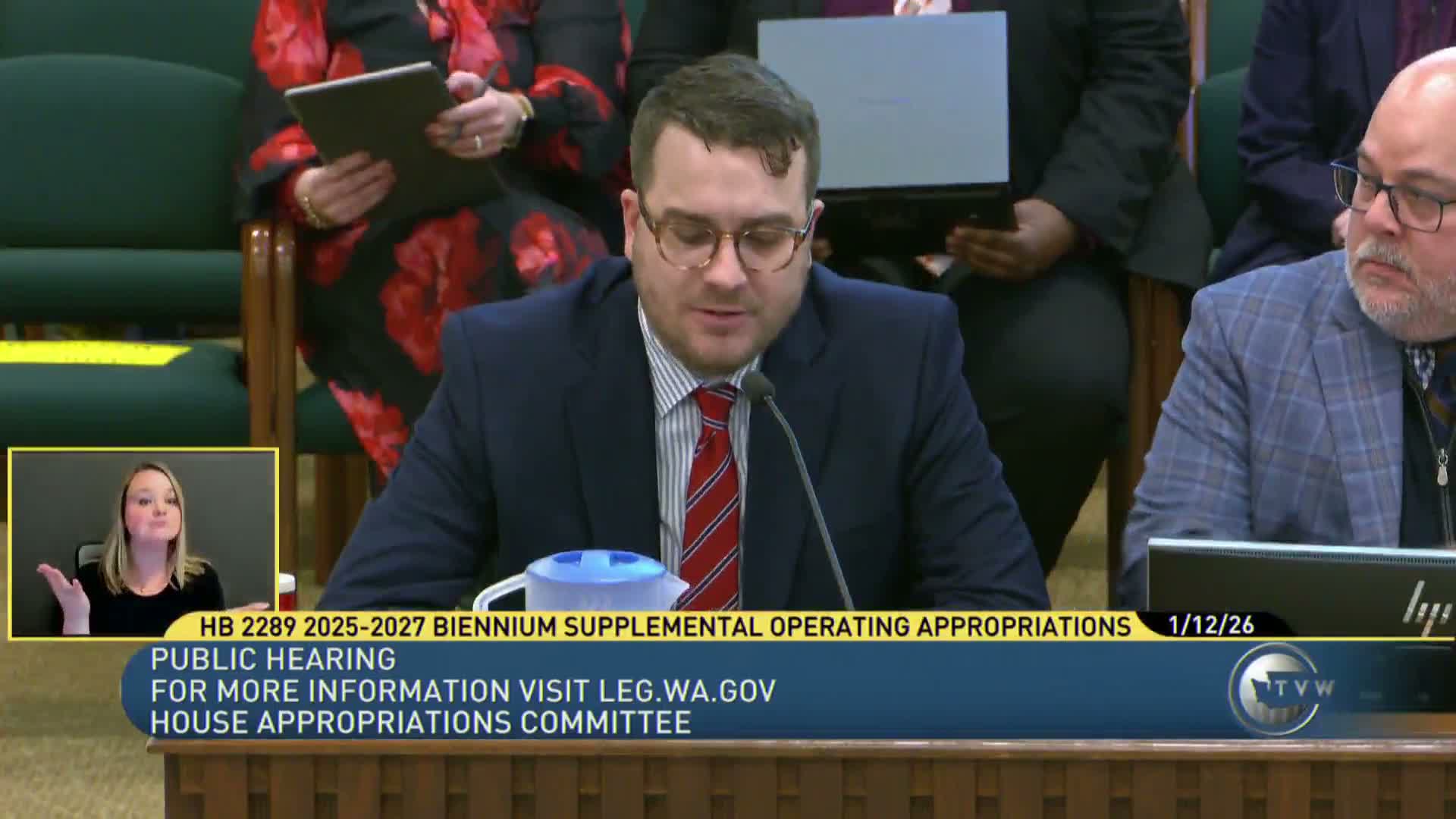
Multiple education and early‑learning advocates told the House Appropriations Committee the governor's supplemental proposal would reduce access to critical programs for children and families.
Tyler Munch, representing the Office of Superintendent of Public Instruction, said the proposal would make "significant cuts to widely used education programs," naming a $14 million cut to Running Start and a 25% reduction to Transition to Kindergarten (TTK) slots. Larry Delaney, president of the Washington Education Association, said educators are "concerned about eroding student supports" and urged reconsideration of reductions to TTK and local effort assistance (LEA).
Early‑learning advocates warned the proposal’s cap on Working Connections Childcare at 33,000 families and reducing subsidy rates from the 80th to the 70th percentile would mean lost access for families and financial strain on providers. Erica Hallock, representing STAR Early Washington and the School Nurse Organization of Washington, said the combined effect of the proposed cap and TTK cuts would cause "nearly 9,000 Washington families [to] lose access to care" and would "disproportionately impact rural communities." Labor and provider representatives said current subsidy rates already operate on thin margins and a permanent rebasing would force providers to reduce services.
Higher‑education speakers including the chancellor of Spokane Colleges and representatives from UW and WSU warned campus budgets would face reductions that could lead to program eliminations, staffing cuts and reduced student services. Testifiers asked the committee to restore key programmatic funding and to consider progressive revenue to address the shortfall rather than steep cuts to education.
The committee did not take immediate action; public testimony was suspended for continuation the following day for those unable to speak.
Tyler Munch, representing the Office of Superintendent of Public Instruction, said the proposal would make "significant cuts to widely used education programs," naming a $14 million cut to Running Start and a 25% reduction to Transition to Kindergarten (TTK) slots. Larry Delaney, president of the Washington Education Association, said educators are "concerned about eroding student supports" and urged reconsideration of reductions to TTK and local effort assistance (LEA).
Early‑learning advocates warned the proposal’s cap on Working Connections Childcare at 33,000 families and reducing subsidy rates from the 80th to the 70th percentile would mean lost access for families and financial strain on providers. Erica Hallock, representing STAR Early Washington and the School Nurse Organization of Washington, said the combined effect of the proposed cap and TTK cuts would cause "nearly 9,000 Washington families [to] lose access to care" and would "disproportionately impact rural communities." Labor and provider representatives said current subsidy rates already operate on thin margins and a permanent rebasing would force providers to reduce services.
Higher‑education speakers including the chancellor of Spokane Colleges and representatives from UW and WSU warned campus budgets would face reductions that could lead to program eliminations, staffing cuts and reduced student services. Testifiers asked the committee to restore key programmatic funding and to consider progressive revenue to address the shortfall rather than steep cuts to education.
The committee did not take immediate action; public testimony was suspended for continuation the following day for those unable to speak.
Don't Miss a Word: See the Full Meeting!
Go beyond summaries. Unlock every video, transcript, and key insight with a Founder Membership.
✓
Get instant access to full meeting videos
✓
Search and clip any phrase from complete transcripts
✓
Receive AI-powered summaries & custom alerts
✓
Enjoy lifetime, unrestricted access to government data
30-day money-back guarantee
