Pierce, Redmond and Snohomish describe heavy lifts, costs and staffing needs in comprehensive plan updates
January 12, 2026 | Legislative Sessions, Washington
This article was created by AI summarizing key points discussed. AI makes mistakes, so for full details and context, please refer to the video of the full meeting. Please report any errors so we can fix them. Report an error »
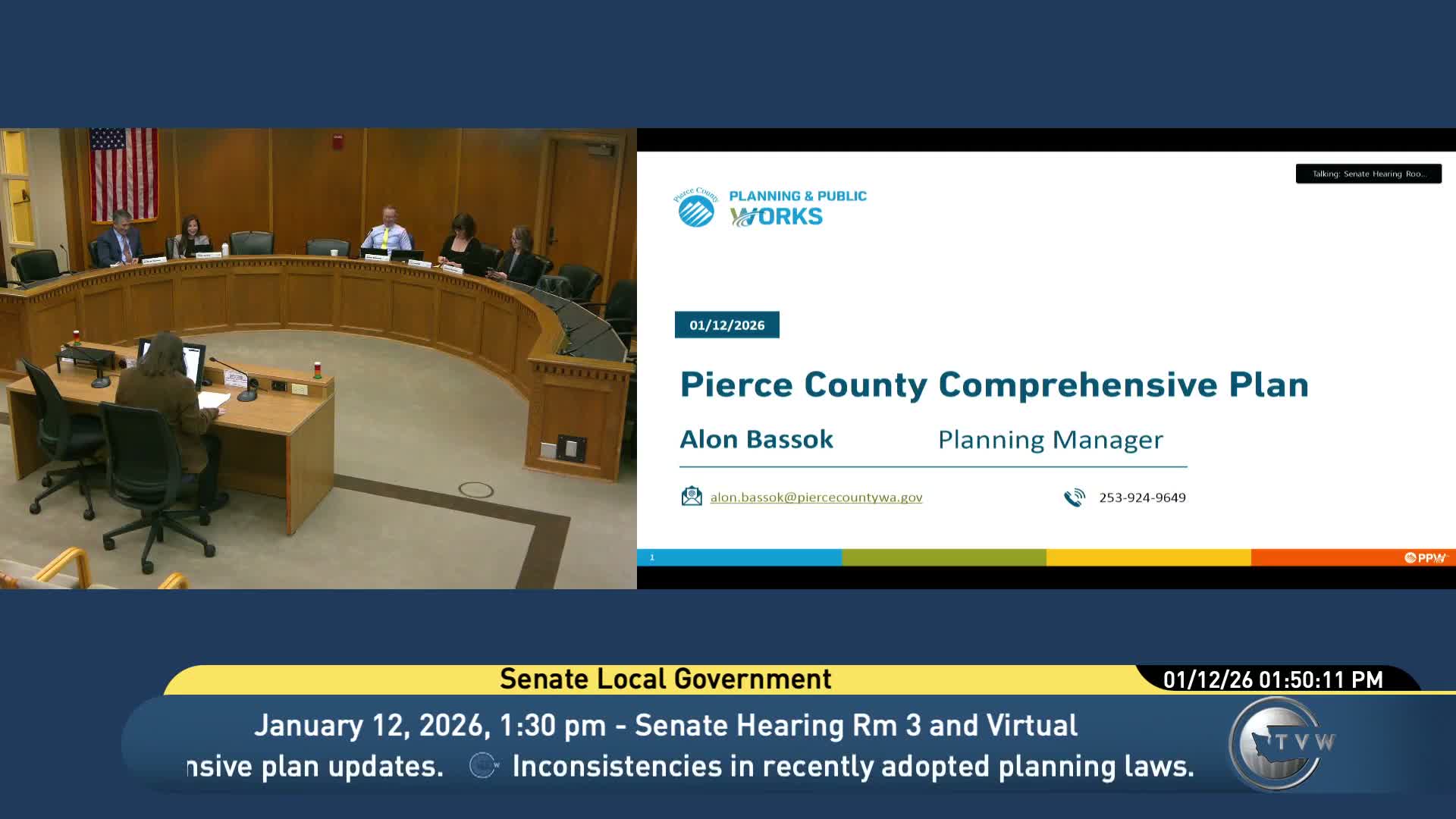
Representatives of Pierce County, the City of Redmond and Snohomish County briefed the Senate Local Government Committee on early implementation and lessons from recent comprehensive plan updates.
Alon Bassock, long‑range planning manager for Pierce County, said the county’s multiyear update included a 1,200‑page implementing code package and an environmental impact statement, and required substantial public engagement. He said Pierce adopted housing targets in 2023 with a special emphasis on homelessness and special‑needs housing, retracted roughly 700 acres of potential urban growth area (UGA) annexation land to prioritize rural protection, and increased zoning capacity within a half‑mile of high‑capacity transit. Bassock said the county created additional capacity for about 250,000 housing units while its 20‑year growth target for unincorporated areas is 32,000 units; he noted developers’ experience is concentrated in single‑family construction and called for more technical assistance from state agencies. He also cited transit funding constraints at Pierce Transit as a barrier to shifting growth patterns.
Carol Helland, planning and community development director for the City of Redmond, described a roughly four‑year engagement process tied to recent light‑rail openings and said Redmond accepted increased growth allocations (roughly 25,000 homes and nearly 30,000 jobs by 2050). Helland urged greater regulatory stability and clearer, coordinated statutory drafting, saying midcycle legislative changes forced costly rework: a supplemental EIS cost about $130,000 and an accelerated climate vulnerability assessment cost about $125,000. She said Redmond meets its annual growth expectations on average (about 1,500 housing units per year currently) and uses lot‑by‑lot land capacity analysis and middle‑housing allowances (6 units by right, 8 with an affordable unit) to translate targets into zoning capacity.
Darren Growth (division manager, long range planning, Snohomish County) said Snohomish adopted its plan in December 2024 and is now translating policy into implementation. He said the county’s early implementation lessons are (1) clarity in policy language matters (for example, the difference between 'shall' and 'should'), (2) implementation capacity is a limiting factor given compressed statutory timelines and overlapping new state requirements, and (3) cross‑departmental and intergovernmental coordination (including interlocal master agreements for UGA matters) is essential to avoid conflicts and ensure predictable delivery of goals such as housing capacity and transit‑oriented development.
All three local officials asked for more timely state guidance and additional technical resources to execute complex code changes and to reduce duplicative procedural requirements, while committee members pressed on questions of sequencing, staffing, and whether counties defer to city standards within UGAs. Presenters described a mix of interjurisdictional negotiation (regional councils and growth management coordinating committees), master interlocal agreements for infrastructure and annexation responsibilities, and phased implementation plans to manage the workload and sequencing of regulatory changes.
The panel’s presentations highlighted the costs and administrative burdens of complying with recent state laws and pointed to specific areas — regulatory stability, technical assistance, staffing and coordinated statutory drafting — where state support could reduce local costs and legal risk.
Alon Bassock, long‑range planning manager for Pierce County, said the county’s multiyear update included a 1,200‑page implementing code package and an environmental impact statement, and required substantial public engagement. He said Pierce adopted housing targets in 2023 with a special emphasis on homelessness and special‑needs housing, retracted roughly 700 acres of potential urban growth area (UGA) annexation land to prioritize rural protection, and increased zoning capacity within a half‑mile of high‑capacity transit. Bassock said the county created additional capacity for about 250,000 housing units while its 20‑year growth target for unincorporated areas is 32,000 units; he noted developers’ experience is concentrated in single‑family construction and called for more technical assistance from state agencies. He also cited transit funding constraints at Pierce Transit as a barrier to shifting growth patterns.
Carol Helland, planning and community development director for the City of Redmond, described a roughly four‑year engagement process tied to recent light‑rail openings and said Redmond accepted increased growth allocations (roughly 25,000 homes and nearly 30,000 jobs by 2050). Helland urged greater regulatory stability and clearer, coordinated statutory drafting, saying midcycle legislative changes forced costly rework: a supplemental EIS cost about $130,000 and an accelerated climate vulnerability assessment cost about $125,000. She said Redmond meets its annual growth expectations on average (about 1,500 housing units per year currently) and uses lot‑by‑lot land capacity analysis and middle‑housing allowances (6 units by right, 8 with an affordable unit) to translate targets into zoning capacity.
Darren Growth (division manager, long range planning, Snohomish County) said Snohomish adopted its plan in December 2024 and is now translating policy into implementation. He said the county’s early implementation lessons are (1) clarity in policy language matters (for example, the difference between 'shall' and 'should'), (2) implementation capacity is a limiting factor given compressed statutory timelines and overlapping new state requirements, and (3) cross‑departmental and intergovernmental coordination (including interlocal master agreements for UGA matters) is essential to avoid conflicts and ensure predictable delivery of goals such as housing capacity and transit‑oriented development.
All three local officials asked for more timely state guidance and additional technical resources to execute complex code changes and to reduce duplicative procedural requirements, while committee members pressed on questions of sequencing, staffing, and whether counties defer to city standards within UGAs. Presenters described a mix of interjurisdictional negotiation (regional councils and growth management coordinating committees), master interlocal agreements for infrastructure and annexation responsibilities, and phased implementation plans to manage the workload and sequencing of regulatory changes.
The panel’s presentations highlighted the costs and administrative burdens of complying with recent state laws and pointed to specific areas — regulatory stability, technical assistance, staffing and coordinated statutory drafting — where state support could reduce local costs and legal risk.
View the Full Meeting & All Its Details
This article offers just a summary. Unlock complete video, transcripts, and insights as a Founder Member.
✓
Watch full, unedited meeting videos
✓
Search every word spoken in unlimited transcripts
✓
AI summaries & real-time alerts (all government levels)
✓
Permanent access to expanding government content
30-day money-back guarantee
