WSDOT outlines storm damage, emergency repairs and funding path after atmospheric‑river events
January 12, 2026 | Legislative Sessions, Washington
This article was created by AI summarizing key points discussed. AI makes mistakes, so for full details and context, please refer to the video of the full meeting. Please report any errors so we can fix them. Report an error »
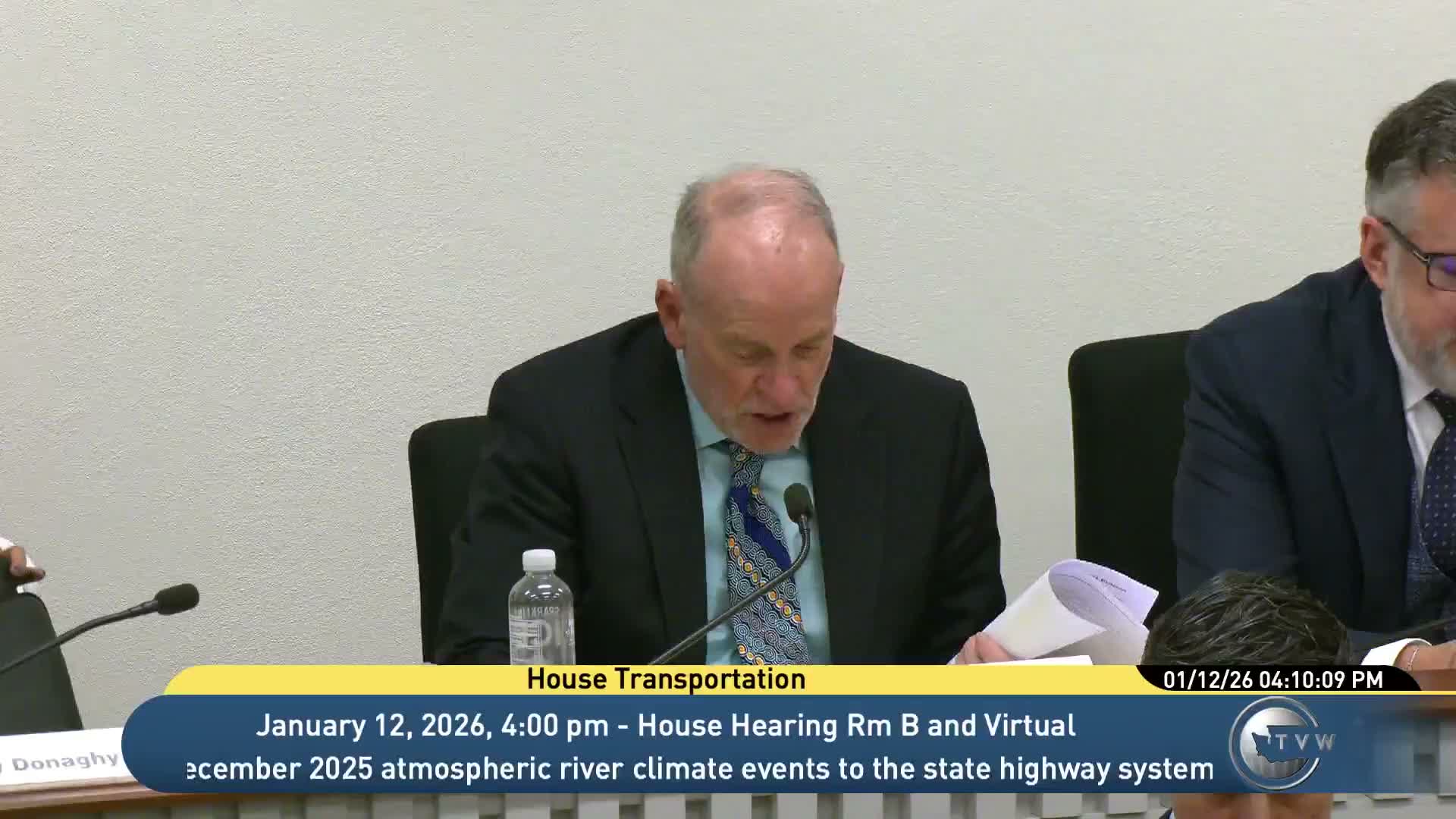
John Himel, emergency and security program manager for the Washington State Department of Transportation, told the House Transportation Committee that WSDOT activated regional and statewide emergency teams in response to December atmospheric‑river storms and used WebEOC to track infrastructure status.
"We activated on December 9 and we deactivated on the nineteenth," Himel said, noting the State Emergency Operations Center was active Dec. 8 through Jan. 2. He said WSDOT’s initial statewide damage survey identified roughly 73 potentially FHWA‑eligible sites and produced an initial damage estimate of about $30,000,000.
Himel described the federal emergency‑relief process: WSDOT surveys sites to determine whether statewide damage to Fed‑Aid eligible roads exceeds the FHWA threshold (>$700,000 total and $5,000 minimum per site), requests a governor’s proclamation or presidential declaration, sends a letter of intent to FHWA, and submits detailed damage inspection reports (DDIRs) and Federal Aid Project Applications for permanent repairs. He emphasized permanent work requires environmental clearances, including compliance with the National Environmental Policy Act.
Steve Roark, WSDOT Olympic region administrator, reviewed field operations and contracting. He said maintenance crews are first responders for initial assessments; geotechnical, hydraulics and structural experts then determine safety and repair approaches. "An emergency declaration…increases [state force] from $60,000 to $100,000," Roark said, and allows expedited, time‑and‑materials force‑account contracts to be issued quickly. He reported more than 50 emergency work orders and 16 emergency contracts let so far, with that number expected to increase.
Roark walked committee members through major corridor impacts and timelines. He said crews mobilized at several US‑2 sites (one contractor mobilized Dec. 19 and a section opened Jan. 1), that a three‑mile eastbound shoulder segment on US‑2 has restricted lanes and will require permanent repairs once snow clears (likely by summer), and that Tumwater Canyon work was let Dec. 22 with hopeful reopening in March depending on weather. At some sites — such as a slide‑prone area on US‑101 south of Forks — extensive geotechnical design and a traditional project schedule will be needed, with work not starting until summer.
Committee members pressed WSDOT on environmental permitting and interagency coordination. Representative Andrew Barkas asked whether emergency proclamations give latitude for in‑stream work; Roark and Himel said emergency processes allow stabilization work to proceed in the near term but that WSDOT remains obligated to obtain required environmental approvals (for example, a hydraulic project approval from the Department of Fish and Wildlife) and often completes some permitting post‑work.
Himel explained how federal funding may apply: FHWA typically covers the majority of permanent repair costs (a pro rata federal share that has been described to committee staff as roughly 86.5–90%), leaving a state match (about 10–13.5%). FEMA public assistance can assume responsibility for highway debris removal (75% federal / 25% state), but Himel cautioned that FEMA reimbursements can take years to process.
Himel and Roark stressed that cost estimates remain preliminary. "The repair estimate…is just that. It is an estimate," Roark said, adding that WSDOT is still compiling costs and that final federal eligibility and funding shares are not yet determined.
The presentation closed with officials saying they will complete after‑action reports and refine communications with partners such as the U.S. Army Corps of Engineers and local flood districts to improve coordination in future events. The committee did not take any formal votes on the presentation.
"We activated on December 9 and we deactivated on the nineteenth," Himel said, noting the State Emergency Operations Center was active Dec. 8 through Jan. 2. He said WSDOT’s initial statewide damage survey identified roughly 73 potentially FHWA‑eligible sites and produced an initial damage estimate of about $30,000,000.
Himel described the federal emergency‑relief process: WSDOT surveys sites to determine whether statewide damage to Fed‑Aid eligible roads exceeds the FHWA threshold (>$700,000 total and $5,000 minimum per site), requests a governor’s proclamation or presidential declaration, sends a letter of intent to FHWA, and submits detailed damage inspection reports (DDIRs) and Federal Aid Project Applications for permanent repairs. He emphasized permanent work requires environmental clearances, including compliance with the National Environmental Policy Act.
Steve Roark, WSDOT Olympic region administrator, reviewed field operations and contracting. He said maintenance crews are first responders for initial assessments; geotechnical, hydraulics and structural experts then determine safety and repair approaches. "An emergency declaration…increases [state force] from $60,000 to $100,000," Roark said, and allows expedited, time‑and‑materials force‑account contracts to be issued quickly. He reported more than 50 emergency work orders and 16 emergency contracts let so far, with that number expected to increase.
Roark walked committee members through major corridor impacts and timelines. He said crews mobilized at several US‑2 sites (one contractor mobilized Dec. 19 and a section opened Jan. 1), that a three‑mile eastbound shoulder segment on US‑2 has restricted lanes and will require permanent repairs once snow clears (likely by summer), and that Tumwater Canyon work was let Dec. 22 with hopeful reopening in March depending on weather. At some sites — such as a slide‑prone area on US‑101 south of Forks — extensive geotechnical design and a traditional project schedule will be needed, with work not starting until summer.
Committee members pressed WSDOT on environmental permitting and interagency coordination. Representative Andrew Barkas asked whether emergency proclamations give latitude for in‑stream work; Roark and Himel said emergency processes allow stabilization work to proceed in the near term but that WSDOT remains obligated to obtain required environmental approvals (for example, a hydraulic project approval from the Department of Fish and Wildlife) and often completes some permitting post‑work.
Himel explained how federal funding may apply: FHWA typically covers the majority of permanent repair costs (a pro rata federal share that has been described to committee staff as roughly 86.5–90%), leaving a state match (about 10–13.5%). FEMA public assistance can assume responsibility for highway debris removal (75% federal / 25% state), but Himel cautioned that FEMA reimbursements can take years to process.
Himel and Roark stressed that cost estimates remain preliminary. "The repair estimate…is just that. It is an estimate," Roark said, adding that WSDOT is still compiling costs and that final federal eligibility and funding shares are not yet determined.
The presentation closed with officials saying they will complete after‑action reports and refine communications with partners such as the U.S. Army Corps of Engineers and local flood districts to improve coordination in future events. The committee did not take any formal votes on the presentation.
View the Full Meeting & All Its Details
This article offers just a summary. Unlock complete video, transcripts, and insights as a Founder Member.
✓
Watch full, unedited meeting videos
✓
Search every word spoken in unlimited transcripts
✓
AI summaries & real-time alerts (all government levels)
✓
Permanent access to expanding government content
30-day money-back guarantee
