Committee approves SB71 as amended, setting limits on state environmental rules
January 20, 2026 | Senate, Alabama Legislative Sessions, Alabama
This article was created by AI summarizing key points discussed. AI makes mistakes, so for full details and context, please refer to the video of the full meeting. Please report any errors so we can fix them. Report an error »
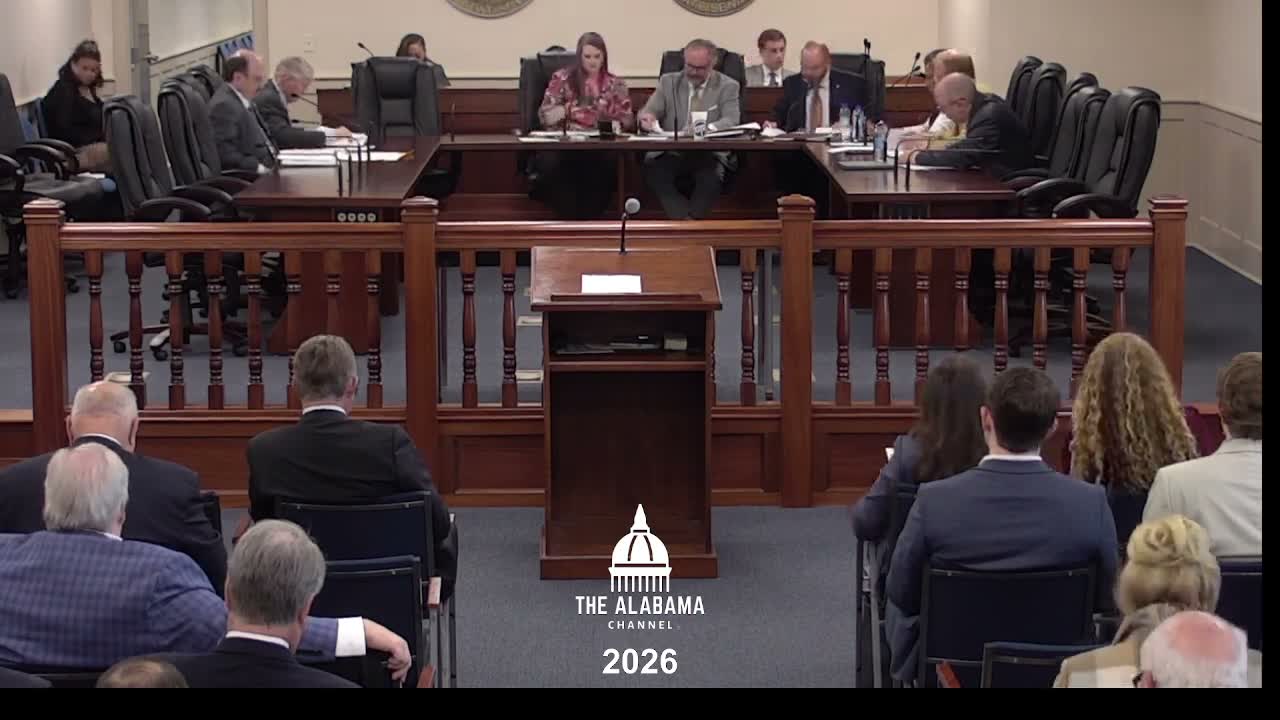
Senate Bill 71, introduced by Sen. Chastain, would prevent state agencies from adopting environmental protection standards that are more stringent than federal law and requires, where federal standards do not exist, that any new state rule be based on the best available science and the weight of the scientific evidence. The committee adopted an implementation amendment and voted to report the bill favorably.
Supporters told the committee the bill brings regulatory consistency and relies on scientific evidence. John Bargainier of Manufacture Alabama said the measure would "create more consistency and reliability" for industry and argued "a striking balance between... best available science and regulatory matters is the best way to balance environmental stewardship and economic development." Mark Bridal of the U.S. Chamber described the bill as a common-sense approach that mirrors federal "gold standard science" principles.
Opponents said the bill would limit agencies’ ability to protect public health. Sarah Stokes, senior attorney at the Southern Environmental Law Center, told the committee SB71 "would keep these standards at harmful levels and keeps agencies from creating new standards unless those standards are shown to directly causally link to manifest bodily harm in humans," and warned that the bill would exclude risk-based epidemiological evidence typically used to set protective limits for toxins such as arsenic and cyanide.
Luke Kisla, government affairs director for Mobile Baykeeper, framed his opposition in federalism terms: he asked the committee not to "voluntarily surrender our powers to defend our citizens' rights," urging the state to retain the authority to protect residents when federal standards are absent or insufficient.
The committee adopted an amendment clarifying rule implementation and reinforcing state flexibility as long as actions are based on sound science. After the public hearing and additional comments from members, the committee voted to report SB71 favorably; the roll call recorded a 5–2 tally in favor of the amended bill.
The committee’s favorable report sends SB71, as amended, to the full Senate for further consideration.
Supporters told the committee the bill brings regulatory consistency and relies on scientific evidence. John Bargainier of Manufacture Alabama said the measure would "create more consistency and reliability" for industry and argued "a striking balance between... best available science and regulatory matters is the best way to balance environmental stewardship and economic development." Mark Bridal of the U.S. Chamber described the bill as a common-sense approach that mirrors federal "gold standard science" principles.
Opponents said the bill would limit agencies’ ability to protect public health. Sarah Stokes, senior attorney at the Southern Environmental Law Center, told the committee SB71 "would keep these standards at harmful levels and keeps agencies from creating new standards unless those standards are shown to directly causally link to manifest bodily harm in humans," and warned that the bill would exclude risk-based epidemiological evidence typically used to set protective limits for toxins such as arsenic and cyanide.
Luke Kisla, government affairs director for Mobile Baykeeper, framed his opposition in federalism terms: he asked the committee not to "voluntarily surrender our powers to defend our citizens' rights," urging the state to retain the authority to protect residents when federal standards are absent or insufficient.
The committee adopted an amendment clarifying rule implementation and reinforcing state flexibility as long as actions are based on sound science. After the public hearing and additional comments from members, the committee voted to report SB71 favorably; the roll call recorded a 5–2 tally in favor of the amended bill.
The committee’s favorable report sends SB71, as amended, to the full Senate for further consideration.
View the Full Meeting & All Its Details
This article offers just a summary. Unlock complete video, transcripts, and insights as a Founder Member.
✓
Watch full, unedited meeting videos
✓
Search every word spoken in unlimited transcripts
✓
AI summaries & real-time alerts (all government levels)
✓
Permanent access to expanding government content
30-day money-back guarantee
