Committee debates inventory of closed/open landfills as a way to expand disposal options
January 20, 2026 | Environment and Agriculture, House of Representatives, Committees , Legislative, New Hampshire
This article was created by AI summarizing key points discussed. AI makes mistakes, so for full details and context, please refer to the video of the full meeting. Please report any errors so we can fix them. Report an error »
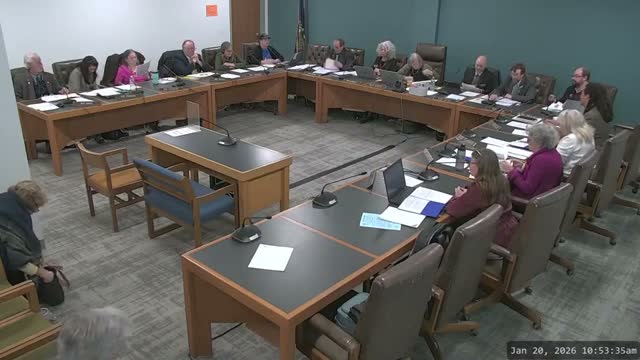
Legislators debated a bill aimed at developing an inventory of potential disposal or redevelopable sites to determine whether other locations could be appropriate for solid-waste disposal or landfill siting.
Representative Haskins said the bill was intended as a simple inventory and screening exercise to test assertions that a single site (Dalton) was the only feasible option for a new landfill. “It's not a brownfield bill, but other open and closed landfill areas so that we could determine whether or not the statement… there was no place else but Dalton to put a new landfill,” Haskins said.
Committee members, DES staff and others pressed for a narrower, lower-cost approach focused on publicly available records and screening criteria (e.g., distance to schools or airports, presence of municipal water) rather than expensive core sampling and hydrogeologic analyses. The department's fiscal note—based on in-depth site studies—was described as large (tens of millions), and members discussed drafting amendments that would limit the work to a paper survey and adjust the fiscal note accordingly.
The committee agreed to send the bill to a solid-waste subcommittee for amendment work to develop screening criteria and a more cost-conscious approach.
Representative Haskins said the bill was intended as a simple inventory and screening exercise to test assertions that a single site (Dalton) was the only feasible option for a new landfill. “It's not a brownfield bill, but other open and closed landfill areas so that we could determine whether or not the statement… there was no place else but Dalton to put a new landfill,” Haskins said.
Committee members, DES staff and others pressed for a narrower, lower-cost approach focused on publicly available records and screening criteria (e.g., distance to schools or airports, presence of municipal water) rather than expensive core sampling and hydrogeologic analyses. The department's fiscal note—based on in-depth site studies—was described as large (tens of millions), and members discussed drafting amendments that would limit the work to a paper survey and adjust the fiscal note accordingly.
The committee agreed to send the bill to a solid-waste subcommittee for amendment work to develop screening criteria and a more cost-conscious approach.
Don't Miss a Word: See the Full Meeting!
Go beyond summaries. Unlock every video, transcript, and key insight with a Founder Membership.
✓
Get instant access to full meeting videos
✓
Search and clip any phrase from complete transcripts
✓
Receive AI-powered summaries & custom alerts
✓
Enjoy lifetime, unrestricted access to government data
30-day money-back guarantee
