Committee hears fiscal and practical hurdles to state offering enhanced driver’s licenses
January 20, 2026 | Transportation, House of Representatives, Committees , Legislative, New Hampshire
This article was created by AI summarizing key points discussed. AI makes mistakes, so for full details and context, please refer to the video of the full meeting. Please report any errors so we can fix them. Report an error »
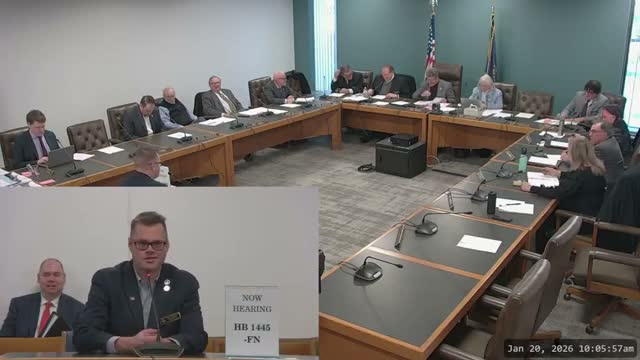
Representative Eric Johnson introduced House Bill 1445 on the committee floor, saying the measure would compel the Division of Motor Vehicles to offer an enhanced driver’s license (EDL) that embeds a chip to facilitate land and seaport crossings and indicates U.S. citizenship. “Enhanced driver’s licenses are Real ID compliant,” Johnson said in opening remarks, adding that five other states — Vermont, Michigan, New York, Minnesota and Washington — currently offer the credential.
John Marasco, director of the DMV, told the committee the program is already authorized by statute but has not been implemented because of cost and past technical issues. “The vendor did explain … it’s costly to produce this type of license,” Marasco said, describing laser engraving and an enhanced polycarbonate card as likely requirements. Assistant director Jen Bailey presented the fiscal note, saying the vendor quoted $163,000 for a new card design and roughly $400,000 for back‑end system work; testing and certification of the RFID chip for Border Patrol recognition had not been quoted.
Committee members pressed the DMV on demand and whether the EDL would supplant passports for international travel. Marasco and Bailey said EDLs are useful for land and sea crossings with less interaction at checkpoints but not for air travel. Bailey said the fiscal note assumed a modest uptake (1–2 percent of current license holders) and a $20 premium over a Real ID, producing an estimated $156,000 in annual revenue against roughly $560,000 in start‑up costs in the fiscal note. Marasco noted New Hampshire’s small border population makes demand uncertain compared with states that border Canada.
The DMV said vendor advice suggested off‑site production and laser engraving to make production cost‑effective, which would alter the card’s appearance versus current licenses. Committee members asked about consumer fees, registration procedures and whether federal or border authorities would need notification; the DMV said those technical and federal‑interoperability questions could be addressed but require additional work.
The hearing closed with no public testimony signed up. The committee later held executive session on multiple bills and formed a titles subcommittee to examine titling and related fiscal issues. Next procedural steps were not decided at the hearing.
John Marasco, director of the DMV, told the committee the program is already authorized by statute but has not been implemented because of cost and past technical issues. “The vendor did explain … it’s costly to produce this type of license,” Marasco said, describing laser engraving and an enhanced polycarbonate card as likely requirements. Assistant director Jen Bailey presented the fiscal note, saying the vendor quoted $163,000 for a new card design and roughly $400,000 for back‑end system work; testing and certification of the RFID chip for Border Patrol recognition had not been quoted.
Committee members pressed the DMV on demand and whether the EDL would supplant passports for international travel. Marasco and Bailey said EDLs are useful for land and sea crossings with less interaction at checkpoints but not for air travel. Bailey said the fiscal note assumed a modest uptake (1–2 percent of current license holders) and a $20 premium over a Real ID, producing an estimated $156,000 in annual revenue against roughly $560,000 in start‑up costs in the fiscal note. Marasco noted New Hampshire’s small border population makes demand uncertain compared with states that border Canada.
The DMV said vendor advice suggested off‑site production and laser engraving to make production cost‑effective, which would alter the card’s appearance versus current licenses. Committee members asked about consumer fees, registration procedures and whether federal or border authorities would need notification; the DMV said those technical and federal‑interoperability questions could be addressed but require additional work.
The hearing closed with no public testimony signed up. The committee later held executive session on multiple bills and formed a titles subcommittee to examine titling and related fiscal issues. Next procedural steps were not decided at the hearing.
Don't Miss a Word: See the Full Meeting!
Go beyond summaries. Unlock every video, transcript, and key insight with a Founder Membership.
✓
Get instant access to full meeting videos
✓
Search and clip any phrase from complete transcripts
✓
Receive AI-powered summaries & custom alerts
✓
Enjoy lifetime, unrestricted access to government data
30-day money-back guarantee
