Public Service says thermal-energy networks promising but not yet ready for NPA inclusion
January 21, 2026 | Public Utilities Commission, Governor's Boards and Commissions, Organizations, Executive, Colorado
This article was created by AI summarizing key points discussed. AI makes mistakes, so for full details and context, please refer to the video of the full meeting. Please report any errors so we can fix them. Report an error »
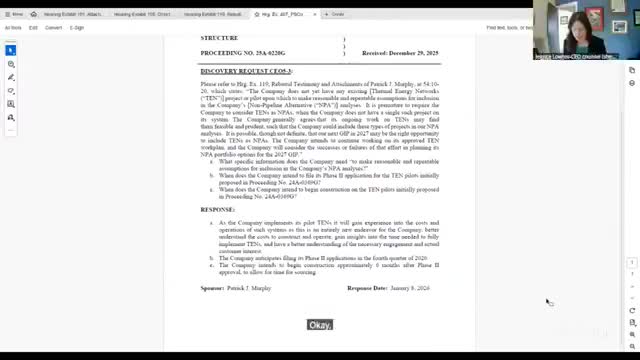
Public Service Company of Colorado told the Public Utilities Commission on Jan. 20 that it supports development of thermal-energy technologies but is not prepared to include thermal-energy networks as eligible non-pipeline alternatives in its next gas infrastructure plan without further data from ongoing pilots.
At a hearing, Patrick Murphy, a manager in regulatory policy for Public Service, acknowledged the conservation and local-government advocates' recommendation that the commission clarify whether thermal-energy networks should be eligible NPA measures. Murphy said the company is early in its thermal-energy network pilots and needs more information about construction and operating costs, realistic implementation timelines and documented customer interest before it can make the "reasonable and repeatable assumptions" required for NPA cost-benefit analysis.
Murphy pointed the commission to a company discovery response admitted into the record (hearing exhibit 407) that lists the kinds of information the utility says it needs: estimated capital and operating costs for thermal networks, expected time to implement, and measures of customer engagement and likely participation. He said the company plans to file a Phase 2 application for a first thermal-energy-network pilot in 2026 and estimated that, if litigated and approved on a typical schedule, construction could begin roughly in 2028.
Advocates pressed whether the company would accept including thermal services (individual customer ground-source heat pumps supplied as a service) versus shared thermal networks. Murphy said the two are distinct: thermal service would keep customers on the gas rate base through a utility-delivered service, while a thermal network would be a shared system that could change rate treatment. He said the company is "fully supportive" of the technology but cannot commit to NPA inclusion for networks until the pilots yield design, cost and customer-participation evidence.
The exchange ended with advocates and commissioners urging the company to provide clearer timelines and to work with stakeholders. The company agreed to engage with the commission and other parties as pilot results become available.
The PUC hearing will continue with further witnesses and cross-examination; company filings in the record identify planned Phase 2 work on thermal pilots in 2026.
At a hearing, Patrick Murphy, a manager in regulatory policy for Public Service, acknowledged the conservation and local-government advocates' recommendation that the commission clarify whether thermal-energy networks should be eligible NPA measures. Murphy said the company is early in its thermal-energy network pilots and needs more information about construction and operating costs, realistic implementation timelines and documented customer interest before it can make the "reasonable and repeatable assumptions" required for NPA cost-benefit analysis.
Murphy pointed the commission to a company discovery response admitted into the record (hearing exhibit 407) that lists the kinds of information the utility says it needs: estimated capital and operating costs for thermal networks, expected time to implement, and measures of customer engagement and likely participation. He said the company plans to file a Phase 2 application for a first thermal-energy-network pilot in 2026 and estimated that, if litigated and approved on a typical schedule, construction could begin roughly in 2028.
Advocates pressed whether the company would accept including thermal services (individual customer ground-source heat pumps supplied as a service) versus shared thermal networks. Murphy said the two are distinct: thermal service would keep customers on the gas rate base through a utility-delivered service, while a thermal network would be a shared system that could change rate treatment. He said the company is "fully supportive" of the technology but cannot commit to NPA inclusion for networks until the pilots yield design, cost and customer-participation evidence.
The exchange ended with advocates and commissioners urging the company to provide clearer timelines and to work with stakeholders. The company agreed to engage with the commission and other parties as pilot results become available.
The PUC hearing will continue with further witnesses and cross-examination; company filings in the record identify planned Phase 2 work on thermal pilots in 2026.
Don't Miss a Word: See the Full Meeting!
Go beyond summaries. Unlock every video, transcript, and key insight with a Founder Membership.
✓
Get instant access to full meeting videos
✓
Search and clip any phrase from complete transcripts
✓
Receive AI-powered summaries & custom alerts
✓
Enjoy lifetime, unrestricted access to government data
30-day money-back guarantee
