Keller proposes region’s first physician-staffed medical control vehicle to reduce unnecessary transports
January 21, 2026 | Keller, Tarrant County, Texas
This article was created by AI summarizing key points discussed. AI makes mistakes, so for full details and context, please refer to the video of the full meeting. Please report any errors so we can fix them. Report an error »
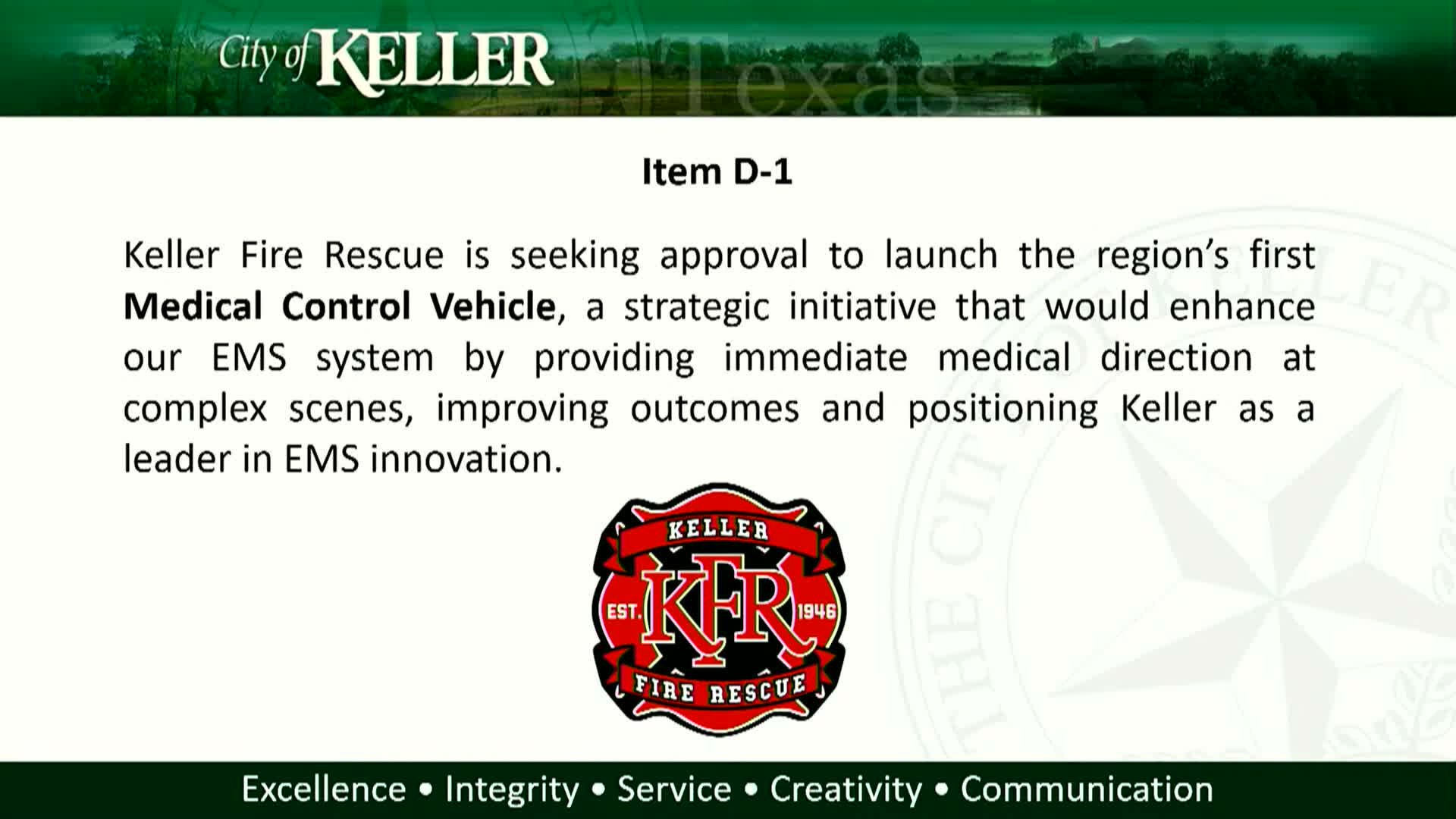
Keller’s EMS captain, Ken Levins, told the City Council on Jan. 20 that the department is seeking approval to launch what he called the region’s first medical control vehicle, a mobile platform staffed by a physician that would respond to complex, high‑acuity scenes and high‑demand locations.
"We're seeking approval to launch the region's first medical control vehicle," Levins said. He described the vehicle as carrying specialized equipment (a jump kit and monitor are already in place) and said it would be staffed by physicians contracted through Best EMS, naming Dr. Northheim and others as likely staffing options.
Levins said 2025 was a record year for calls in Keller: "over 5,000 calls," including "3,037 EMS calls," and identified several high‑demand "hot zones" such as Country Brook and area nursing homes. He said the vehicle would allow clinicians to make on‑scene decisions that could avoid unnecessary ambulance transports and the associated emergency room bills.
"There's no cost," Levins told councilmembers when asked about billing for on‑scene physician visits, adding that patients would avoid transport costs when the physician determined transport was not needed.
The proposal relies on the city’s existing contract with Best EMS; Levins said the contract already provides physician staffing capacity "7 days a month" and that Best EMS has offered to pay for the vehicle’s exterior wrap. He and councilmembers discussed a regional funding model in which nearby cities could contribute (Levins said several cities had offered about $2,000 each) and possibly increase total coverage days.
Supporters told the council the vehicle could keep fire trucks in service and reduce mutual‑aid calls, although staff acknowledged data on measurable systemwide benefits will only be evident after the program has operated for a period.
Levins also outlined future capability goals, including adding whole‑blood capability and ultrasound to the vehicle. He cited Parker County’s experience as a nearby example of a successful program and said the Keller version would begin with the equipment and partial staffing already available under the current contract.
The council asked follow‑up questions about measurement, liability and coordination with regional hospitals; Levins said physicians would be licensed and that Best EMS carries malpractice coverage. He encouraged further discussion with regional partners as the pilot plan develops.
Next steps: staff will continue to refine operational details and return to council with any required approvals or interlocal funding arrangements.
"We're seeking approval to launch the region's first medical control vehicle," Levins said. He described the vehicle as carrying specialized equipment (a jump kit and monitor are already in place) and said it would be staffed by physicians contracted through Best EMS, naming Dr. Northheim and others as likely staffing options.
Levins said 2025 was a record year for calls in Keller: "over 5,000 calls," including "3,037 EMS calls," and identified several high‑demand "hot zones" such as Country Brook and area nursing homes. He said the vehicle would allow clinicians to make on‑scene decisions that could avoid unnecessary ambulance transports and the associated emergency room bills.
"There's no cost," Levins told councilmembers when asked about billing for on‑scene physician visits, adding that patients would avoid transport costs when the physician determined transport was not needed.
The proposal relies on the city’s existing contract with Best EMS; Levins said the contract already provides physician staffing capacity "7 days a month" and that Best EMS has offered to pay for the vehicle’s exterior wrap. He and councilmembers discussed a regional funding model in which nearby cities could contribute (Levins said several cities had offered about $2,000 each) and possibly increase total coverage days.
Supporters told the council the vehicle could keep fire trucks in service and reduce mutual‑aid calls, although staff acknowledged data on measurable systemwide benefits will only be evident after the program has operated for a period.
Levins also outlined future capability goals, including adding whole‑blood capability and ultrasound to the vehicle. He cited Parker County’s experience as a nearby example of a successful program and said the Keller version would begin with the equipment and partial staffing already available under the current contract.
The council asked follow‑up questions about measurement, liability and coordination with regional hospitals; Levins said physicians would be licensed and that Best EMS carries malpractice coverage. He encouraged further discussion with regional partners as the pilot plan develops.
Next steps: staff will continue to refine operational details and return to council with any required approvals or interlocal funding arrangements.
View the Full Meeting & All Its Details
This article offers just a summary. Unlock complete video, transcripts, and insights as a Founder Member.
✓
Watch full, unedited meeting videos
✓
Search every word spoken in unlimited transcripts
✓
AI summaries & real-time alerts (all government levels)
✓
Permanent access to expanding government content
30-day money-back guarantee
