Norwood officials propose $2.1M levy to add fire and police staffing, training and gear
January 21, 2026 | Town of Norwood, Norfolk County, Massachusetts
This article was created by AI summarizing key points discussed. AI makes mistakes, so for full details and context, please refer to the video of the full meeting. Please report any errors so we can fix them. Report an error »
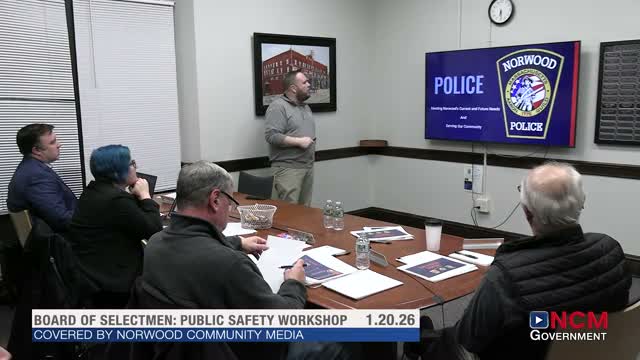
NORWOOD — Town staff and public-safety leaders presented a staffing study at a workshop recommending a phased increase in both fire and police personnel, a dedicated fire training officer and one-time equipment purchases, funded in part by a proposed operational override that staff estimated would increase the town’s levy by about $2.1 million.
The study, presented by town staff (Speaker 2), said emergency call volumes have risen over the last 10–15 years and spiked after the pandemic, stressing existing crews. For fire operations the plan calls for adding three firefighters per shift so a second engine now staffed with two people would reach four, and to create an additional float position per shift to support medical responses and cover retirements, injuries and long-term absences. “Mutual aid is not a solution to our staffing needs,” the presenter said, noting NFPA 1710 response-time and staffing benchmarks and the difficulty of getting neighboring units to meet an eight-minute full-assignment window.
The presenter proposed a 32-hour minimum annual training requirement for firefighters, coordinated by a new full-time training officer who would manage certifications and in-house instruction. The presenter said the town is designing a gear storage capital project to hold 72 turnout sets and that short-term storage in the apparatus bay is tight but feasible until the project is completed.
On the police side, staff reported 65 full-time sworn officers and roughly 39,000 calls for service last year (about 107 per day). The study recommended adding six police positions initially — including a detective/task-force officer, an additional sergeant to ensure two supervisors per shift, better midnight coverage, a traffic officer and a community service officer to support school resource officers and quality-of-life issues. “We’re the busiest community in the Devon District Court,” the presenter said, arguing that Norwood’s density and business presence increase demand.
Staff provided cost estimates: roughly $786,000 to add six police officers and total combined public-safety costs that staff said would require a levy increase of about $2.1 million. The presenter described the impact to the average homeowner as about $12 a month. Turnout gear and other one-time purchases were described as candidates for free cash (one-off funds), with recurring salary and benefits proposed for the override.
Board members and chiefs pressed on implementation details. Questions included whether Norwood should pursue a substation in the South Node development, how to phase hires, whether substitution or overtime savings could be redirected to training, vehicle and locker capacity, and how EMS mutual-aid billing and revenue flows work. Staff said ambulance revenues exceed $2.5 million a year and that mutual-aid ambulance runs are split (50% split cited) when an outside provider serves a Norwood resident.
Procedurally, staff outlined a timeline: additional review and a board decision point in February, information sessions for town meeting members and the public, a Town Meeting vote around May 11 to place one-time items on the warrant, and targeting the June 9 ballot (traditional June election timing) for the operational override question. The presenter framed a phased approach to police hires (add six now, evaluate adding up to nine overall) while noting fire staffing often requires adding entire crews rather than single positions.
No formal vote was taken at the workshop. Staff said they will return to finance and to the board with additional data requested by members, including per-capita public-safety spending comparisons and further breakdowns of substitution/overtime savings and proposed training budgets.
What happens next: the board will receive follow-up materials, hold public information sessions, and is expected to decide by a planned February meeting whether to place the public-safety package on the May Town Meeting warrant and pursue the June ballot override if approved at Town Meeting.
The study, presented by town staff (Speaker 2), said emergency call volumes have risen over the last 10–15 years and spiked after the pandemic, stressing existing crews. For fire operations the plan calls for adding three firefighters per shift so a second engine now staffed with two people would reach four, and to create an additional float position per shift to support medical responses and cover retirements, injuries and long-term absences. “Mutual aid is not a solution to our staffing needs,” the presenter said, noting NFPA 1710 response-time and staffing benchmarks and the difficulty of getting neighboring units to meet an eight-minute full-assignment window.
The presenter proposed a 32-hour minimum annual training requirement for firefighters, coordinated by a new full-time training officer who would manage certifications and in-house instruction. The presenter said the town is designing a gear storage capital project to hold 72 turnout sets and that short-term storage in the apparatus bay is tight but feasible until the project is completed.
On the police side, staff reported 65 full-time sworn officers and roughly 39,000 calls for service last year (about 107 per day). The study recommended adding six police positions initially — including a detective/task-force officer, an additional sergeant to ensure two supervisors per shift, better midnight coverage, a traffic officer and a community service officer to support school resource officers and quality-of-life issues. “We’re the busiest community in the Devon District Court,” the presenter said, arguing that Norwood’s density and business presence increase demand.
Staff provided cost estimates: roughly $786,000 to add six police officers and total combined public-safety costs that staff said would require a levy increase of about $2.1 million. The presenter described the impact to the average homeowner as about $12 a month. Turnout gear and other one-time purchases were described as candidates for free cash (one-off funds), with recurring salary and benefits proposed for the override.
Board members and chiefs pressed on implementation details. Questions included whether Norwood should pursue a substation in the South Node development, how to phase hires, whether substitution or overtime savings could be redirected to training, vehicle and locker capacity, and how EMS mutual-aid billing and revenue flows work. Staff said ambulance revenues exceed $2.5 million a year and that mutual-aid ambulance runs are split (50% split cited) when an outside provider serves a Norwood resident.
Procedurally, staff outlined a timeline: additional review and a board decision point in February, information sessions for town meeting members and the public, a Town Meeting vote around May 11 to place one-time items on the warrant, and targeting the June 9 ballot (traditional June election timing) for the operational override question. The presenter framed a phased approach to police hires (add six now, evaluate adding up to nine overall) while noting fire staffing often requires adding entire crews rather than single positions.
No formal vote was taken at the workshop. Staff said they will return to finance and to the board with additional data requested by members, including per-capita public-safety spending comparisons and further breakdowns of substitution/overtime savings and proposed training budgets.
What happens next: the board will receive follow-up materials, hold public information sessions, and is expected to decide by a planned February meeting whether to place the public-safety package on the May Town Meeting warrant and pursue the June ballot override if approved at Town Meeting.
View the Full Meeting & All Its Details
This article offers just a summary. Unlock complete video, transcripts, and insights as a Founder Member.
✓
Watch full, unedited meeting videos
✓
Search every word spoken in unlimited transcripts
✓
AI summaries & real-time alerts (all government levels)
✓
Permanent access to expanding government content
30-day money-back guarantee
