Service providers tell council fines don’t solve homelessness; urge low‑barrier sites and outreach
December 08, 2025 | Astoria City, Clatsop County, Oregon
This article was created by AI summarizing key points discussed. AI makes mistakes, so for full details and context, please refer to the video of the full meeting. Please report any errors so we can fix them. Report an error »
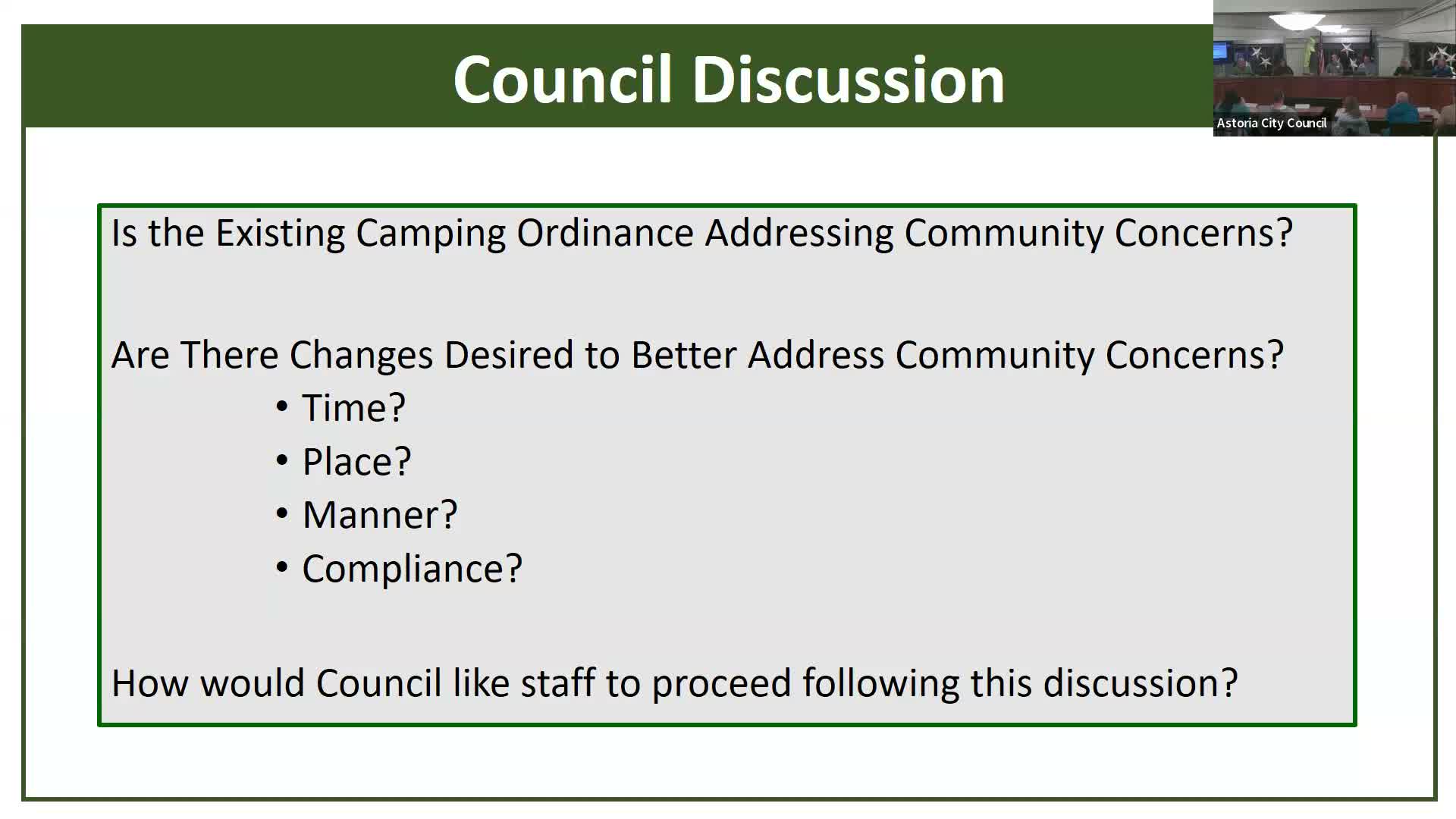
Several community organizations told the Estrella City Council on Dec. 8 that citation‑based enforcement is ineffective for people experiencing homelessness and urged investment in low‑barrier, site‑based programs and sustained outreach.
Susan Perdeman Hartel, deputy director at the harbor, said citations are often unpayable and clog the legal system: “Issuing a citation to somebody who’s experiencing homelessness makes no sense,” she said. She called for “compassion‑based enforcement” with outreach teams that connect individuals to existing resources.
Shaira Marillah Simmons, executive director of Clatsop Behavioral Health, said long engagement timelines are normal for people with substance‑use and mental‑health challenges and that contingency management and deflection programs can improve treatment participation. Simmons said a 32‑unit housing project could be ready to lease in January but cautioned it will only modestly reduce visible homelessness.
Kenny Hansen, Clatsop Community Action’s street outreach manager, described Seaside’s Stepping Stones site — assigned tent sites, daily staff contact, weekly street medicine visits and partner support — and said consistent presence and case management improved engagement. Joshua Bloomquist, COO of Helping Hands Reentry and a longtime Astoria resident, agreed that citations are a poor tool and highlighted downtown accessibility and business impacts.
Providers told council they are willing to partner on pilot sites but cautioned that clinics and service centers cannot easily repurpose lots (for example, parking lots used for clinical appointments) without disrupting services. The council directed staff to study the feasibility and costs of sanctioned sites, private‑property temporary camping and progressive enforcement paired with deflection options, and to return with draft proposals in early 2026.
No ordinance changes were adopted at the session; council asked staff for legal, budgetary and operational analyses before any formal action.
Susan Perdeman Hartel, deputy director at the harbor, said citations are often unpayable and clog the legal system: “Issuing a citation to somebody who’s experiencing homelessness makes no sense,” she said. She called for “compassion‑based enforcement” with outreach teams that connect individuals to existing resources.
Shaira Marillah Simmons, executive director of Clatsop Behavioral Health, said long engagement timelines are normal for people with substance‑use and mental‑health challenges and that contingency management and deflection programs can improve treatment participation. Simmons said a 32‑unit housing project could be ready to lease in January but cautioned it will only modestly reduce visible homelessness.
Kenny Hansen, Clatsop Community Action’s street outreach manager, described Seaside’s Stepping Stones site — assigned tent sites, daily staff contact, weekly street medicine visits and partner support — and said consistent presence and case management improved engagement. Joshua Bloomquist, COO of Helping Hands Reentry and a longtime Astoria resident, agreed that citations are a poor tool and highlighted downtown accessibility and business impacts.
Providers told council they are willing to partner on pilot sites but cautioned that clinics and service centers cannot easily repurpose lots (for example, parking lots used for clinical appointments) without disrupting services. The council directed staff to study the feasibility and costs of sanctioned sites, private‑property temporary camping and progressive enforcement paired with deflection options, and to return with draft proposals in early 2026.
No ordinance changes were adopted at the session; council asked staff for legal, budgetary and operational analyses before any formal action.
View the Full Meeting & All Its Details
This article offers just a summary. Unlock complete video, transcripts, and insights as a Founder Member.
✓
Watch full, unedited meeting videos
✓
Search every word spoken in unlimited transcripts
✓
AI summaries & real-time alerts (all government levels)
✓
Permanent access to expanding government content
30-day money-back guarantee
