Denver committee reviews charter change to allow two‑year budget cycle
December 08, 2025 | Denver (Consolidated County and City), Colorado
This article was created by AI summarizing key points discussed. AI makes mistakes, so for full details and context, please refer to the video of the full meeting. Please report any errors so we can fix them. Report an error »
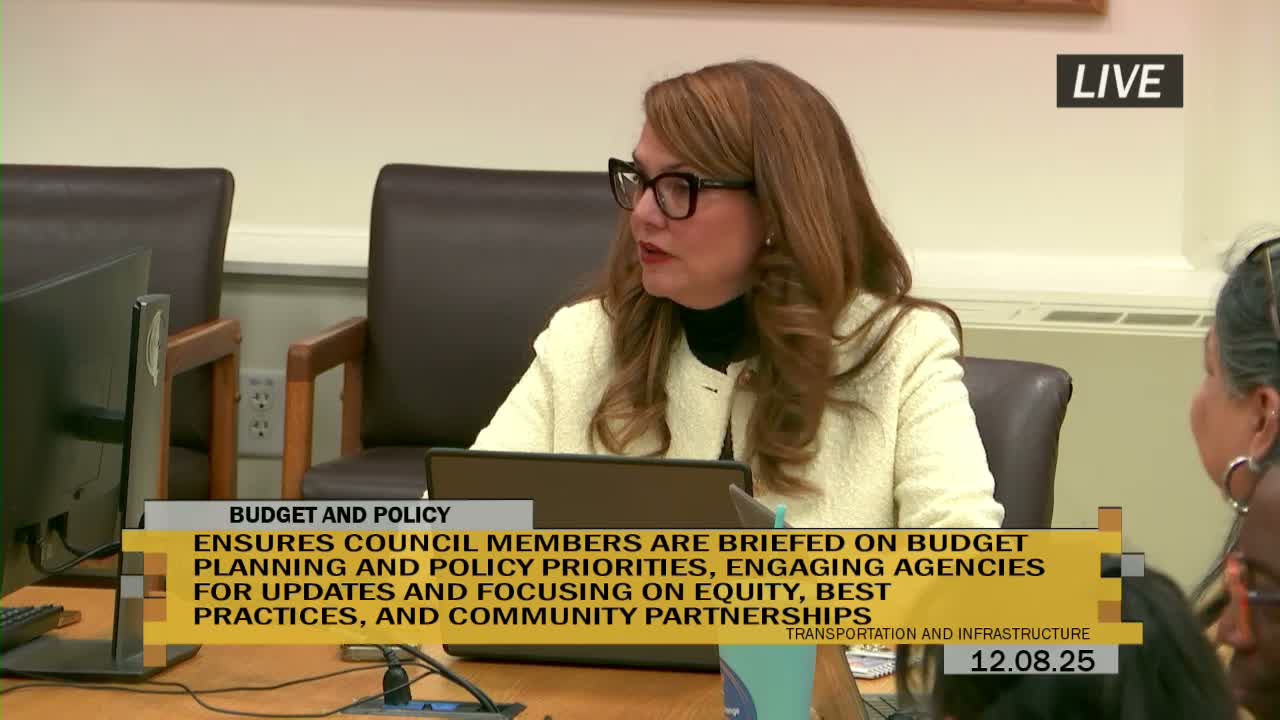
At a Dec. 8 meeting of the Denver City Council Budget and Policy Committee, Councilmember Amanda Sawyer and two co‑sponsors asked the committee to consider a charter amendment that would allow the City and County of Denver to adopt a two‑year budget cycle, with an ordinance option to revert to a one‑year cycle in periods of economic uncertainty.
Proponents said a two‑year cadence would create more time for strategic planning, public engagement and capital work and make it easier for nonprofits and agencies to plan multiyear initiatives. "This would be a charter change," Sawyer told the committee, laying out a timeline that includes public outreach in February 2026, a committee revisit in April, stakeholder briefings in May and a potential referral to the November ballot.
The sponsors framed the change as a transparency and accountability tool. Sawyer noted that Denver's total budget approaches $5 billion and that the general fund for 2024 was approximately $1.5 billion; current fiscal rules include a 2% contingency, a recommended 15% unassigned fund balance and a TABOR emergency reserve of 3%. She said the city's unassigned fund balance dropped below 10% in 2025, prompting hiring freezes, furloughs and layoffs.
Supporters pointed to peer examples such as King County and Fort Collins, where "on" and "off" years permit a bigger planning year followed by a lighter "tweak" year. Sponsors said the proposal would remove the current July 1 preliminary baseline and move the mayor's required submission date earlier to give council more time to review materials.
Not all members were persuaded. "I have to say I'm very, very skeptical," Councilmember Lynn Strasser said, pointing to jurisdictions that moved away from biennial budgeting and asking whether the model would lock councils into inaccurate multiyear projections. Strasser asked for examples of Fort Collins' strategic plans and how many cycles they have completed.
Justin Sykes, director of the Budget Management Office, told the committee the finance department saw "pros and cons" and had no definitive position yet. "I think waiting until language is drafted, waiting until we have time to sit down with other agencies" would be important before adopting the change, he said.
Members also debated whether a two‑year process would reduce council oversight or impede newly seated members. Sponsors argued the second, projected year would require reconciliation and public reporting that could strengthen accountability rather than weaken it. The committee discussed whether charter language or companion ordinances should specify hearing requirements, amendment processes and safeguards for council authority.
No formal motion or vote was taken. Sponsors said they would return to the committee with draft language and additional research; the stated outreach and procedural timeline included public meetings in February 2026 and an April committee check‑in before any decision on ballot referral.
The committee meeting ended with no action; members left the proposal open for further drafting and review.
Proponents said a two‑year cadence would create more time for strategic planning, public engagement and capital work and make it easier for nonprofits and agencies to plan multiyear initiatives. "This would be a charter change," Sawyer told the committee, laying out a timeline that includes public outreach in February 2026, a committee revisit in April, stakeholder briefings in May and a potential referral to the November ballot.
The sponsors framed the change as a transparency and accountability tool. Sawyer noted that Denver's total budget approaches $5 billion and that the general fund for 2024 was approximately $1.5 billion; current fiscal rules include a 2% contingency, a recommended 15% unassigned fund balance and a TABOR emergency reserve of 3%. She said the city's unassigned fund balance dropped below 10% in 2025, prompting hiring freezes, furloughs and layoffs.
Supporters pointed to peer examples such as King County and Fort Collins, where "on" and "off" years permit a bigger planning year followed by a lighter "tweak" year. Sponsors said the proposal would remove the current July 1 preliminary baseline and move the mayor's required submission date earlier to give council more time to review materials.
Not all members were persuaded. "I have to say I'm very, very skeptical," Councilmember Lynn Strasser said, pointing to jurisdictions that moved away from biennial budgeting and asking whether the model would lock councils into inaccurate multiyear projections. Strasser asked for examples of Fort Collins' strategic plans and how many cycles they have completed.
Justin Sykes, director of the Budget Management Office, told the committee the finance department saw "pros and cons" and had no definitive position yet. "I think waiting until language is drafted, waiting until we have time to sit down with other agencies" would be important before adopting the change, he said.
Members also debated whether a two‑year process would reduce council oversight or impede newly seated members. Sponsors argued the second, projected year would require reconciliation and public reporting that could strengthen accountability rather than weaken it. The committee discussed whether charter language or companion ordinances should specify hearing requirements, amendment processes and safeguards for council authority.
No formal motion or vote was taken. Sponsors said they would return to the committee with draft language and additional research; the stated outreach and procedural timeline included public meetings in February 2026 and an April committee check‑in before any decision on ballot referral.
The committee meeting ended with no action; members left the proposal open for further drafting and review.
View the Full Meeting & All Its Details
This article offers just a summary. Unlock complete video, transcripts, and insights as a Founder Member.
✓
Watch full, unedited meeting videos
✓
Search every word spoken in unlimited transcripts
✓
AI summaries & real-time alerts (all government levels)
✓
Permanent access to expanding government content
30-day money-back guarantee
