Committee grills AGO and law‑enforcement groups over bill letting AG investigators serve business warrants
January 12, 2026 | Legislative Sessions, Washington
This article was created by AI summarizing key points discussed. AI makes mistakes, so for full details and context, please refer to the video of the full meeting. Please report any errors so we can fix them. Report an error »
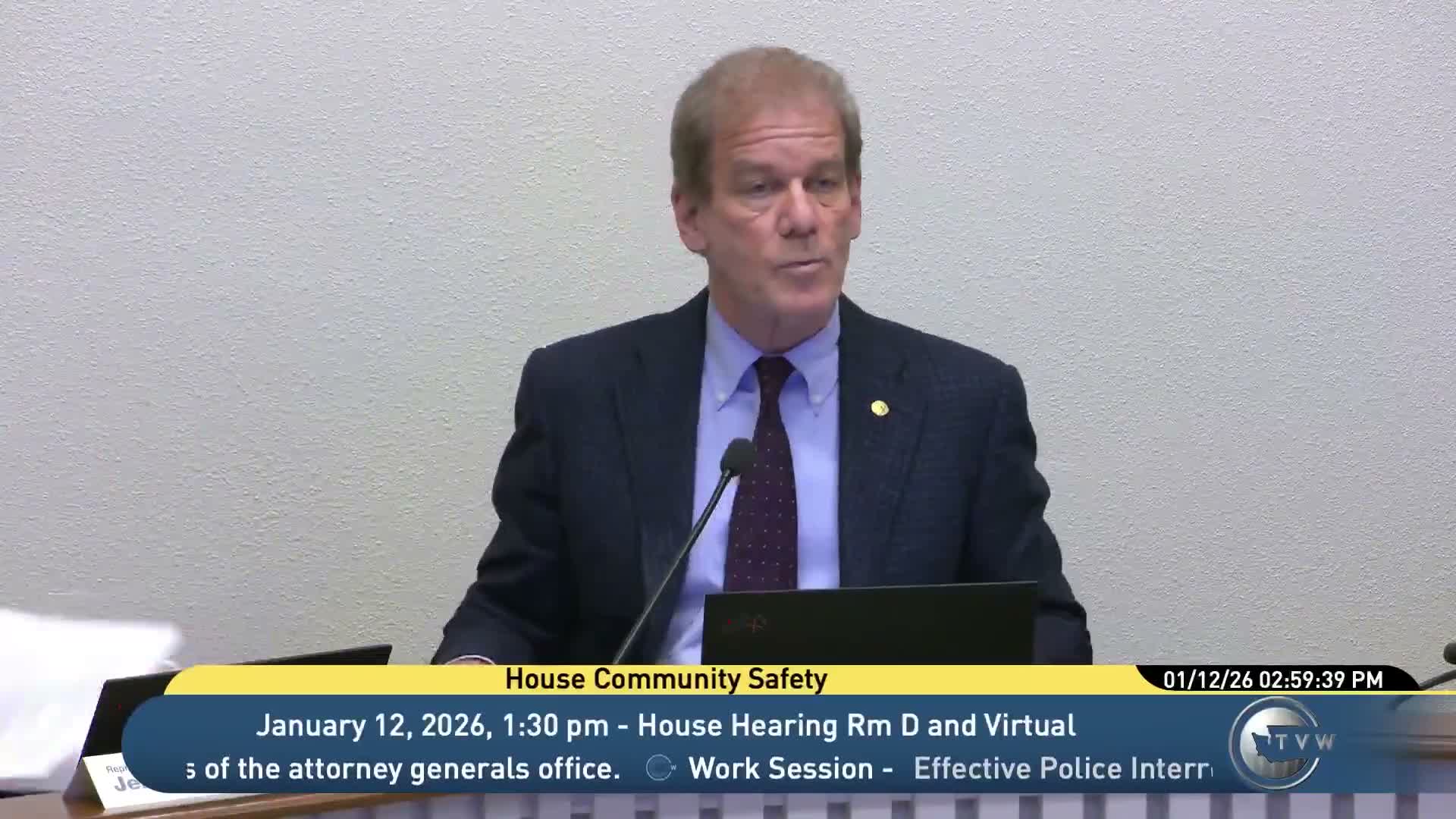
The committee next considered House Bill 2156, an AGO request bill that would give Attorney General Office investigators limited authority to serve search warrants on businesses (primarily for business records) when the AGO has concurrent jurisdiction from a county prosecutor or the governor.
Staff explained the bill’s three parts: (1) an AGO investigator’s authority is limited by the scope of the entity granting concurrent jurisdiction, (2) AGO investigators must have judicial authorization before serving a warrant on a business and typically would serve electronically, and (3) AGO investigators may not detain, arrest, or be armed.
Representative Edwin Obras, sponsor of HB 2156, said the measure is intended to speed investigations into economic crimes — such as organized retail theft, wage theft and construction fraud — in instances where local agencies lack bandwidth to serve multiple electronic warrants on business records.
Opponents included retired veteran Bob Linenhoevius and James McMahon of the Association of Sheriffs and Police Chiefs. Linenhoevius argued the bill "expands executive investigative power without sufficient structural restraint" and raised separation‑of‑powers and due‑process concerns. McMahon said AGO investigators are not commissioned peace officers, do not automatically receive the same police training, and that processes such as deconfliction, decertification oversight and use‑of‑force standards differ between agencies; he urged more safeguards and reporting requirements.
Drew Swaim of the AGO’s Major Economic Crimes unit countered that the bill is narrowly drawn: the AGO does not seek weapon‑carry authority or arrest powers for investigators (those remain with commissioned officers). He said most AGO investigators in the unit are retired law‑enforcement personnel, the bill usually concerns electronic service of warrants on corporations (email or secure portals), and the AGO will obtain concurrence from local prosecutors before proceeding in practice.
Committee members asked the parties to meet to resolve legal, training and oversight questions; the chair asked the prime sponsor to convene stakeholders and nonpartisan staff before executive action, scheduled in about 10 days.
Staff explained the bill’s three parts: (1) an AGO investigator’s authority is limited by the scope of the entity granting concurrent jurisdiction, (2) AGO investigators must have judicial authorization before serving a warrant on a business and typically would serve electronically, and (3) AGO investigators may not detain, arrest, or be armed.
Representative Edwin Obras, sponsor of HB 2156, said the measure is intended to speed investigations into economic crimes — such as organized retail theft, wage theft and construction fraud — in instances where local agencies lack bandwidth to serve multiple electronic warrants on business records.
Opponents included retired veteran Bob Linenhoevius and James McMahon of the Association of Sheriffs and Police Chiefs. Linenhoevius argued the bill "expands executive investigative power without sufficient structural restraint" and raised separation‑of‑powers and due‑process concerns. McMahon said AGO investigators are not commissioned peace officers, do not automatically receive the same police training, and that processes such as deconfliction, decertification oversight and use‑of‑force standards differ between agencies; he urged more safeguards and reporting requirements.
Drew Swaim of the AGO’s Major Economic Crimes unit countered that the bill is narrowly drawn: the AGO does not seek weapon‑carry authority or arrest powers for investigators (those remain with commissioned officers). He said most AGO investigators in the unit are retired law‑enforcement personnel, the bill usually concerns electronic service of warrants on corporations (email or secure portals), and the AGO will obtain concurrence from local prosecutors before proceeding in practice.
Committee members asked the parties to meet to resolve legal, training and oversight questions; the chair asked the prime sponsor to convene stakeholders and nonpartisan staff before executive action, scheduled in about 10 days.
View the Full Meeting & All Its Details
This article offers just a summary. Unlock complete video, transcripts, and insights as a Founder Member.
✓
Watch full, unedited meeting videos
✓
Search every word spoken in unlimited transcripts
✓
AI summaries & real-time alerts (all government levels)
✓
Permanent access to expanding government content
30-day money-back guarantee
