WADDL explains role in avian influenza response and trade‑enabling testing
January 12, 2026 | Legislative Sessions, Washington
This article was created by AI summarizing key points discussed. AI makes mistakes, so for full details and context, please refer to the video of the full meeting. Please report any errors so we can fix them. Report an error »
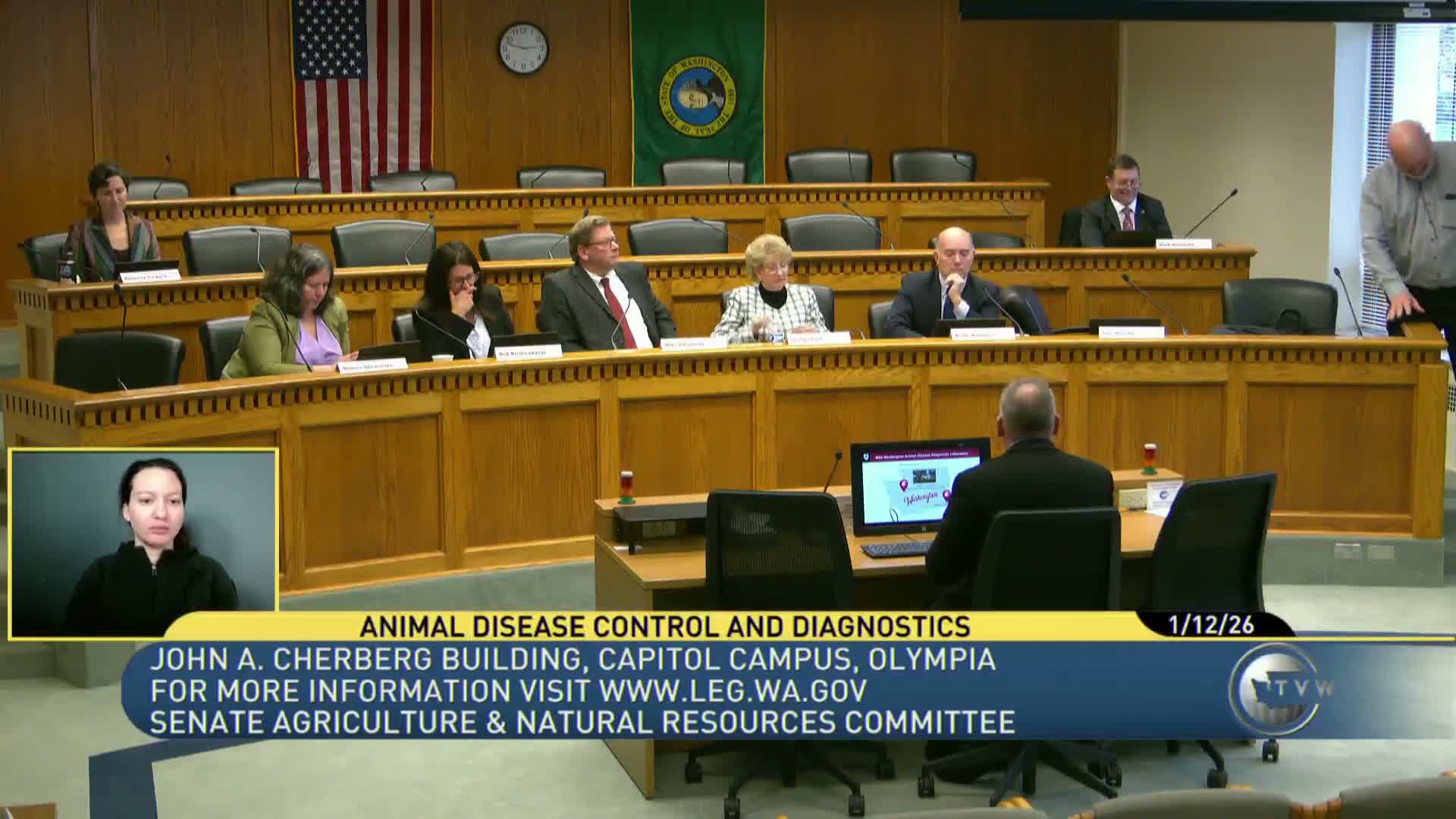
Dr. Kevin Snegovic, executive director of the Washington Animal Disease Diagnostic Laboratory at Washington State University, briefed the committee on the laboratory’s diagnostic, food‑safety and surveillance roles.
Snegovic said WADDL runs roughly 230,000 tests a year (peaking at 310,000 in 2021 during the pandemic period) and operates a biosafety level‑3 facility. He described the lab’s role in proving negative tests to allow commodity movement in quarantine zones and said rapid state‑level testing can speed regulatory actions "by literally days," which kept eggs moving from affected counties during recent detections. He noted the lab is the only accredited veterinary medical laboratory in Washington and is part of the National Animal Health Laboratory Network.
WADDL’s portfolio includes transboundary disease surveillance (avian influenza, foot‑and‑mouth risk monitoring), food‑safety testing for eggs and shellfish pathogens, chronic wasting disease testing in partnership with Fish & Wildlife, and toxicology and standard veterinary diagnostics. Snegovic said the lab’s operating budget is roughly $10.7 million, funded by testing fees, state allocations (about 25%) and grants/contracts.
Senators asked about staffing and career pathways; Snegovic said the lab employs about 90 people across technician, managerial and faculty roles and generally requires a BS for testing staff with advanced degrees for lab leadership. He said WADDL is recruiting to replace specialists and described its role in incident command for outbreak response.
What happens next: WADDL will continue routine surveillance, maintain accreditation and recruit staff to sustain diagnostic capacity; senators thanked the lab for its responsiveness during recent avian influenza detections.
Notes: testimony tied lab activity to trade, food safety and interagency outbreak response. Specific hypotheses about why Washington dairy herds remained negative for avian influenza were presented as possibilities rather than definitive conclusions.
Snegovic said WADDL runs roughly 230,000 tests a year (peaking at 310,000 in 2021 during the pandemic period) and operates a biosafety level‑3 facility. He described the lab’s role in proving negative tests to allow commodity movement in quarantine zones and said rapid state‑level testing can speed regulatory actions "by literally days," which kept eggs moving from affected counties during recent detections. He noted the lab is the only accredited veterinary medical laboratory in Washington and is part of the National Animal Health Laboratory Network.
WADDL’s portfolio includes transboundary disease surveillance (avian influenza, foot‑and‑mouth risk monitoring), food‑safety testing for eggs and shellfish pathogens, chronic wasting disease testing in partnership with Fish & Wildlife, and toxicology and standard veterinary diagnostics. Snegovic said the lab’s operating budget is roughly $10.7 million, funded by testing fees, state allocations (about 25%) and grants/contracts.
Senators asked about staffing and career pathways; Snegovic said the lab employs about 90 people across technician, managerial and faculty roles and generally requires a BS for testing staff with advanced degrees for lab leadership. He said WADDL is recruiting to replace specialists and described its role in incident command for outbreak response.
What happens next: WADDL will continue routine surveillance, maintain accreditation and recruit staff to sustain diagnostic capacity; senators thanked the lab for its responsiveness during recent avian influenza detections.
Notes: testimony tied lab activity to trade, food safety and interagency outbreak response. Specific hypotheses about why Washington dairy herds remained negative for avian influenza were presented as possibilities rather than definitive conclusions.
View the Full Meeting & All Its Details
This article offers just a summary. Unlock complete video, transcripts, and insights as a Founder Member.
✓
Watch full, unedited meeting videos
✓
Search every word spoken in unlimited transcripts
✓
AI summaries & real-time alerts (all government levels)
✓
Permanent access to expanding government content
30-day money-back guarantee
