Debate sharpens on bill to let gas plants with carbon capture count toward Washington’s clean‑energy law
January 12, 2026 | Legislative Sessions, Washington
This article was created by AI summarizing key points discussed. AI makes mistakes, so for full details and context, please refer to the video of the full meeting. Please report any errors so we can fix them. Report an error »
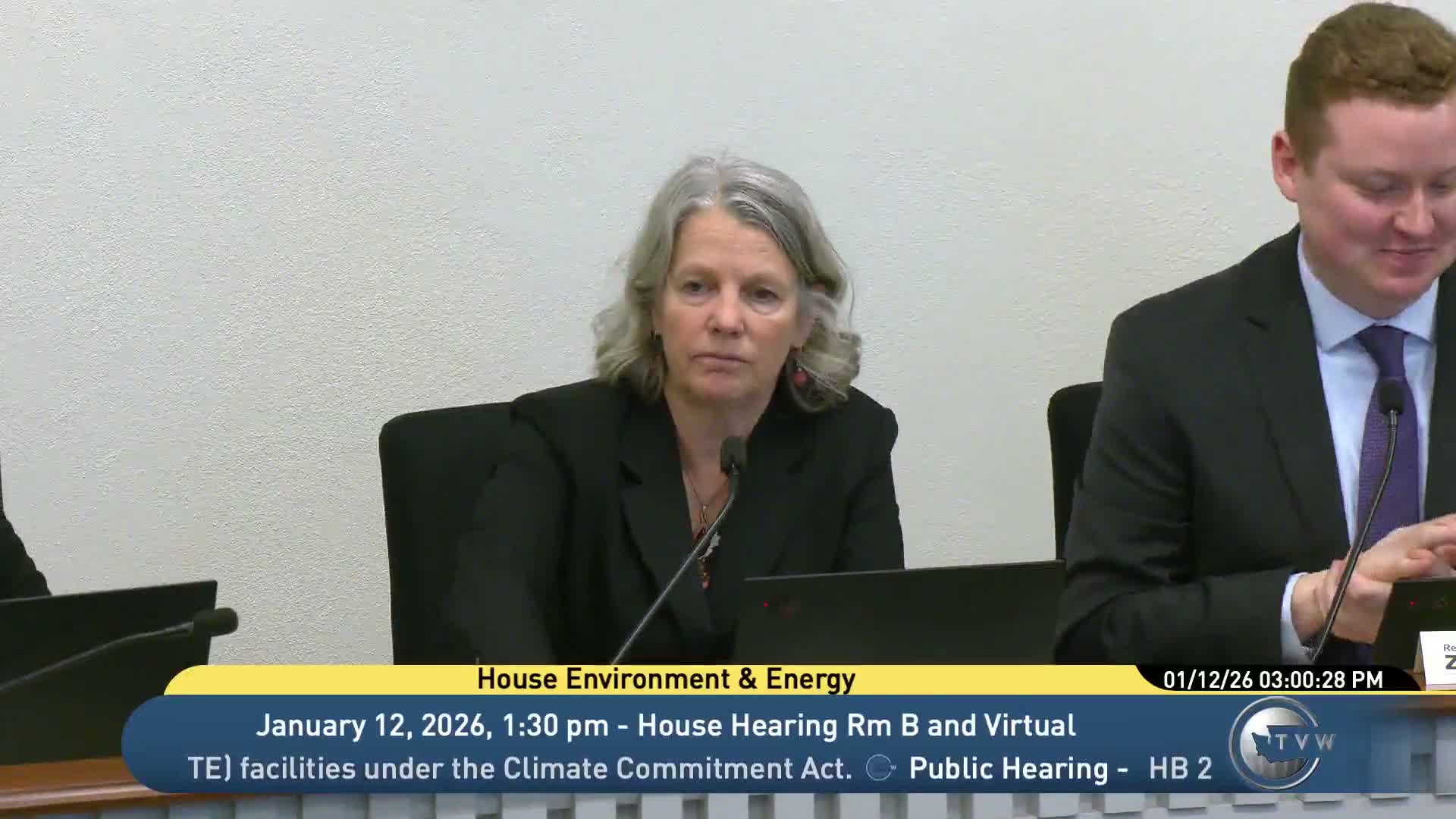
Committee staff briefed House Bill 2285 as a proposal to allow natural‑gas generation operated with certain carbon capture, utilization or mineralization technologies to be treated as compliant under the Clean Energy Transformation Act (CETA). The bill sets a design threshold of at least 75% capture of a system’s baseline carbon dioxide output and outlines a method to calculate that baseline.
Proponents: Trade associations, utilities and unions, including the Association of Washington Business, the Washington State Association of UA Plumbers and Pipefitters, Puget Sound Energy, Carbon Quest, and the International Brotherhood of Electrical Workers, testified in favor. They argued HB 2285 provides a pragmatic pathway to maintain reliable, dispatchable power while reducing emissions and bridging gaps created by transmission constraints and slow buildout of renewable capacity. "This is not a retreat from climate goals. It is a bridge solution that preserves reliability while emissions are meaningfully reduced," said Neil Hartman of the plumbers and pipefitters union.
Opponents and agency concerns: Environmental groups, Ecology and Commerce raised objections. Charlie Thompson of the Northwest Energy Coalition and Leah Missick of Climate Solutions argued that allowing a resource with a 75% design capture capacity would still permit emitting generation to count toward CETA’s statutory objective of 100% non‑emitting power and could incentivize extended life for fossil generation. Joel Creswell (Ecology) told the committee that while Ecology supports research and deployment of CCUS technologies, HB 2285 "would permanently weaken the greenhouse gas emissions reduction standards in the Clean Energy Transformation Act, likely resulting in higher emissions" and would require Ecology to undertake rulemaking to reconcile the change with existing standards and no‑cost allowance allocation under the Climate Commitment Act.
Technical and accounting questions: Committee members raised questions about potential double‑counting if captured carbon is sold or reused, permanence of sequestration, and interactions with existing emissions performance standards (testimony referenced RCW 8080 as a related emissions performance standard). Department of Commerce also cautioned that the bill's language is silent on how captured carbon would be retained permanently and that many current uses of CO2 are temporary or result in later release.
Why it matters: HB 2285 sits at the intersection of reliability policy, decarbonization strategy and statutory definitions that underpin Washington’s greenhouse‑gas and electricity laws. If enacted, the bill would change what qualifies as a "non‑emitting" resource under CETA and could have ripple effects for allowance accounting, regional modeling and utility compliance planning.
What's next: The committee received extensive panels for and against the bill, asked follow‑up questions, and closed the hearing for further work. Ecology and Commerce both asked to continue technical engagement and to see clarifying language on permanence and accounting for captured CO2.
Proponents: Trade associations, utilities and unions, including the Association of Washington Business, the Washington State Association of UA Plumbers and Pipefitters, Puget Sound Energy, Carbon Quest, and the International Brotherhood of Electrical Workers, testified in favor. They argued HB 2285 provides a pragmatic pathway to maintain reliable, dispatchable power while reducing emissions and bridging gaps created by transmission constraints and slow buildout of renewable capacity. "This is not a retreat from climate goals. It is a bridge solution that preserves reliability while emissions are meaningfully reduced," said Neil Hartman of the plumbers and pipefitters union.
Opponents and agency concerns: Environmental groups, Ecology and Commerce raised objections. Charlie Thompson of the Northwest Energy Coalition and Leah Missick of Climate Solutions argued that allowing a resource with a 75% design capture capacity would still permit emitting generation to count toward CETA’s statutory objective of 100% non‑emitting power and could incentivize extended life for fossil generation. Joel Creswell (Ecology) told the committee that while Ecology supports research and deployment of CCUS technologies, HB 2285 "would permanently weaken the greenhouse gas emissions reduction standards in the Clean Energy Transformation Act, likely resulting in higher emissions" and would require Ecology to undertake rulemaking to reconcile the change with existing standards and no‑cost allowance allocation under the Climate Commitment Act.
Technical and accounting questions: Committee members raised questions about potential double‑counting if captured carbon is sold or reused, permanence of sequestration, and interactions with existing emissions performance standards (testimony referenced RCW 8080 as a related emissions performance standard). Department of Commerce also cautioned that the bill's language is silent on how captured carbon would be retained permanently and that many current uses of CO2 are temporary or result in later release.
Why it matters: HB 2285 sits at the intersection of reliability policy, decarbonization strategy and statutory definitions that underpin Washington’s greenhouse‑gas and electricity laws. If enacted, the bill would change what qualifies as a "non‑emitting" resource under CETA and could have ripple effects for allowance accounting, regional modeling and utility compliance planning.
What's next: The committee received extensive panels for and against the bill, asked follow‑up questions, and closed the hearing for further work. Ecology and Commerce both asked to continue technical engagement and to see clarifying language on permanence and accounting for captured CO2.
View the Full Meeting & All Its Details
This article offers just a summary. Unlock complete video, transcripts, and insights as a Founder Member.
✓
Watch full, unedited meeting videos
✓
Search every word spoken in unlimited transcripts
✓
AI summaries & real-time alerts (all government levels)
✓
Permanent access to expanding government content
30-day money-back guarantee
