New DSHS secretary outlines reorganization and warns of HR1 SNAP changes that could affect benefits in May
January 12, 2026 | Legislative Sessions, Washington
This article was created by AI summarizing key points discussed. AI makes mistakes, so for full details and context, please refer to the video of the full meeting. Please report any errors so we can fix them. Report an error »
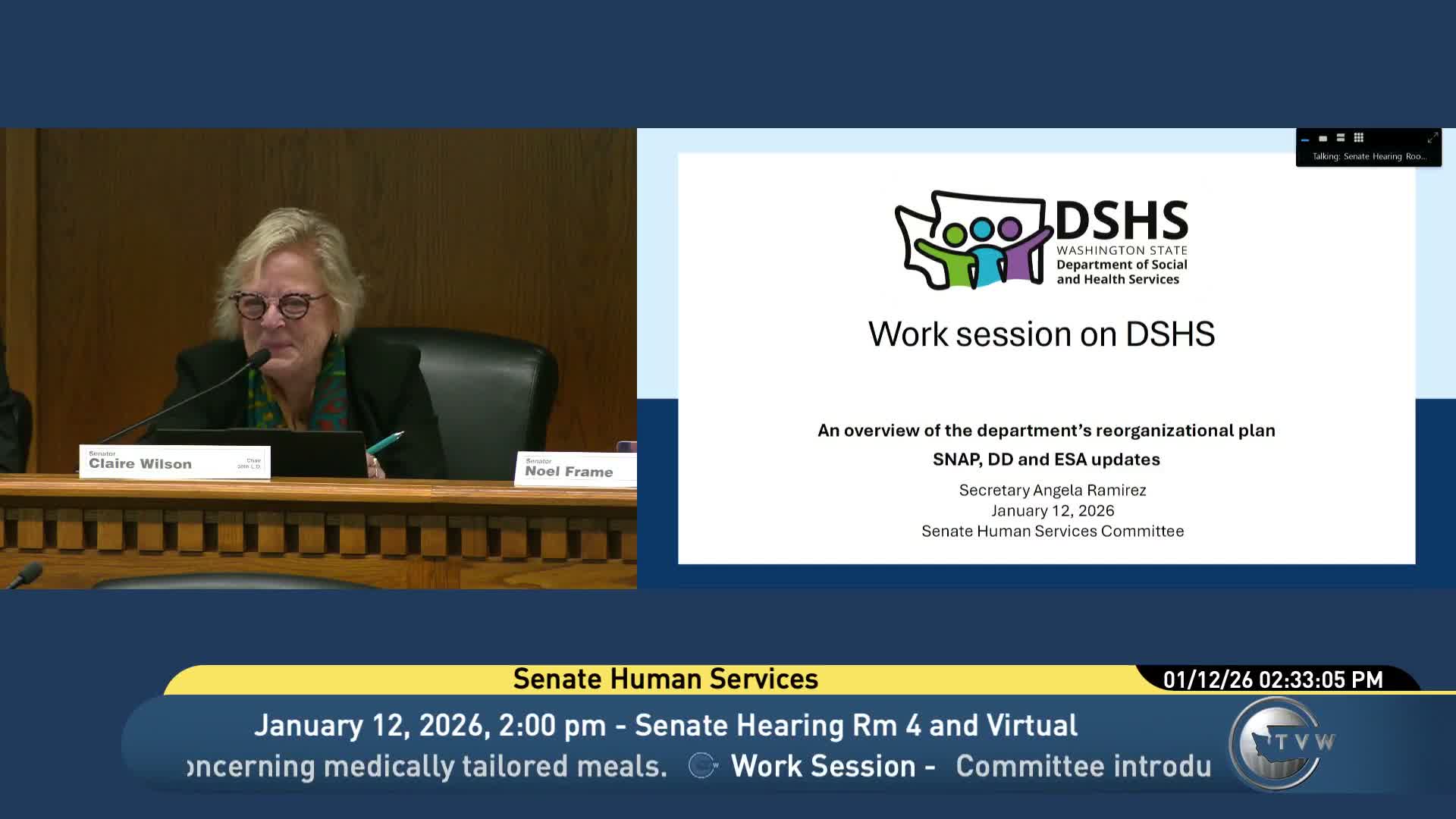
Angela Ramirez, the newly appointed secretary of the Department of Social and Health Services, told the Senate Human Services Committee on Jan. 12 that DSHS has begun implementing a 'reimagine' restructuring intended to reduce silos and improve client experience while maintaining key partnerships.
Ramirez said DSHS has consolidated functions from four prior administrations into three new administrations: a Behavioral Health and Habilitation Administration, a Home and Community Living Administration (and Facilities), and a Technology and Analytics Administration. The change is intended to improve transitions in care, reduce administrative burden, and increase coordination among staff and partner agencies.
On fiscal and program highlights, Ramirez said the governor’s proposed budget moves funds into the new administrations, funds maintenance-level increases for developmental-disability (DD) caseloads, and includes $2,000,000 to the Dan Thompson account to build community capacity for DD services. She said some agency-request bills to align statutes with the restructure have been approved for pursuit and that CMS sign-off will be required for certain waiver-related changes.
Ramirez also addressed recent federal changes tied to HR1. She said USDA issued guidance reinstating an area waiver for work requirements (which had been terminated on Nov. 2), restoring the waiver to its original end date of Jan. 31, 2026; Ramirez warned the committee that the earliest people outside King County who do not meet new work requirements could lose regular monthly benefits in May. Ramirez described HR1 as narrowing immigrant eligibility under section 6(f) of the Food and Nutrition Act of 2008 and noted USDA guidance indicating some groups (for example, certain refugees or asylees) may lose eligibility but will not be subject to a five-year lawful-permanent-resident waiting period once they attain LPR status.
Ramirez said DSHS has sought tribal consultation on HR1 changes and referenced a recent multi‑organization letter to congressional leaders urging (1) a delay of SNAP administrative cost shares for all states until FY 2030, (2) excluding Oct–Nov 2025 from the FY 2026 quality-control sample, and (3) hold‑harmless protections through Jan. 31, 2026.
Assistant Secretary Carla Reyes told the committee DSHS is designing a verification hub to align information across SNAP, Medicaid and TANF, verify eligibility without placing additional burden on customers where possible, and balance verification with data security and privacy. Reyes said technical and business requirements and funding considerations are underway to support the hub and to prepare for work‑requirement verification tied to Medicaid implementation.
Senators asked for more specific estimates of people potentially affected by reinstated work requirements; Reyes said aggregate counts are available on the department’s slides and that DSHS staff would follow up with more detailed figures on impacts for May and beyond.
Ramirez closed by inviting committee input on statutory alignment and implementation steps and highlighted a planned DSHS website redesign targeted for a June–July go‑live to improve access and navigation for clients and partners.
Ramirez said DSHS has consolidated functions from four prior administrations into three new administrations: a Behavioral Health and Habilitation Administration, a Home and Community Living Administration (and Facilities), and a Technology and Analytics Administration. The change is intended to improve transitions in care, reduce administrative burden, and increase coordination among staff and partner agencies.
On fiscal and program highlights, Ramirez said the governor’s proposed budget moves funds into the new administrations, funds maintenance-level increases for developmental-disability (DD) caseloads, and includes $2,000,000 to the Dan Thompson account to build community capacity for DD services. She said some agency-request bills to align statutes with the restructure have been approved for pursuit and that CMS sign-off will be required for certain waiver-related changes.
Ramirez also addressed recent federal changes tied to HR1. She said USDA issued guidance reinstating an area waiver for work requirements (which had been terminated on Nov. 2), restoring the waiver to its original end date of Jan. 31, 2026; Ramirez warned the committee that the earliest people outside King County who do not meet new work requirements could lose regular monthly benefits in May. Ramirez described HR1 as narrowing immigrant eligibility under section 6(f) of the Food and Nutrition Act of 2008 and noted USDA guidance indicating some groups (for example, certain refugees or asylees) may lose eligibility but will not be subject to a five-year lawful-permanent-resident waiting period once they attain LPR status.
Ramirez said DSHS has sought tribal consultation on HR1 changes and referenced a recent multi‑organization letter to congressional leaders urging (1) a delay of SNAP administrative cost shares for all states until FY 2030, (2) excluding Oct–Nov 2025 from the FY 2026 quality-control sample, and (3) hold‑harmless protections through Jan. 31, 2026.
Assistant Secretary Carla Reyes told the committee DSHS is designing a verification hub to align information across SNAP, Medicaid and TANF, verify eligibility without placing additional burden on customers where possible, and balance verification with data security and privacy. Reyes said technical and business requirements and funding considerations are underway to support the hub and to prepare for work‑requirement verification tied to Medicaid implementation.
Senators asked for more specific estimates of people potentially affected by reinstated work requirements; Reyes said aggregate counts are available on the department’s slides and that DSHS staff would follow up with more detailed figures on impacts for May and beyond.
Ramirez closed by inviting committee input on statutory alignment and implementation steps and highlighted a planned DSHS website redesign targeted for a June–July go‑live to improve access and navigation for clients and partners.
View the Full Meeting & All Its Details
This article offers just a summary. Unlock complete video, transcripts, and insights as a Founder Member.
✓
Watch full, unedited meeting videos
✓
Search every word spoken in unlimited transcripts
✓
AI summaries & real-time alerts (all government levels)
✓
Permanent access to expanding government content
30-day money-back guarantee
