Vermont League of Cities and Towns backs three-year extension of telecom-siting sunset, warns of disruption if it lapses
January 17, 2026 | Environment & Energy, HOUSE OF REPRESENTATIVES, Committees, Legislative , Vermont
This article was created by AI summarizing key points discussed. AI makes mistakes, so for full details and context, please refer to the video of the full meeting. Please report any errors so we can fix them. Report an error »
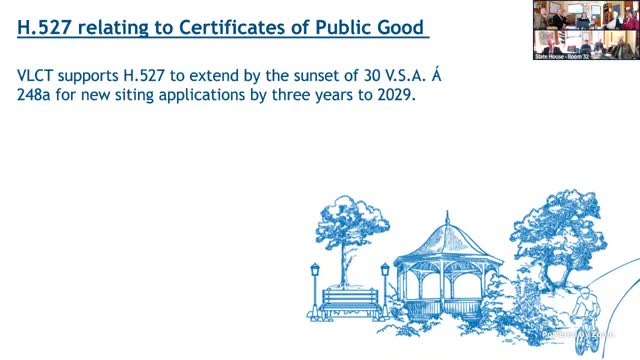
House Energy and Digital Infrastructure — The Vermont League of Cities and Towns told the House committee on Jan. 16 that it supports H.527, a bill to extend the statutory sunset on telecommunications siting under 30 V.S.A. §248a by three years to 2029, saying municipalities need continued access to the Certificate of Public Good (CPG) process while statewide land‑use implementation is in flux.
"VLCT supports H.527 to extend the sunset of 30 V.S.A. §248a for siting applications by three years to 2029," Samantha Sheehan, municipal policy and advocacy specialist for the Vermont League of Cities and Towns, told the committee. "We would not oppose eliminating the sunset, but we value the opportunity for legislative review."
Sheehan told lawmakers that VLCT represents all 251 Vermont municipalities and emphasized that local plans and zoning do not directly regulate telecommunications siting; rather, those plans provide the basis for municipal input to the PUC's CPG process. She described the municipal role under current law: a company seeking to build telecommunications infrastructure must provide municipalities 60 days' advance notice before filing a CPG application; towns and regional planning commissions may hold public meetings during the advance-notice period and later file recommendations and comments in the PUC's 30-day public comment period after the application is filed.
Representative Kathleen James (Manchester) said lawmakers should be cautious about allowing the statutory sunset to expire while the state is implementing Act 181, which will define location‑based jurisdiction and what constitutes "development" for land‑use review. "I think it's really important that towns and people be able to engage in the process of siting cell towers," James said, adding that letting the sunset lapse during a multiyear transition would be a "big mistake" that could leave communities with reduced avenues for input.
Greg Barber of the Public Utility Commission explained the timeline and how municipal input is considered: the 60‑day advance notice precedes the applicant's filing, and once the filing is made there is a minimum 30‑day public comment period during which towns, regional planning commissions and members of the public can submit comments or motions to intervene. Barber said substantial deference is given to the recommendations of the town and the regional planning commission where those recommendations are based on an adopted municipal or regional plan.
Witnesses and committee members also discussed the Granville case as an example of an extended local process that resulted in a nonbinding town ballot and multiple public meetings; the testimony showed how local deliberations can produce differing outcomes for different communities. VLCT said that many municipal plans are out of date — plans are often updated on roughly an eight‑year cycle — and that only about 200 municipalities currently have an adopted municipal plan, a fact that affects how "substantial deference" operates in practice.
Committee members asked whether the PUC would undertake formal rulemaking or recommend statutory tweaks if the sunset is extended; PUC staff said formal rulemaking is possible and would give the legislature greater input on implementation, though implementing by order (without formal rulemaking) is faster.
No committee vote on H.527 or formal legislative action occurred at the hearing. Lawmakers and witnesses said they will continue discussions about whether limited statutory clarifications, improved notice procedures, or PUC rulemaking would better preserve municipal input while accommodating the state’s larger Act 181 implementation process.
"VLCT supports H.527 to extend the sunset of 30 V.S.A. §248a for siting applications by three years to 2029," Samantha Sheehan, municipal policy and advocacy specialist for the Vermont League of Cities and Towns, told the committee. "We would not oppose eliminating the sunset, but we value the opportunity for legislative review."
Sheehan told lawmakers that VLCT represents all 251 Vermont municipalities and emphasized that local plans and zoning do not directly regulate telecommunications siting; rather, those plans provide the basis for municipal input to the PUC's CPG process. She described the municipal role under current law: a company seeking to build telecommunications infrastructure must provide municipalities 60 days' advance notice before filing a CPG application; towns and regional planning commissions may hold public meetings during the advance-notice period and later file recommendations and comments in the PUC's 30-day public comment period after the application is filed.
Representative Kathleen James (Manchester) said lawmakers should be cautious about allowing the statutory sunset to expire while the state is implementing Act 181, which will define location‑based jurisdiction and what constitutes "development" for land‑use review. "I think it's really important that towns and people be able to engage in the process of siting cell towers," James said, adding that letting the sunset lapse during a multiyear transition would be a "big mistake" that could leave communities with reduced avenues for input.
Greg Barber of the Public Utility Commission explained the timeline and how municipal input is considered: the 60‑day advance notice precedes the applicant's filing, and once the filing is made there is a minimum 30‑day public comment period during which towns, regional planning commissions and members of the public can submit comments or motions to intervene. Barber said substantial deference is given to the recommendations of the town and the regional planning commission where those recommendations are based on an adopted municipal or regional plan.
Witnesses and committee members also discussed the Granville case as an example of an extended local process that resulted in a nonbinding town ballot and multiple public meetings; the testimony showed how local deliberations can produce differing outcomes for different communities. VLCT said that many municipal plans are out of date — plans are often updated on roughly an eight‑year cycle — and that only about 200 municipalities currently have an adopted municipal plan, a fact that affects how "substantial deference" operates in practice.
Committee members asked whether the PUC would undertake formal rulemaking or recommend statutory tweaks if the sunset is extended; PUC staff said formal rulemaking is possible and would give the legislature greater input on implementation, though implementing by order (without formal rulemaking) is faster.
No committee vote on H.527 or formal legislative action occurred at the hearing. Lawmakers and witnesses said they will continue discussions about whether limited statutory clarifications, improved notice procedures, or PUC rulemaking would better preserve municipal input while accommodating the state’s larger Act 181 implementation process.
Don't Miss a Word: See the Full Meeting!
Go beyond summaries. Unlock every video, transcript, and key insight with a Founder Membership.
✓
Get instant access to full meeting videos
✓
Search and clip any phrase from complete transcripts
✓
Receive AI-powered summaries & custom alerts
✓
Enjoy lifetime, unrestricted access to government data
30-day money-back guarantee
