Oak Harbor committee told marina revenues fall short of needed dredging and redevelopment costs; study outlines rate, grant and privatization options
January 17, 2026 | Oak Harbor, Island County, Washington
This article was created by AI summarizing key points discussed. AI makes mistakes, so for full details and context, please refer to the video of the full meeting. Please report any errors so we can fix them. Report an error »
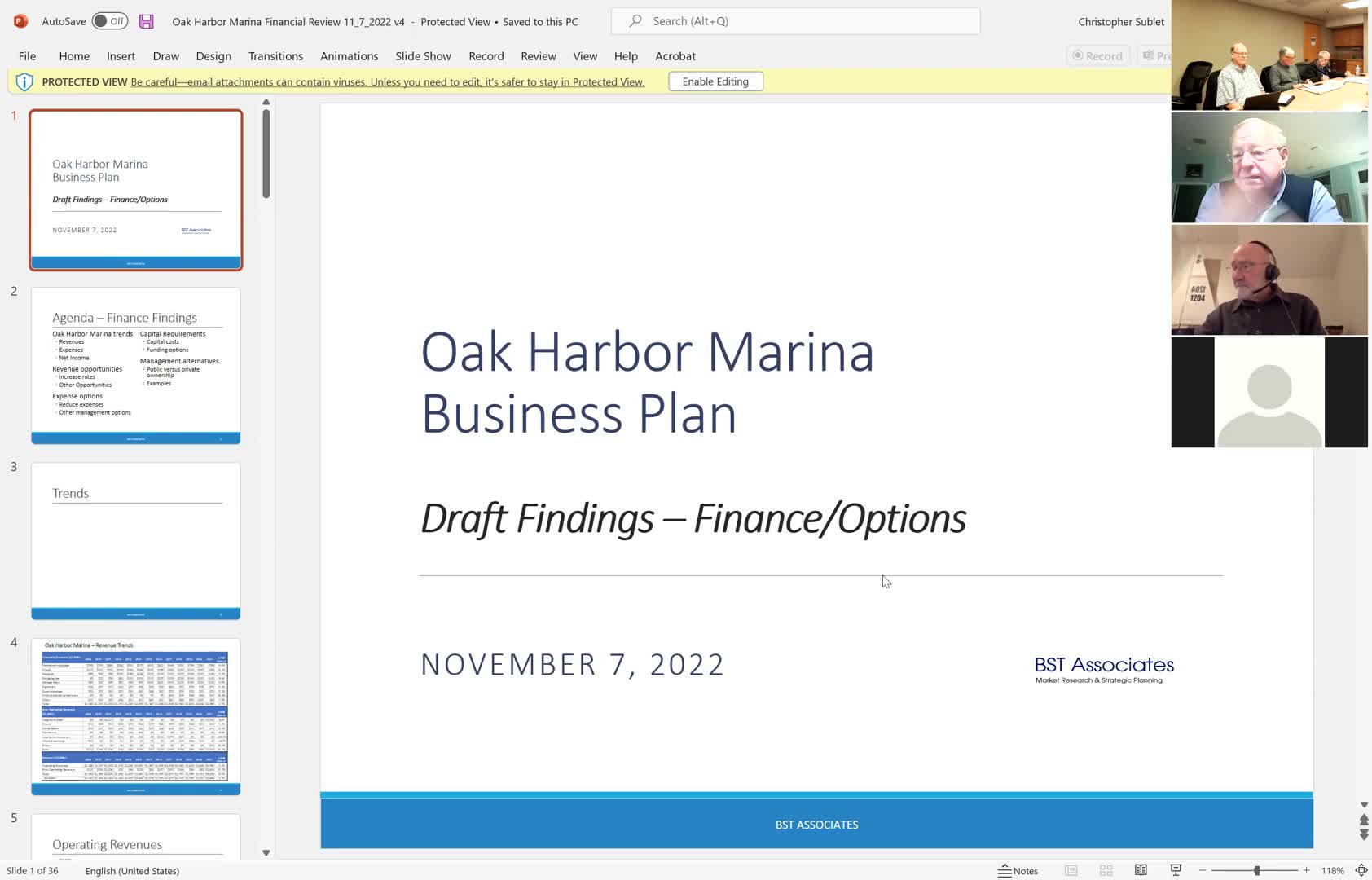
A consultant briefing to the Oak Harbor Marina Committee on long‑term finances found the marina’s primary revenue source has barely kept pace with costs, leaving little capacity to fund major capital work such as dredging and breakwater replacement.
"Permanent mortgage revenue — your biggest source of revenue — grew at about 0.6% per year on average from 2009 through 2021," Paul told the committee, noting that operating expenses rose faster and net operating income has declined when averaged across years. Paul presented nominal (not inflation‑adjusted) figures showing operating revenues rising roughly 3.3–3.5% per year while operating expenses increased about 4.6–4.9% annually.
Why it matters: the study found available net revenue is far smaller than the debt service a full redevelopment would require. Paul offered ballpark capital figures: basin dredging estimated at about $4.5 million, a proxy $5 million for channel dredging, and marina redevelopment and a new breakwater in the $30–40 million range. He estimated the annual debt service on a 30‑year bond at 4% would be roughly $1.5–$2.0 million — far above the committee’s current net revenue available, which the consultant estimated at about $100,000.
During the presentation Paul reviewed the composition of fees and how they compare with regional peers. Oak Harbor’s all‑in rates (per‑foot base plus dredging and environmental compliance fees) sit below many Northern Puget Sound marinas in the consultant’s comparison set — for example, Paul said Oak Harbor shows in the roughly $8–$10 per foot range while many comparables average $12–$14 per foot. He also highlighted a structural issue: Oak Harbor’s slip mix is skewed toward small slips (many 28 feet or shorter), limiting potential revenue from larger, higher‑priced berths.
Committee members pressed on causes and options. One member noted that some recent years included meaningful rate increases and asked how that squares with the low long‑term growth; Paul replied that rates were kept flat for several years and that occupancy declines in lean years contributed to the revenue shortfall. Paul showed that the dredging fee, introduced around 2010–2011, had grown from roughly $22,000 in 2010 to about $140,000 in later years but stressed that those amounts are insufficient to cover major capital needs.
The consultant outlined a menu of responses the city could pursue: modest annual rate adjustments tied to CPI or competitive indices; targeted slip reconfiguration to attract larger boats; pursuit of federal and state grants (examples cited include the Recreation and Conservation Office and Economic Development Administration); public‑private partnerships or long‑term leases to shift capital burden; and cooperative approaches to dredging among nearby ports to reduce cost. He warned grants are competitive, permitting timelines can extend multiple years, and some options (privatization or condo‑style upland development) would change the marina’s market positioning.
"Even if you increased rates to the regional average or cut operating costs substantially, those steps alone would not close the gap," Paul said, summarizing the study’s findings that current funds are not sufficient for full redevelopment without additional revenue or external capital.
Several committee members voiced concern about affordability. "That's pretty grim," one member said after the presentation, later warning that sizeable fee increases or added dredging charges could price many current tenants — including those on fixed incomes — out of the marina and push small‑boat owners to trailering and local alternatives. The consultant acknowledged that raising rates on small slips risks higher vacancy and emphasized the need to model slip‑mix changes alongside dredging so that reconfiguration and capital work proceed in a coordinated way.
Near the close of the session, staff and committee members agreed on next steps: conduct a tenant survey (the consultant said the project team has about 800 tenant or former‑tenant email contacts), refine financial modeling for slip reconfiguration to run concurrent with dredging, pursue a harbor plan and coordinated grant strategy (a CEDS or similar pre‑project study was recommended), and present the business plan to the city council after the new parks and recreation director is in place. A committee speaker said the committee has selected Moffett Nichols to perform the initial dredging contract and that the agreement will be taken to council for approval.
What the committee did: members approved the prior meeting’s minutes by voice vote. No formal policy changes or funding commitments were made at the meeting; the group directed staff and consultants to continue outreach, refine options and report back.
The committee also heard brief updates on ongoing projects (Mariners Haven business‑plan work, whaler repairs and outreach, and launch ramp scheduling) and discussed community access issues — the marina’s relative distance from downtown and transient visitor amenities — as factors in any long‑term plan.
The committee is scheduled to reconvene on December 5; staff and consultants will continue modeling and outreach in the interim.
"Permanent mortgage revenue — your biggest source of revenue — grew at about 0.6% per year on average from 2009 through 2021," Paul told the committee, noting that operating expenses rose faster and net operating income has declined when averaged across years. Paul presented nominal (not inflation‑adjusted) figures showing operating revenues rising roughly 3.3–3.5% per year while operating expenses increased about 4.6–4.9% annually.
Why it matters: the study found available net revenue is far smaller than the debt service a full redevelopment would require. Paul offered ballpark capital figures: basin dredging estimated at about $4.5 million, a proxy $5 million for channel dredging, and marina redevelopment and a new breakwater in the $30–40 million range. He estimated the annual debt service on a 30‑year bond at 4% would be roughly $1.5–$2.0 million — far above the committee’s current net revenue available, which the consultant estimated at about $100,000.
During the presentation Paul reviewed the composition of fees and how they compare with regional peers. Oak Harbor’s all‑in rates (per‑foot base plus dredging and environmental compliance fees) sit below many Northern Puget Sound marinas in the consultant’s comparison set — for example, Paul said Oak Harbor shows in the roughly $8–$10 per foot range while many comparables average $12–$14 per foot. He also highlighted a structural issue: Oak Harbor’s slip mix is skewed toward small slips (many 28 feet or shorter), limiting potential revenue from larger, higher‑priced berths.
Committee members pressed on causes and options. One member noted that some recent years included meaningful rate increases and asked how that squares with the low long‑term growth; Paul replied that rates were kept flat for several years and that occupancy declines in lean years contributed to the revenue shortfall. Paul showed that the dredging fee, introduced around 2010–2011, had grown from roughly $22,000 in 2010 to about $140,000 in later years but stressed that those amounts are insufficient to cover major capital needs.
The consultant outlined a menu of responses the city could pursue: modest annual rate adjustments tied to CPI or competitive indices; targeted slip reconfiguration to attract larger boats; pursuit of federal and state grants (examples cited include the Recreation and Conservation Office and Economic Development Administration); public‑private partnerships or long‑term leases to shift capital burden; and cooperative approaches to dredging among nearby ports to reduce cost. He warned grants are competitive, permitting timelines can extend multiple years, and some options (privatization or condo‑style upland development) would change the marina’s market positioning.
"Even if you increased rates to the regional average or cut operating costs substantially, those steps alone would not close the gap," Paul said, summarizing the study’s findings that current funds are not sufficient for full redevelopment without additional revenue or external capital.
Several committee members voiced concern about affordability. "That's pretty grim," one member said after the presentation, later warning that sizeable fee increases or added dredging charges could price many current tenants — including those on fixed incomes — out of the marina and push small‑boat owners to trailering and local alternatives. The consultant acknowledged that raising rates on small slips risks higher vacancy and emphasized the need to model slip‑mix changes alongside dredging so that reconfiguration and capital work proceed in a coordinated way.
Near the close of the session, staff and committee members agreed on next steps: conduct a tenant survey (the consultant said the project team has about 800 tenant or former‑tenant email contacts), refine financial modeling for slip reconfiguration to run concurrent with dredging, pursue a harbor plan and coordinated grant strategy (a CEDS or similar pre‑project study was recommended), and present the business plan to the city council after the new parks and recreation director is in place. A committee speaker said the committee has selected Moffett Nichols to perform the initial dredging contract and that the agreement will be taken to council for approval.
What the committee did: members approved the prior meeting’s minutes by voice vote. No formal policy changes or funding commitments were made at the meeting; the group directed staff and consultants to continue outreach, refine options and report back.
The committee also heard brief updates on ongoing projects (Mariners Haven business‑plan work, whaler repairs and outreach, and launch ramp scheduling) and discussed community access issues — the marina’s relative distance from downtown and transient visitor amenities — as factors in any long‑term plan.
The committee is scheduled to reconvene on December 5; staff and consultants will continue modeling and outreach in the interim.
Don't Miss a Word: See the Full Meeting!
Go beyond summaries. Unlock every video, transcript, and key insight with a Founder Membership.
✓
Get instant access to full meeting videos
✓
Search and clip any phrase from complete transcripts
✓
Receive AI-powered summaries & custom alerts
✓
Enjoy lifetime, unrestricted access to government data
30-day money-back guarantee
