U‑M economist: AI could raise productivity but who owns the gains will shape outcomes
January 17, 2026 | 2025-2026 House Legislature MI, Michigan
This article was created by AI summarizing key points discussed. AI makes mistakes, so for full details and context, please refer to the video of the full meeting. Please report any errors so we can fix them. Report an error »
Dr. Justin Wolfers, a professor of public policy and economics at the University of Michigan, told the Consensus Revenue Estimating Conference that artificial intelligence can yield large productivity gains in individual tasks and modest but meaningful increases in long‑run GDP, while raising important distributional and policy questions.
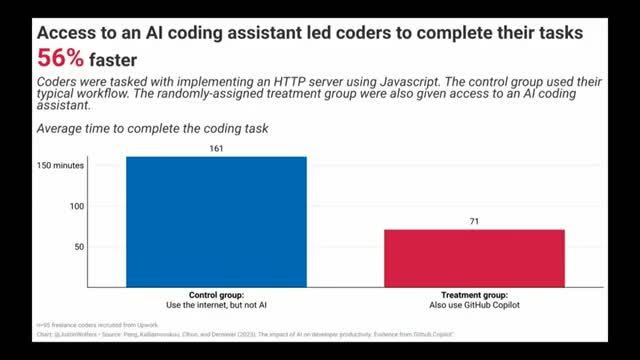
Wolfers summarized randomized and field studies showing sharp productivity improvements in narrow tasks: he cited experiments where access to GitHub Copilot reduced coding task time from 161 minutes to 71 minutes (a 56% improvement) and where an office‑type task fell from 27 to 16 minutes (about a 40% gain) when workers used large language models. He said such micro gains could aggregate differently depending on adoption, complements, and whether AI raises the productivity of innovators.
On macro scenarios, Wolfers presented a cautious baseline that yields roughly a 1% increase in GDP over a decade and contrasted it with more aggressive assumptions used by some forecasters that imply larger gains. He emphasized uncertainty about timing: historical technology revolutions often require years of reorganization and capital accumulation before productivity gains appear in official statistics.
Wolfers stressed distributional mechanics: "if the boss owns the AI, we're screwed," he told the room, arguing that who controls AI services and key upstream inputs will determine whether gains flow to labor or concentrate with capital owners. He highlighted three regulatory and market risks: concentration among AI service providers, monopolistic bottlenecks for key hardware (chips), and lack of competition that would capture most gains for a small set of firms.
He urged policymakers to focus on competition policy, skills and education (particularly science and critical‑thinking skills), and practical adoption steps for public organizations. For practitioners he recommended daily experimentation—"open a tab with your favorite large language model and give it one task a day"—to build familiarity and capture complementarities.
Wolfers also addressed sectoral impacts relevant to Michigan: health care and manufacturing are in the crosshairs of an AI‑driven white‑collar transformation, he said, with health care adoption already showing rapid change in documentation and diagnostic aide tasks. He recommended legislators consider the political‑economy levers that will shape whether AI adoption leads to broad shared gains or concentrated rents.
The presentation followed RSQE economic forecasts that informed the revenue discussion; Wolfers framed his remarks as longer‑run context for how productivity and adoption dynamics could alter state revenue trajectories over time.
Wolfers summarized randomized and field studies showing sharp productivity improvements in narrow tasks: he cited experiments where access to GitHub Copilot reduced coding task time from 161 minutes to 71 minutes (a 56% improvement) and where an office‑type task fell from 27 to 16 minutes (about a 40% gain) when workers used large language models. He said such micro gains could aggregate differently depending on adoption, complements, and whether AI raises the productivity of innovators.
On macro scenarios, Wolfers presented a cautious baseline that yields roughly a 1% increase in GDP over a decade and contrasted it with more aggressive assumptions used by some forecasters that imply larger gains. He emphasized uncertainty about timing: historical technology revolutions often require years of reorganization and capital accumulation before productivity gains appear in official statistics.
Wolfers stressed distributional mechanics: "if the boss owns the AI, we're screwed," he told the room, arguing that who controls AI services and key upstream inputs will determine whether gains flow to labor or concentrate with capital owners. He highlighted three regulatory and market risks: concentration among AI service providers, monopolistic bottlenecks for key hardware (chips), and lack of competition that would capture most gains for a small set of firms.
He urged policymakers to focus on competition policy, skills and education (particularly science and critical‑thinking skills), and practical adoption steps for public organizations. For practitioners he recommended daily experimentation—"open a tab with your favorite large language model and give it one task a day"—to build familiarity and capture complementarities.
Wolfers also addressed sectoral impacts relevant to Michigan: health care and manufacturing are in the crosshairs of an AI‑driven white‑collar transformation, he said, with health care adoption already showing rapid change in documentation and diagnostic aide tasks. He recommended legislators consider the political‑economy levers that will shape whether AI adoption leads to broad shared gains or concentrated rents.
The presentation followed RSQE economic forecasts that informed the revenue discussion; Wolfers framed his remarks as longer‑run context for how productivity and adoption dynamics could alter state revenue trajectories over time.
View the Full Meeting & All Its Details
This article offers just a summary. Unlock complete video, transcripts, and insights as a Founder Member.
✓
Watch full, unedited meeting videos
✓
Search every word spoken in unlimited transcripts
✓
AI summaries & real-time alerts (all government levels)
✓
Permanent access to expanding government content
30-day money-back guarantee
