Hubbardston committee weighs meeting house as multiuse venue or museum, appoints volunteer treasurer
January 17, 2026 | Town of Hubbardston, Worcester County, Massachusetts
This article was created by AI summarizing key points discussed. AI makes mistakes, so for full details and context, please refer to the video of the full meeting. Please report any errors so we can fix them. Report an error »
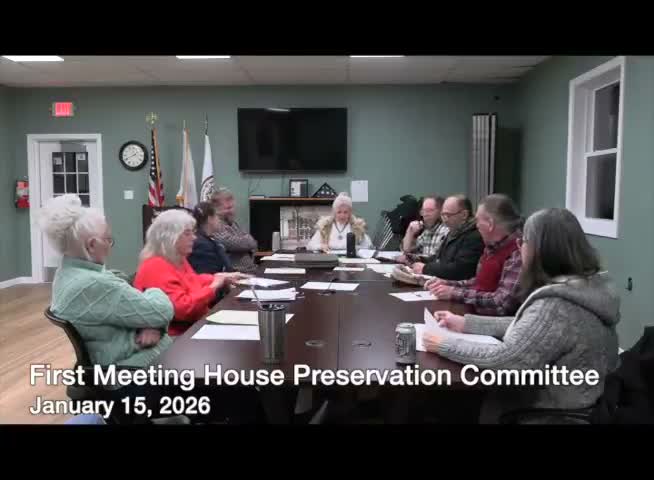
At a recent Meeting House Committee meeting in the Town of Hubbardston, members discussed whether the town’s newly acquired meeting house should be used as a permanent museum or kept flexible for performances, community events and rotating exhibits, and they appointed a volunteer to track project funds.
The committee heard from residents and committee members about uses for the building. Laurie Gill, a two‑year resident, described touring the meeting house and asked, “Is it going to be a venue for various town functions, or is it going to be something that’s always there museum like?” Several members urged developing a clear mission statement to guide decisions.
Historical‑society advocates said a permanent museum would protect artifacts. Gary Kangas, a long‑time resident and identified in the discussion as the Historical Commission chair, said his original vision was “to have the town museum in there” and recommended discreet security measures because of past break‑ins. Others cautioned that permanently dedicating the downstairs to a museum would limit other uses; one member suggested “a rolling display” or temporary exhibits so items could be shown without occupying the space full‑time.
Committee members also discussed practical constraints. Multiple speakers noted the kitchen is not up to commercial standards and “you’d have to gut it and bring it up to standards,” including installing a commercial hood and suppression system, which would be expensive and could conflict with historic‑preservation restrictions. Members raised building integrity and accessibility concerns, with one noting the basement and some structural elements are old; feasibility work has been done by a consultant and the draft report was circulated to the committee that day. Speaker 2 emphasized near‑term, essential items and suggested a “straw man budget” broken down by annual fixed costs and winterization needs rather than committing to full‑time operations immediately.
Susan Worth, who described herself as a member of the CPC and the Historical Commission, reviewed Community Preservation Coalition guidance and summarized preliminary account balances she had collected (she cautioned the numbers were not official): Open Space approximately $51,077.49, Historic approximately $15,967, Housing approximately $42,766, and an undesignated reserve of about $140,001.99. She noted CPA funding can be used for rehabilitation, restoration and certain ADA upgrades when consistent with historic standards.
On committee business, a motion to appoint Susan Worth as the committee’s volunteer funds tracker (described in the meeting as a treasurer or “money tracker”) was moved and seconded; the motion passed by voice vote and Worth accepted the role. The committee also approved prior meeting minutes earlier in the session by voice vote.
Members agreed on several next steps: circulate and post the consultant feasibility report and preservation restriction documents in a centralized place on the town website, form small subcommittees (no larger than a quorum) to prioritize facility issues and draft a mission statement, investigate septic and winterization costs, and explore options for temporary or rotating exhibits that would preserve flexibility. The committee set its next meeting for February 19 at 6:00 p.m. and adjourned.
The meeting record shows discussion and several volunteer assignments but no formal vote to dedicate the meeting house to a single permanent use; decisions about permanent museum displays or major capital changes were deferred pending review of the feasibility report, exact budget figures and consultation on preservation restrictions.
The committee heard from residents and committee members about uses for the building. Laurie Gill, a two‑year resident, described touring the meeting house and asked, “Is it going to be a venue for various town functions, or is it going to be something that’s always there museum like?” Several members urged developing a clear mission statement to guide decisions.
Historical‑society advocates said a permanent museum would protect artifacts. Gary Kangas, a long‑time resident and identified in the discussion as the Historical Commission chair, said his original vision was “to have the town museum in there” and recommended discreet security measures because of past break‑ins. Others cautioned that permanently dedicating the downstairs to a museum would limit other uses; one member suggested “a rolling display” or temporary exhibits so items could be shown without occupying the space full‑time.
Committee members also discussed practical constraints. Multiple speakers noted the kitchen is not up to commercial standards and “you’d have to gut it and bring it up to standards,” including installing a commercial hood and suppression system, which would be expensive and could conflict with historic‑preservation restrictions. Members raised building integrity and accessibility concerns, with one noting the basement and some structural elements are old; feasibility work has been done by a consultant and the draft report was circulated to the committee that day. Speaker 2 emphasized near‑term, essential items and suggested a “straw man budget” broken down by annual fixed costs and winterization needs rather than committing to full‑time operations immediately.
Susan Worth, who described herself as a member of the CPC and the Historical Commission, reviewed Community Preservation Coalition guidance and summarized preliminary account balances she had collected (she cautioned the numbers were not official): Open Space approximately $51,077.49, Historic approximately $15,967, Housing approximately $42,766, and an undesignated reserve of about $140,001.99. She noted CPA funding can be used for rehabilitation, restoration and certain ADA upgrades when consistent with historic standards.
On committee business, a motion to appoint Susan Worth as the committee’s volunteer funds tracker (described in the meeting as a treasurer or “money tracker”) was moved and seconded; the motion passed by voice vote and Worth accepted the role. The committee also approved prior meeting minutes earlier in the session by voice vote.
Members agreed on several next steps: circulate and post the consultant feasibility report and preservation restriction documents in a centralized place on the town website, form small subcommittees (no larger than a quorum) to prioritize facility issues and draft a mission statement, investigate septic and winterization costs, and explore options for temporary or rotating exhibits that would preserve flexibility. The committee set its next meeting for February 19 at 6:00 p.m. and adjourned.
The meeting record shows discussion and several volunteer assignments but no formal vote to dedicate the meeting house to a single permanent use; decisions about permanent museum displays or major capital changes were deferred pending review of the feasibility report, exact budget figures and consultation on preservation restrictions.
View the Full Meeting & All Its Details
This article offers just a summary. Unlock complete video, transcripts, and insights as a Founder Member.
✓
Watch full, unedited meeting videos
✓
Search every word spoken in unlimited transcripts
✓
AI summaries & real-time alerts (all government levels)
✓
Permanent access to expanding government content
30-day money-back guarantee
