Michigan House asks court to pause $644.9 million in work-project spending; judge declines immediate restraining order
January 17, 2026 | Supreme Court Judicial Rulings ( Opinions ), Judicial, Michigan
This article was created by AI summarizing key points discussed. AI makes mistakes, so for full details and context, please refer to the video of the full meeting. Please report any errors so we can fix them. Report an error »
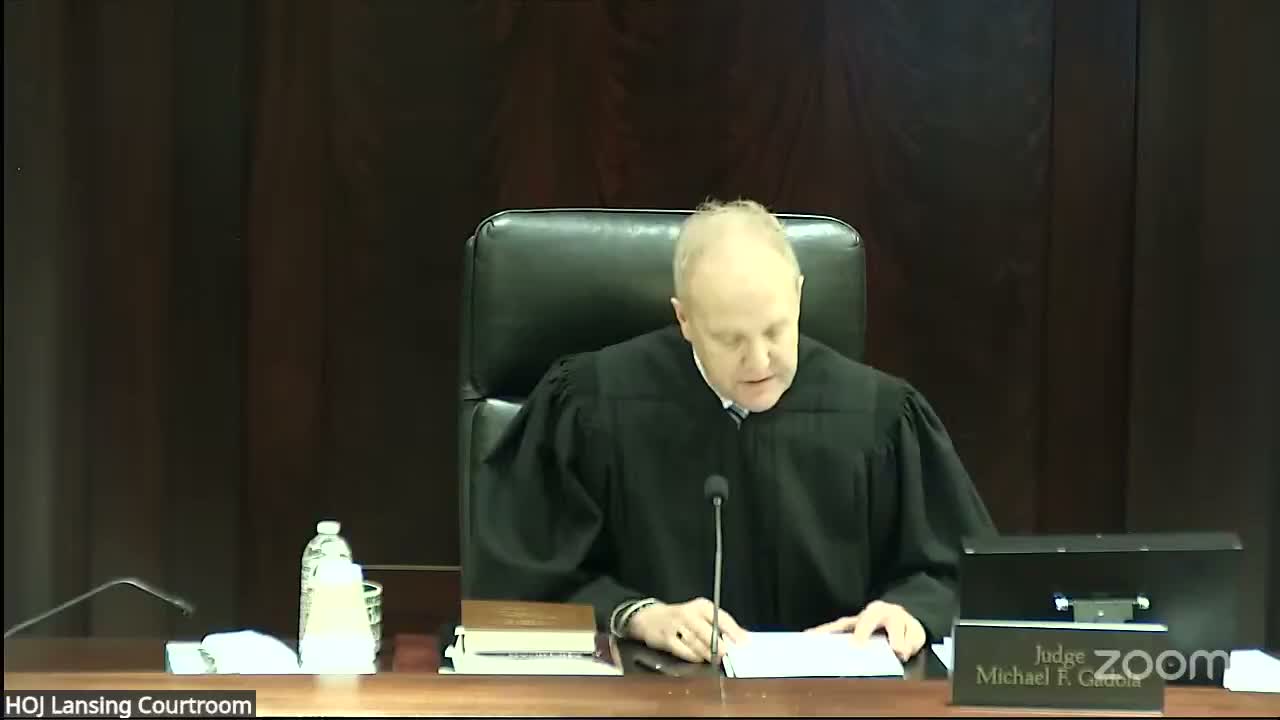
A Michigan Court of Claims judge said on the record that he was not inclined to issue a temporary restraining order after hearing arguments from the Michigan House and state lawyers over whether the executive branch may continue to spend certain work-project appropriations.
Sean Dutton, counsel for the House, told the court the hearing’s limited purpose was to "stop the bleeding" while the parties litigate whether the executive may lawfully retain and spend money the House says should have lapsed. "They are spending money that we think they have no right to have," Dutton said, arguing that the alleged ongoing expenditures create both an institutional harm to the legislature and monetary harms that would be difficult or impossible to claw back.
Assistant Attorney General Adam DeBaer disputed the breadth of the relief the House sought and urged the court to limit any injunction, if issued, to funds that were not timely encumbered. DeBaer said the state’s reporting mechanisms and audits help prevent improper spending and that, in his view, the parties and the court should focus on unencumbered balances. "I never represented that the state is still spending this money," DeBaer said, noting he had not instructed agencies not to spend funds but also telling the court that many departments had not rushed to expend unencumbered funds.
Scott Eldridge, counsel for the Michigan Economic Development Corporation, told the judge that MEDC’s unrebutted affidavit shows most MEDC-designated funds were encumbered before the statutory deadline, and that MEDC has "taken a step to go ahead and just stop, until this is resolved" with respect to unencumbered funds. Eldridge said roughly $11.9 million of MEDC's roughly $104 million at issue remained unencumbered, per MEDC’s accounting provided to the court.
Much of the hearing turned on statutory interpretation of the Management and Budget Act (including references to MCL 18.1451 and adjacent subsections) and separation-of-powers questions about whether the budget director’s "propose to be designated" authority operates as an effective unilateral extension of appropriations. Counsel debated whether the disapproval authority reserved to legislative committees is severable from the remainder of the statutory scheme if a court finds that disapproval power unconstitutional.
The judge repeatedly pressed counsel on the practical consequence of a TRO that would distinguish encumbered from unencumbered funds, asking whether the House could actually claw funds back and how the budget codes in the state’s accounting system (SIGMA) reflect encumbrances. Counsel disagreed on the accuracy of the House’s $644.9 million figure; the state said a large portion of that total was encumbered in time.
At the close of argument the judge said the court was "still not inclined to issue a temporary restraining order" at the hearing and that he would issue a written ruling on the preliminary injunction question "by the middle of next week." The judge adjourned the hearing and indicated the underlying lawsuit will continue to proceed regardless of the preliminary-injunction determination.
The dispute centers on whether work-project designations and the legislature’s committee disapproval mechanism permit the executive to retain and spend appropriated funds beyond the typical one-year lapse, and whether any portion of the disputed funds can be frozen without harming contracts and encumbered obligations. The House has asked the court to preserve the status quo for unencumbered funds while the litigation proceeds; state counsel argues that an overly broad injunction could prevent the state from honoring valid encumbrances and contracts.
A written decision was promised by mid next week; meanwhile the lawsuit remains active.
Sean Dutton, counsel for the House, told the court the hearing’s limited purpose was to "stop the bleeding" while the parties litigate whether the executive may lawfully retain and spend money the House says should have lapsed. "They are spending money that we think they have no right to have," Dutton said, arguing that the alleged ongoing expenditures create both an institutional harm to the legislature and monetary harms that would be difficult or impossible to claw back.
Assistant Attorney General Adam DeBaer disputed the breadth of the relief the House sought and urged the court to limit any injunction, if issued, to funds that were not timely encumbered. DeBaer said the state’s reporting mechanisms and audits help prevent improper spending and that, in his view, the parties and the court should focus on unencumbered balances. "I never represented that the state is still spending this money," DeBaer said, noting he had not instructed agencies not to spend funds but also telling the court that many departments had not rushed to expend unencumbered funds.
Scott Eldridge, counsel for the Michigan Economic Development Corporation, told the judge that MEDC’s unrebutted affidavit shows most MEDC-designated funds were encumbered before the statutory deadline, and that MEDC has "taken a step to go ahead and just stop, until this is resolved" with respect to unencumbered funds. Eldridge said roughly $11.9 million of MEDC's roughly $104 million at issue remained unencumbered, per MEDC’s accounting provided to the court.
Much of the hearing turned on statutory interpretation of the Management and Budget Act (including references to MCL 18.1451 and adjacent subsections) and separation-of-powers questions about whether the budget director’s "propose to be designated" authority operates as an effective unilateral extension of appropriations. Counsel debated whether the disapproval authority reserved to legislative committees is severable from the remainder of the statutory scheme if a court finds that disapproval power unconstitutional.
The judge repeatedly pressed counsel on the practical consequence of a TRO that would distinguish encumbered from unencumbered funds, asking whether the House could actually claw funds back and how the budget codes in the state’s accounting system (SIGMA) reflect encumbrances. Counsel disagreed on the accuracy of the House’s $644.9 million figure; the state said a large portion of that total was encumbered in time.
At the close of argument the judge said the court was "still not inclined to issue a temporary restraining order" at the hearing and that he would issue a written ruling on the preliminary injunction question "by the middle of next week." The judge adjourned the hearing and indicated the underlying lawsuit will continue to proceed regardless of the preliminary-injunction determination.
The dispute centers on whether work-project designations and the legislature’s committee disapproval mechanism permit the executive to retain and spend appropriated funds beyond the typical one-year lapse, and whether any portion of the disputed funds can be frozen without harming contracts and encumbered obligations. The House has asked the court to preserve the status quo for unencumbered funds while the litigation proceeds; state counsel argues that an overly broad injunction could prevent the state from honoring valid encumbrances and contracts.
A written decision was promised by mid next week; meanwhile the lawsuit remains active.
Don't Miss a Word: See the Full Meeting!
Go beyond summaries. Unlock every video, transcript, and key insight with a Founder Membership.
✓
Get instant access to full meeting videos
✓
Search and clip any phrase from complete transcripts
✓
Receive AI-powered summaries & custom alerts
✓
Enjoy lifetime, unrestricted access to government data
30-day money-back guarantee
