City of Portland reports 8,677 employees, 741 non-casual vacancies and hiring challenges to committee
January 17, 2026 | Portland, Multnomah County, Oregon
This article was created by AI summarizing key points discussed. AI makes mistakes, so for full details and context, please refer to the video of the full meeting. Please report any errors so we can fix them. Report an error »
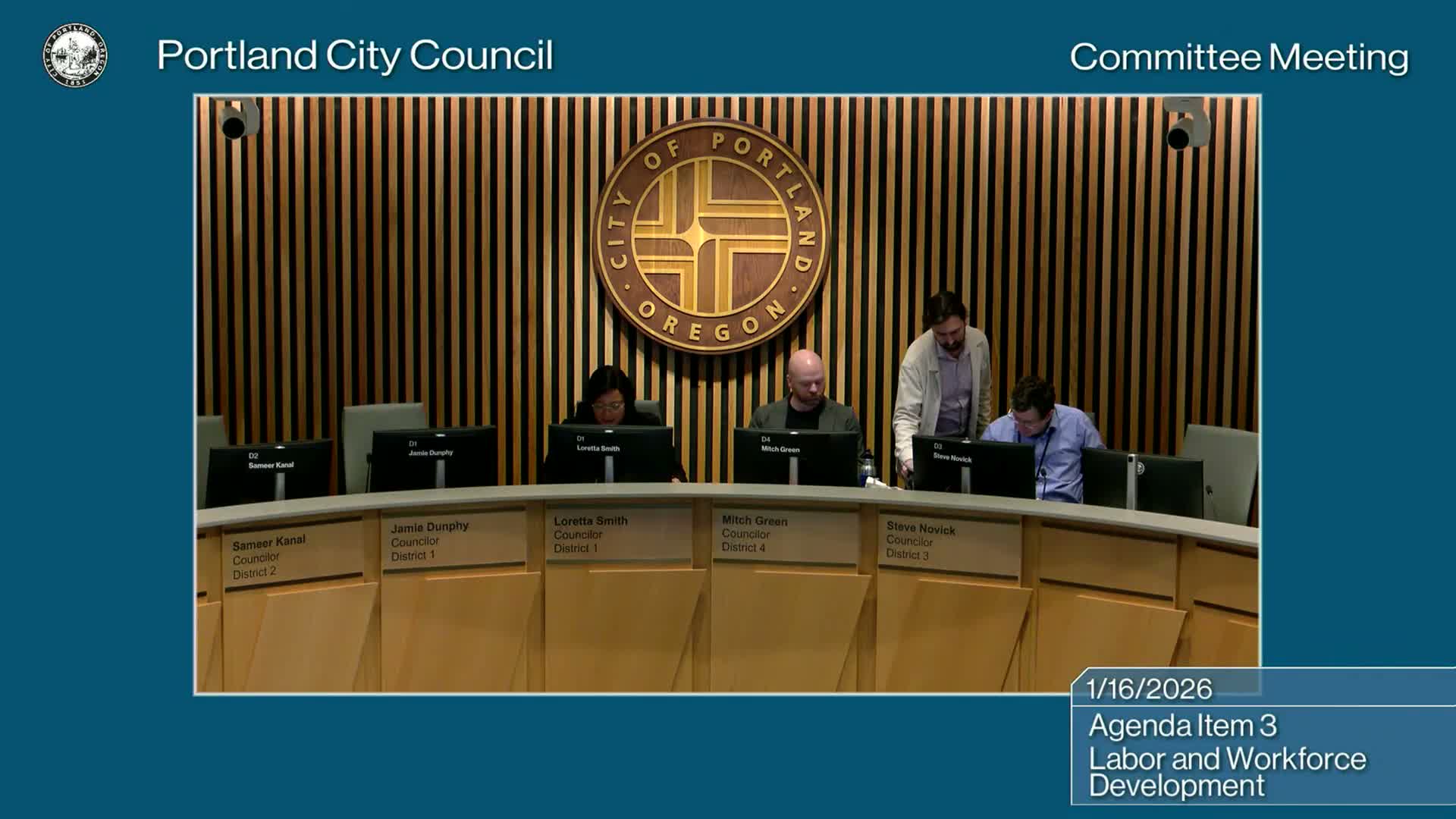
Bureau of Human Resources officials presented a personnel update to the Labor and Workforce Development Committee on Jan. 16, reporting staffing levels, turnover patterns and initiatives to strengthen recruitment pipelines.
Ronald Zito, director of the Bureau of Human Resources, told the committee the city employed about 8,677 total workers as of Jan. 1, including 6,709 non-casual employees and 1,968 casual or seasonal employees (about 22 percent casual). He said the bureau counted roughly 741 non-casual vacancies, with about 386 of those currently in active recruitments.
Christopher Parra, the city’s workforce recruitment and training manager, said one key hiring metric is time to fill — defined as the time from requisition to a verbal offer — and that the bureau’s goal is 85 days; the recent five-year average was about 86 days. Parra noted requisitions have declined in the last two fiscal years compared with a five-year average, a pattern the bureau associates with budget constraints and shifting resource allocation.
Risa Williams, the classification, compensation and pay equity manager, said the city’s classification structure contains more than 738 classifications and that base pay increases since 2017 have outpaced inflation: "The base rate for represented employees has increased by more than 46%," she said, and about 42 percent of classifications now have a maximum salary at or above $100,000.
BHR highlighted recruitment pipelines and workforce development programs including SummerWorks (paid internships and learn-and-earn opportunities for ages 16–24), partnerships with Worksystems Inc., university cooperative programs for engineers, and a water distribution worker trainee program requiring about 4,000 hours over up to two years that has transitioned trainees into journey-worker roles. The bureau said apprenticeship and traineeship programs are a strategy to address hard-to-fill roles such as facilities maintenance technicians and electricians.
Councilors raised follow-up requests and concerns: they asked for year-by-year breakdowns of span-of-control metrics, additional detail on the composition of large bureau FTE counts, and further analysis of retirement-eligible staff. Councilor Green pushed the bureau to consider benefit-cost strategies, including in-house clinic models to restrain health-care inflation; BHR said the idea is among options discussed in labor-management benefits forums and that the city recently added on-site EAP support.
BHR said it has been operating under a hiring freeze since Oct. 1 with exceptions through an approval process; the bureau also noted multiple class/comp studies in bargaining and realignment work expected to affect hiring and compensation moving into the budget cycle.
The committee asked BHR to provide additional breakout data and follow-up materials for budget planning and for scheduled future committee sessions.
Ronald Zito, director of the Bureau of Human Resources, told the committee the city employed about 8,677 total workers as of Jan. 1, including 6,709 non-casual employees and 1,968 casual or seasonal employees (about 22 percent casual). He said the bureau counted roughly 741 non-casual vacancies, with about 386 of those currently in active recruitments.
Christopher Parra, the city’s workforce recruitment and training manager, said one key hiring metric is time to fill — defined as the time from requisition to a verbal offer — and that the bureau’s goal is 85 days; the recent five-year average was about 86 days. Parra noted requisitions have declined in the last two fiscal years compared with a five-year average, a pattern the bureau associates with budget constraints and shifting resource allocation.
Risa Williams, the classification, compensation and pay equity manager, said the city’s classification structure contains more than 738 classifications and that base pay increases since 2017 have outpaced inflation: "The base rate for represented employees has increased by more than 46%," she said, and about 42 percent of classifications now have a maximum salary at or above $100,000.
BHR highlighted recruitment pipelines and workforce development programs including SummerWorks (paid internships and learn-and-earn opportunities for ages 16–24), partnerships with Worksystems Inc., university cooperative programs for engineers, and a water distribution worker trainee program requiring about 4,000 hours over up to two years that has transitioned trainees into journey-worker roles. The bureau said apprenticeship and traineeship programs are a strategy to address hard-to-fill roles such as facilities maintenance technicians and electricians.
Councilors raised follow-up requests and concerns: they asked for year-by-year breakdowns of span-of-control metrics, additional detail on the composition of large bureau FTE counts, and further analysis of retirement-eligible staff. Councilor Green pushed the bureau to consider benefit-cost strategies, including in-house clinic models to restrain health-care inflation; BHR said the idea is among options discussed in labor-management benefits forums and that the city recently added on-site EAP support.
BHR said it has been operating under a hiring freeze since Oct. 1 with exceptions through an approval process; the bureau also noted multiple class/comp studies in bargaining and realignment work expected to affect hiring and compensation moving into the budget cycle.
The committee asked BHR to provide additional breakout data and follow-up materials for budget planning and for scheduled future committee sessions.
View the Full Meeting & All Its Details
This article offers just a summary. Unlock complete video, transcripts, and insights as a Founder Member.
✓
Watch full, unedited meeting videos
✓
Search every word spoken in unlimited transcripts
✓
AI summaries & real-time alerts (all government levels)
✓
Permanent access to expanding government content
30-day money-back guarantee
