AOT study finds Act 181 exemptions would cut modest impact-fee revenue and shift mitigation to local governments
January 17, 2026 | Senate Transportation, SENATE, Committees, Legislative , Vermont
This article was created by AI summarizing key points discussed. AI makes mistakes, so for full details and context, please refer to the video of the full meeting. Please report any errors so we can fix them. Report an error »
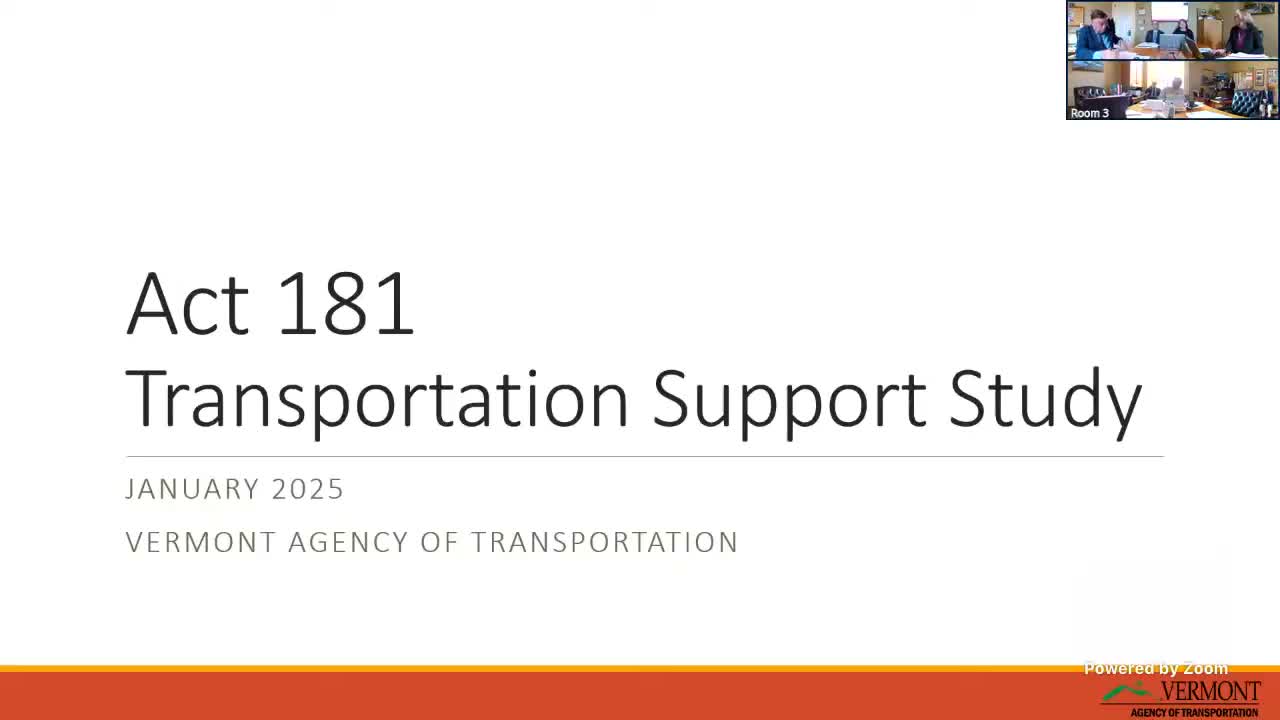
Marcela Dent, a planning coordinator at the Agency of Transportation, told the Senate Transportation Committee that the agency commissioned a transportation support study to assess how Act 181’s tiered mapping and exemptions could change the state’s role in development review and affect revenues historically collected through Act 145.
Consultant Jonathan Slicin of RSG summarized the study’s scope and findings. He said Act 145 (the statewide transportation impact fee established circa 2014) has produced limited revenue: roughly 53 projects and about 156 land-use applications have paid the fee, concentrated in Chittenden County. “The revenue itself has not been substantial, about $160,000 per year,” Slicin said. He noted that one large project, the Colchester Diverging Diamond Interchange, generated about $309,000 in total fees for that facility.
Why it matters: Act 181 creates standardized tier mapping and exempts many Tier 1A and 1B land-use applications from Act 250 review. Because Act 145 fees commonly are assessed through that development-review pathway, Slicin told senators that exempting those tiers could remove a mechanism that has contributed to mitigation funding. “We’re estimating that if [the exemptions] went in today, it might be somewhere around $50,000 lost out of that $160,000,” he said, emphasizing that the figure depends on future growth patterns.
Committee members pressed presenters on what the change would mean in practice. Senators pointed out that the exempted areas are precisely where the state wants growth — downtowns and locations with water and sewer service — and asked whether removing the state-level review would lead developers to locate projects just outside tier boundaries to avoid fees. Slicin said that pattern has occurred historically and that removing the state’s review tool reduces one way to generate fair-share mitigation.
The presentation looked beyond fees to examine transit and travel-demand management (TDM). Slicin and AOT staff said Act 145 explicitly limited contributions to vehicle-capacity projects and did not fund transit or TDM directly; development-review mechanisms historically have not been a primary, stable funding source for transit operations. Committee members and presenters discussed local examples of developer or private contributions to transit (one resort was cited as contributing roughly $100,000 per year) and the importance of having durable, agreed-upon mitigation standards.
Options and opportunities identified in the report include:
- Strengthening municipal development-review capacity with technical assistance, model ordinances or level-of-service standards so towns can impose predictable mitigation; regional planning commissions (RPCs) were the stakeholders’ preferred avenue for delivering such support.
- Statutory changes or targeted administrative options, including amending Section 1111 (the state permitting authority for work in state rights-of-way) so AOT could collect certain fees or require studies in defined circumstances, while recognizing that would require administrative resources and guidance on scope.
- Revisiting municipal impact fees and Transportation Improvement Districts as locally governed mechanisms to capture mitigation funding where appropriate.
AOT engineer Chris Tyle described an instance where a development one block from a state highway did not require a Section 1111 permit but nonetheless raised concerns about effects on the state road; he said the agency would want a traffic-impact study in such cases so off-site impacts could be assessed. “I think I would want the developer to do a traffic-impact study on that,” Tyle said.
What was not decided: The committee did not take formal votes or adopt statutory language at the meeting. Presenters recommended follow-up work on whether and how to (1) expand municipal standards, (2) provide RPC technical support, and (3) pursue narrow statutory changes such as clarifying Section 1111 or enabling limited AOT participation in local review when state-system impacts are likely.
Next steps: Committee members thanked the presenters and indicated interest in additional materials (examples from New Hampshire towns, model checklists and further detail on Section 1111 implications) and follow-up conversations with AOT and RPCs. The meeting adjourned with no formal action taken.
Consultant Jonathan Slicin of RSG summarized the study’s scope and findings. He said Act 145 (the statewide transportation impact fee established circa 2014) has produced limited revenue: roughly 53 projects and about 156 land-use applications have paid the fee, concentrated in Chittenden County. “The revenue itself has not been substantial, about $160,000 per year,” Slicin said. He noted that one large project, the Colchester Diverging Diamond Interchange, generated about $309,000 in total fees for that facility.
Why it matters: Act 181 creates standardized tier mapping and exempts many Tier 1A and 1B land-use applications from Act 250 review. Because Act 145 fees commonly are assessed through that development-review pathway, Slicin told senators that exempting those tiers could remove a mechanism that has contributed to mitigation funding. “We’re estimating that if [the exemptions] went in today, it might be somewhere around $50,000 lost out of that $160,000,” he said, emphasizing that the figure depends on future growth patterns.
Committee members pressed presenters on what the change would mean in practice. Senators pointed out that the exempted areas are precisely where the state wants growth — downtowns and locations with water and sewer service — and asked whether removing the state-level review would lead developers to locate projects just outside tier boundaries to avoid fees. Slicin said that pattern has occurred historically and that removing the state’s review tool reduces one way to generate fair-share mitigation.
The presentation looked beyond fees to examine transit and travel-demand management (TDM). Slicin and AOT staff said Act 145 explicitly limited contributions to vehicle-capacity projects and did not fund transit or TDM directly; development-review mechanisms historically have not been a primary, stable funding source for transit operations. Committee members and presenters discussed local examples of developer or private contributions to transit (one resort was cited as contributing roughly $100,000 per year) and the importance of having durable, agreed-upon mitigation standards.
Options and opportunities identified in the report include:
- Strengthening municipal development-review capacity with technical assistance, model ordinances or level-of-service standards so towns can impose predictable mitigation; regional planning commissions (RPCs) were the stakeholders’ preferred avenue for delivering such support.
- Statutory changes or targeted administrative options, including amending Section 1111 (the state permitting authority for work in state rights-of-way) so AOT could collect certain fees or require studies in defined circumstances, while recognizing that would require administrative resources and guidance on scope.
- Revisiting municipal impact fees and Transportation Improvement Districts as locally governed mechanisms to capture mitigation funding where appropriate.
AOT engineer Chris Tyle described an instance where a development one block from a state highway did not require a Section 1111 permit but nonetheless raised concerns about effects on the state road; he said the agency would want a traffic-impact study in such cases so off-site impacts could be assessed. “I think I would want the developer to do a traffic-impact study on that,” Tyle said.
What was not decided: The committee did not take formal votes or adopt statutory language at the meeting. Presenters recommended follow-up work on whether and how to (1) expand municipal standards, (2) provide RPC technical support, and (3) pursue narrow statutory changes such as clarifying Section 1111 or enabling limited AOT participation in local review when state-system impacts are likely.
Next steps: Committee members thanked the presenters and indicated interest in additional materials (examples from New Hampshire towns, model checklists and further detail on Section 1111 implications) and follow-up conversations with AOT and RPCs. The meeting adjourned with no formal action taken.
View the Full Meeting & All Its Details
This article offers just a summary. Unlock complete video, transcripts, and insights as a Founder Member.
✓
Watch full, unedited meeting videos
✓
Search every word spoken in unlimited transcripts
✓
AI summaries & real-time alerts (all government levels)
✓
Permanent access to expanding government content
30-day money-back guarantee
