After failed bond, Mercer Island staff to reframe facilities plan, leverage new 9655 building and step up engagement
January 17, 2026 | Mercer Island, King County, Washington
This article was created by AI summarizing key points discussed. AI makes mistakes, so for full details and context, please refer to the video of the full meeting. Please report any errors so we can fix them. Report an error »
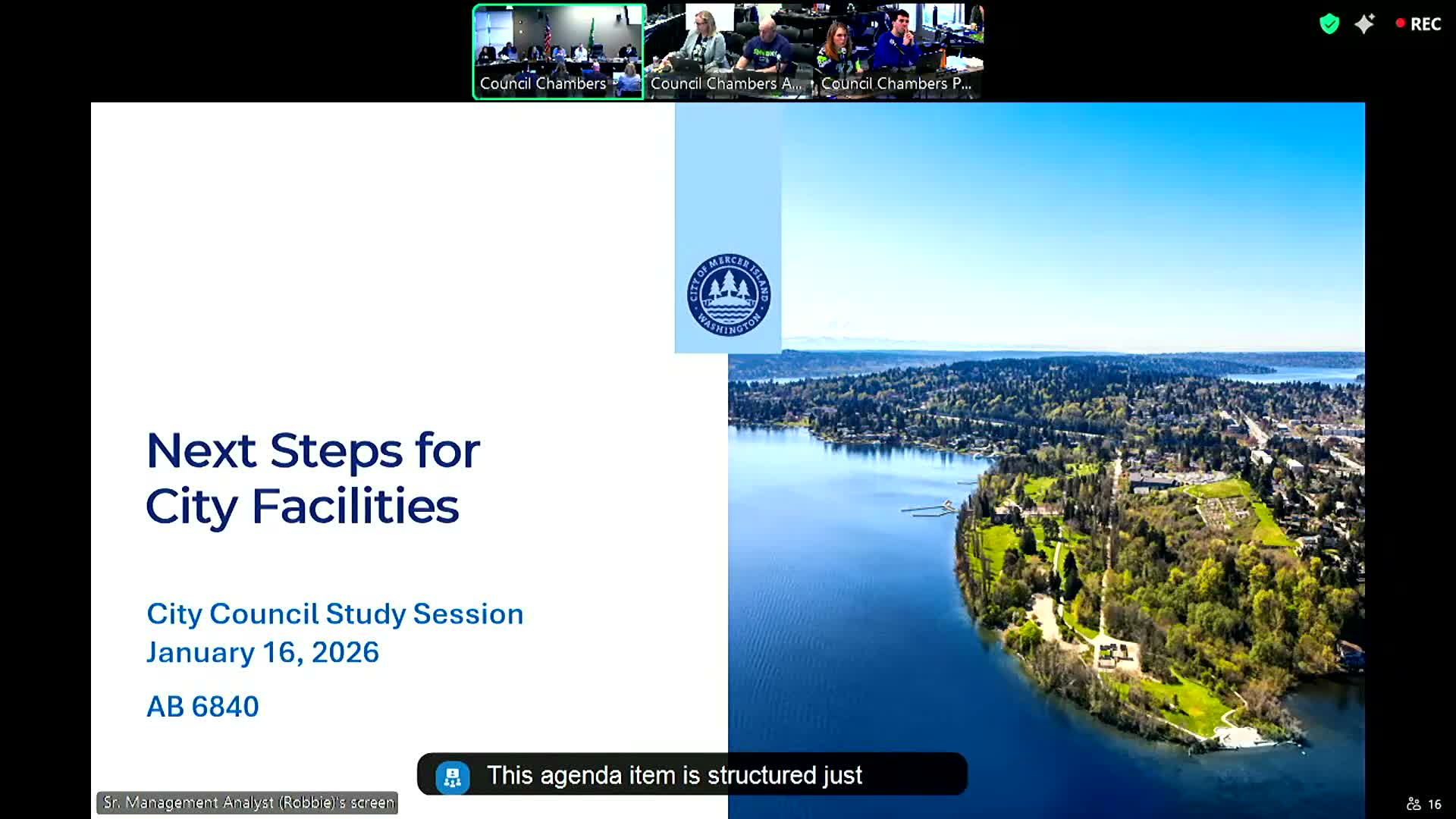
Mercer Island city leaders used the Jan. 16 planning session to examine lessons from a failed November bond measure intended to fund a public‑safety and maintenance (PSM) facility and related projects, and to give staff direction to reshape the approach.
Staff and council members traced the vote result to several factors: perceived confusion about project scope (many voters thought the proposal was a new city hall), the $103 million price tag and the 25‑year debt implication, and mixed economic context at the time of the vote. City Manager Jessie Baughn and staff emphasized that City Hall was permanently closed after a 2023 asbestos finding that had left settled asbestos fibers in HVAC system insulation; staff said abatement and full rehabilitation proved costly and likely required code upgrades and structural work that made reoccupation infeasible.
What staff proposed and council directed: staff presented a retooled, phased strategy that starts by maximizing recently purchased municipal property (the 9655 Building, roughly 22,000 square feet), reusing and renovating where practical; right‑sizing any new construction and redistributing functions (for example, moving non‑public‑facing operations to industrial‑type space and keeping critical public access functions in more central locations); and increasing community engagement, including staff tours, targeted surveys and clear visuals that show asset lifecycles.
Staff said emergency operations and police needs remain urgent: police currently operate from modular temporary buildings on the City Hall campus; those units are functional but not a long‑term solution because of security and operational limitations (no sally port, constrained holding areas) and impacts on recruitment and accreditation. The city also reported staff displacement across departments and use of leased court space in other jurisdictions.
Council reflections and guidance: members urged improved public messaging that demonstrates lifecycle replacement needs across a portfolio of aging city facilities (one councilor suggested a simple graphic that shows a "conveyor belt" of buildings aging out). Several councilors recommended scaling a potential bond into smaller, more digestible chunks, better explaining recurring capital needs, and emphasizing operational efficiencies and prioritizing safety‑critical work. There was unanimous support for pursuing a smaller, phased plan and for stepped community engagement including open houses, staff tours and a public survey to reach voters before a future ballot measure.
Next steps: staff said they will continue space‑planning work and return in February/March with options and a community engagement plan. The city will also add a small appropriation in an upcoming packet to keep planning work moving. No bond or appropriation for construction was approved at the Jan. 16 meeting; council’s action was limited to direction and planning authorization.
Representative quotes:
"Everything is not fine," City Manager Jessie Baughn said, urging the council to recognize operational strain after City Hall’s closure. "This is not sustainable."
Council Member Reynolds: "I don't want us to fall into the trap of doing a short‑term solution that costs more in the long run; build something that lasts."
The council will use input from a planned survey and public meetings to revise plans and cost estimates before considering another ballot measure.
Staff and council members traced the vote result to several factors: perceived confusion about project scope (many voters thought the proposal was a new city hall), the $103 million price tag and the 25‑year debt implication, and mixed economic context at the time of the vote. City Manager Jessie Baughn and staff emphasized that City Hall was permanently closed after a 2023 asbestos finding that had left settled asbestos fibers in HVAC system insulation; staff said abatement and full rehabilitation proved costly and likely required code upgrades and structural work that made reoccupation infeasible.
What staff proposed and council directed: staff presented a retooled, phased strategy that starts by maximizing recently purchased municipal property (the 9655 Building, roughly 22,000 square feet), reusing and renovating where practical; right‑sizing any new construction and redistributing functions (for example, moving non‑public‑facing operations to industrial‑type space and keeping critical public access functions in more central locations); and increasing community engagement, including staff tours, targeted surveys and clear visuals that show asset lifecycles.
Staff said emergency operations and police needs remain urgent: police currently operate from modular temporary buildings on the City Hall campus; those units are functional but not a long‑term solution because of security and operational limitations (no sally port, constrained holding areas) and impacts on recruitment and accreditation. The city also reported staff displacement across departments and use of leased court space in other jurisdictions.
Council reflections and guidance: members urged improved public messaging that demonstrates lifecycle replacement needs across a portfolio of aging city facilities (one councilor suggested a simple graphic that shows a "conveyor belt" of buildings aging out). Several councilors recommended scaling a potential bond into smaller, more digestible chunks, better explaining recurring capital needs, and emphasizing operational efficiencies and prioritizing safety‑critical work. There was unanimous support for pursuing a smaller, phased plan and for stepped community engagement including open houses, staff tours and a public survey to reach voters before a future ballot measure.
Next steps: staff said they will continue space‑planning work and return in February/March with options and a community engagement plan. The city will also add a small appropriation in an upcoming packet to keep planning work moving. No bond or appropriation for construction was approved at the Jan. 16 meeting; council’s action was limited to direction and planning authorization.
Representative quotes:
"Everything is not fine," City Manager Jessie Baughn said, urging the council to recognize operational strain after City Hall’s closure. "This is not sustainable."
Council Member Reynolds: "I don't want us to fall into the trap of doing a short‑term solution that costs more in the long run; build something that lasts."
The council will use input from a planned survey and public meetings to revise plans and cost estimates before considering another ballot measure.
Don't Miss a Word: See the Full Meeting!
Go beyond summaries. Unlock every video, transcript, and key insight with a Founder Membership.
✓
Get instant access to full meeting videos
✓
Search and clip any phrase from complete transcripts
✓
Receive AI-powered summaries & custom alerts
✓
Enjoy lifetime, unrestricted access to government data
30-day money-back guarantee
