Jones County commissioners approve conditional‑use rules to allow data centers in industrial park after heated public hearing
January 17, 2026 | Jones County, Georgia
This article was created by AI summarizing key points discussed. AI makes mistakes, so for full details and context, please refer to the video of the full meeting. Please report any errors so we can fix them. Report an error »
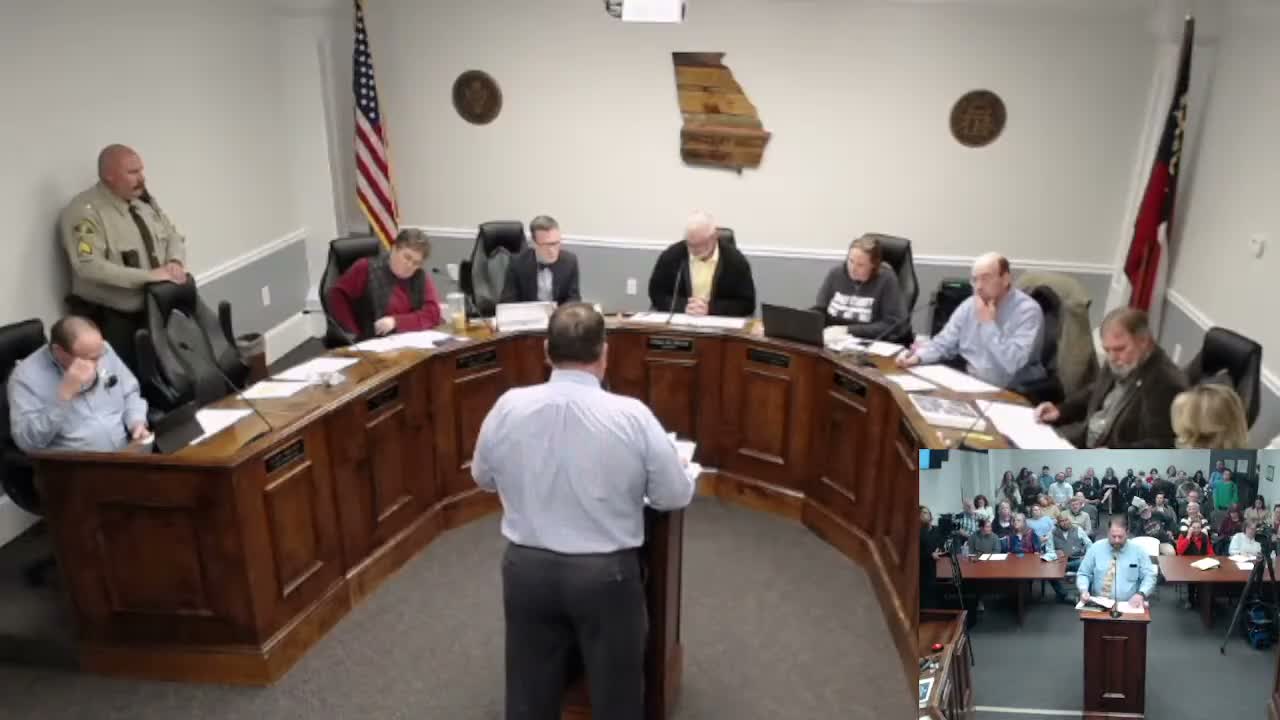
The Jones County Board of Commissioners voted Jan. 16 to adopt a zoning text amendment that establishes a conditional‑use pathway for data centers in the county’s M‑2 industrial district, after several hours of testimony from developers, technical experts and hundreds of residents.
Ken Gerard, the attorney the county retained to draft the ordinance, told the board the change does not make data centers an as‑of‑right use but creates a use‑permit track through which applicants must supply a baseline environmental impact study and meet board‑set benchmarks before a building permit is issued. "An application for a use permit for a data center shall be accompanied by a baseline environmental impact study," Gerard said, describing the two‑step review that lets the board require more specific mitigation at the permit stage.
Why it matters: Griswoldville Industrial Park is a roughly 1,000‑acre site the county has marketed for decades; proponents said the ordinance will improve marketability and could generate substantial tax revenue. Opponents and environmental advocates warned that the draft lacks adequate protections for groundwater, low‑frequency noise and cultural resources and urged a moratorium and independent reviews before the board acted.
What was proposed and approved: The adopted text makes data centers a conditional use in the M‑2 district and adds new baseline requirements for environmental review, setbacks and buffers and numeric noise limits that the board discussed in public. Gerard asked commissioners to consider changing the earlier 65 dBA daytime/55 dBA nighttime standard to "55 dBA daytime, 45 dBA nighttime"; commissioners debated but ultimately left the ordinance as the version shown on the screen and approved by motion.
Proponents' case: Jeff Haymore, a land‑use attorney representing the Jones County Development Authority, said the county’s 2022 comprehensive plan designates the parcel for industrial uses and that zoning is the county’s tool to implement that plan. Development‑authority chairman Eric Barnardo presented an economic impact estimate—derived by extrapolating a previous Highway 18 example—describing "about a $30,000,000,000 investment over the course of 20 years" and annual county tax receipts in the tens of millions, figures he said represent model estimates rather than guaranteed outcomes.
Opponents' concerns and technical testimony: Residents and specialists repeatedly pressed for stricter protections. Alexander Lefholtz argued the document lacked independent fiscal and infrastructure analysis and urged a moratorium, saying the proposed amendment was being advanced "without a single independent comparison to other options." Environmental groups and technical witnesses asked for more explicit wellhead and groundwater protections, diesel and hazardous‑fuel secondary containment, PFAS disclosure, traffic and stormwater plans, and stronger standards for low‑frequency vibration and noise. Fletcher Sams of Altamaha Riverkeeper urged adding site maps showing wells and fuel storage, saying the industrial park overlaps significant groundwater recharge areas. Lauren O'Quinn of the Middle Georgia Preservation Alliance asked for a Phase I archaeological survey before ground disturbance.
Board debate and vote: Commissioners who supported the amendment said the ordinance sets guardrails and keeps the final decision discretionary, allowing the board to deny applications that do not meet site‑specific mitigation. One commissioner offered an unsuccessful late amendment to set noise at 65 dBA day and night; the amendment failed for lack of a second. The motion to adopt the conditional‑use framework carried; the clerk recorded five ayes for the record and the ordinance was approved as presented.
What happens next: Approval of the code change does not authorize any particular data‑center project. Any developer still must file a use‑permit application, provide the baseline studies and undergo public hearings and a separate board vote on that application. Several speakers and the county’s attorney encouraged residents to monitor for required legal notices and to participate when formal permit applications are filed.
Quotes that capture the meeting’s tenor:
"An application for a use permit for a data center shall be accompanied by a baseline environmental impact study," — Ken Gerard, county counsel retained attorney, on the two‑step environmental review.
"If a project requires large public resources and then also blocks the kind of employers we say we want, that is not growth, that is a bad trade," — Alexander Lefholtz, resident and opponent.
"This has tasked the authority with carrying out that vision," — Jeff Haymore, representing the Jones County Development Authority, on implementing the comprehensive plan.
Ending: The board also withdrew a separate agenda item that would have extended an existing moratorium. Commissioners and staff repeatedly told residents the ordinance is a framework; detailed, project‑level environmental, traffic, noise and cultural‑resource documents will be required when and if specific applications are filed.
Ken Gerard, the attorney the county retained to draft the ordinance, told the board the change does not make data centers an as‑of‑right use but creates a use‑permit track through which applicants must supply a baseline environmental impact study and meet board‑set benchmarks before a building permit is issued. "An application for a use permit for a data center shall be accompanied by a baseline environmental impact study," Gerard said, describing the two‑step review that lets the board require more specific mitigation at the permit stage.
Why it matters: Griswoldville Industrial Park is a roughly 1,000‑acre site the county has marketed for decades; proponents said the ordinance will improve marketability and could generate substantial tax revenue. Opponents and environmental advocates warned that the draft lacks adequate protections for groundwater, low‑frequency noise and cultural resources and urged a moratorium and independent reviews before the board acted.
What was proposed and approved: The adopted text makes data centers a conditional use in the M‑2 district and adds new baseline requirements for environmental review, setbacks and buffers and numeric noise limits that the board discussed in public. Gerard asked commissioners to consider changing the earlier 65 dBA daytime/55 dBA nighttime standard to "55 dBA daytime, 45 dBA nighttime"; commissioners debated but ultimately left the ordinance as the version shown on the screen and approved by motion.
Proponents' case: Jeff Haymore, a land‑use attorney representing the Jones County Development Authority, said the county’s 2022 comprehensive plan designates the parcel for industrial uses and that zoning is the county’s tool to implement that plan. Development‑authority chairman Eric Barnardo presented an economic impact estimate—derived by extrapolating a previous Highway 18 example—describing "about a $30,000,000,000 investment over the course of 20 years" and annual county tax receipts in the tens of millions, figures he said represent model estimates rather than guaranteed outcomes.
Opponents' concerns and technical testimony: Residents and specialists repeatedly pressed for stricter protections. Alexander Lefholtz argued the document lacked independent fiscal and infrastructure analysis and urged a moratorium, saying the proposed amendment was being advanced "without a single independent comparison to other options." Environmental groups and technical witnesses asked for more explicit wellhead and groundwater protections, diesel and hazardous‑fuel secondary containment, PFAS disclosure, traffic and stormwater plans, and stronger standards for low‑frequency vibration and noise. Fletcher Sams of Altamaha Riverkeeper urged adding site maps showing wells and fuel storage, saying the industrial park overlaps significant groundwater recharge areas. Lauren O'Quinn of the Middle Georgia Preservation Alliance asked for a Phase I archaeological survey before ground disturbance.
Board debate and vote: Commissioners who supported the amendment said the ordinance sets guardrails and keeps the final decision discretionary, allowing the board to deny applications that do not meet site‑specific mitigation. One commissioner offered an unsuccessful late amendment to set noise at 65 dBA day and night; the amendment failed for lack of a second. The motion to adopt the conditional‑use framework carried; the clerk recorded five ayes for the record and the ordinance was approved as presented.
What happens next: Approval of the code change does not authorize any particular data‑center project. Any developer still must file a use‑permit application, provide the baseline studies and undergo public hearings and a separate board vote on that application. Several speakers and the county’s attorney encouraged residents to monitor for required legal notices and to participate when formal permit applications are filed.
Quotes that capture the meeting’s tenor:
"An application for a use permit for a data center shall be accompanied by a baseline environmental impact study," — Ken Gerard, county counsel retained attorney, on the two‑step environmental review.
"If a project requires large public resources and then also blocks the kind of employers we say we want, that is not growth, that is a bad trade," — Alexander Lefholtz, resident and opponent.
"This has tasked the authority with carrying out that vision," — Jeff Haymore, representing the Jones County Development Authority, on implementing the comprehensive plan.
Ending: The board also withdrew a separate agenda item that would have extended an existing moratorium. Commissioners and staff repeatedly told residents the ordinance is a framework; detailed, project‑level environmental, traffic, noise and cultural‑resource documents will be required when and if specific applications are filed.
View the Full Meeting & All Its Details
This article offers just a summary. Unlock complete video, transcripts, and insights as a Founder Member.
✓
Watch full, unedited meeting videos
✓
Search every word spoken in unlimited transcripts
✓
AI summaries & real-time alerts (all government levels)
✓
Permanent access to expanding government content
30-day money-back guarantee
