House Education hears timeline and contingency concerns for Act 73 rollout
January 16, 2026 | Education, HOUSE OF REPRESENTATIVES, Committees, Legislative , Vermont
This article was created by AI summarizing key points discussed. AI makes mistakes, so for full details and context, please refer to the video of the full meeting. Please report any errors so we can fix them. Report an error »
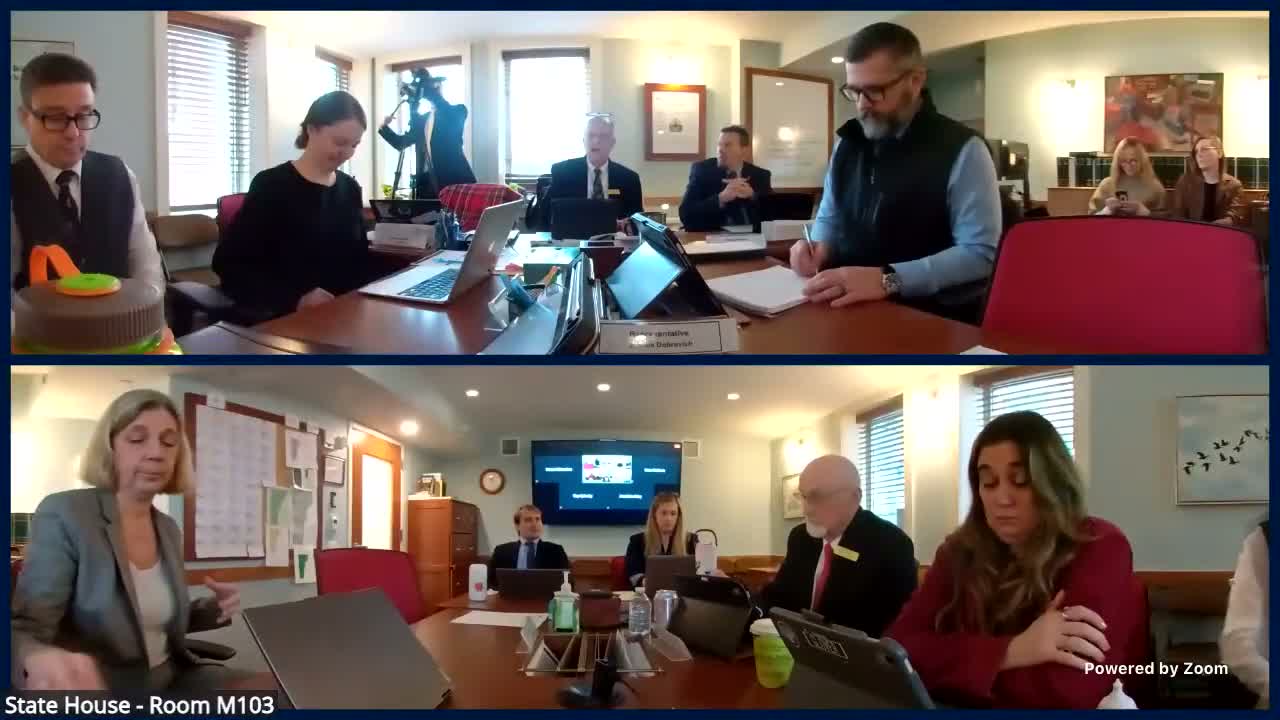
The House Education Committee on Jan. 15 heard a briefing from Legislative Council staff on Act 73’s timeline, contingent provisions and what must happen before elements such as a statewide foundation formula take effect.
Legislative Council attorney John Bray told the committee some changes in Act 73 are already scheduled to become statutory (with effective dates such as July 1, 2026), while other provisions are contingent. "This is a great illustration of session law versus, amending your green books statutory law," Bray said, explaining that provisions tied to contingencies do not take effect unless the specified conditions are met.
Staff walked members through the committee’s graphic timeline and the major dates the group flagged: earlier effective changes on 07/01/2025 (for certain tuitioning provisions); an intent and action window in the 2026 session for school district boundaries, CTE and pre-K updates; a practical date for initial school-board special elections in November 2027; administrative changes to property-tax classifications in January 2028; and the envisioned full-rollout of the foundation formula and associated homestead exemptions on 07/01/2028 (FY29). Bray stressed that the legislature can unlink or alter the package’s contingencies, but doing so is a conscious policy choice.
Lawmakers repeatedly pressed staff on how the foundation formula would change local tax dynamics. Representative Brady asked why modest local budget increases sometimes translate into double-digit local property-tax spikes and whether the foundation formula would fix that disconnect. Staff replied that the foundation approach replaces locally driven education tax levies with a statewide education tax based on each district’s calculated Educational Opportunity Payment (EOP) and student-weighted factors; local supplemental spending would still be raised locally and appraisal adjustments (CLA) could continue to move local tax bills.
Committee members focused heavily on the unresolved question of school facilities and construction funding. Multiple members used a hypothetical—"if a roof collapses"—to ask how districts would respond when foundation formulas set an aggregate per-student payment but do not include a clear statewide construction program. Staff acknowledged there is no settled method in Act 73 for funding new construction and that the Agency of Education’s emergency fund exists but likely is insufficient for major capital needs. Several members said the transition toward regional middle and high school models and any large-scale reconfiguration will require a dedicated state-level facilities program or capital funding stream.
Members also raised sequencing concerns. Representative McCann warned about implementing a foundation formula before resolving redistricting and governance questions, saying consolidation or new district structures affect whether per-student funding yields intended equity. Staff noted transition measures and phased adjustments would smooth the shift for districts over several years and that recalibration of the foundation formula is expected periodically (statutorily and by practice, roughly every five years) with an inflator to update cost inputs between full recalibrations.
Other operational topics included: the requirement that new districts hold special elections to seat boards before they can be fully operational (members were told elections are legally necessary to make a district operational); the need to update administrative materials such as the December 1 letter and forms in 2027 to implement an FY29 rollout; and local reserve practices, where committee members discussed common recommendations for district fund balances (often cited at roughly 5–8%).
The committee scheduled additional testimony to probe implementation details, including a planned appearance by the Burlington School System business manager to describe local equitable budgeting practices. The House Education Committee recessed for lunch and reconvened for a joint meeting at 1:15 p.m., with plans to continue questions and gather further technical detail on contingencies, recalibration, and proposed facilities funding approaches.
Legislative Council attorney John Bray told the committee some changes in Act 73 are already scheduled to become statutory (with effective dates such as July 1, 2026), while other provisions are contingent. "This is a great illustration of session law versus, amending your green books statutory law," Bray said, explaining that provisions tied to contingencies do not take effect unless the specified conditions are met.
Staff walked members through the committee’s graphic timeline and the major dates the group flagged: earlier effective changes on 07/01/2025 (for certain tuitioning provisions); an intent and action window in the 2026 session for school district boundaries, CTE and pre-K updates; a practical date for initial school-board special elections in November 2027; administrative changes to property-tax classifications in January 2028; and the envisioned full-rollout of the foundation formula and associated homestead exemptions on 07/01/2028 (FY29). Bray stressed that the legislature can unlink or alter the package’s contingencies, but doing so is a conscious policy choice.
Lawmakers repeatedly pressed staff on how the foundation formula would change local tax dynamics. Representative Brady asked why modest local budget increases sometimes translate into double-digit local property-tax spikes and whether the foundation formula would fix that disconnect. Staff replied that the foundation approach replaces locally driven education tax levies with a statewide education tax based on each district’s calculated Educational Opportunity Payment (EOP) and student-weighted factors; local supplemental spending would still be raised locally and appraisal adjustments (CLA) could continue to move local tax bills.
Committee members focused heavily on the unresolved question of school facilities and construction funding. Multiple members used a hypothetical—"if a roof collapses"—to ask how districts would respond when foundation formulas set an aggregate per-student payment but do not include a clear statewide construction program. Staff acknowledged there is no settled method in Act 73 for funding new construction and that the Agency of Education’s emergency fund exists but likely is insufficient for major capital needs. Several members said the transition toward regional middle and high school models and any large-scale reconfiguration will require a dedicated state-level facilities program or capital funding stream.
Members also raised sequencing concerns. Representative McCann warned about implementing a foundation formula before resolving redistricting and governance questions, saying consolidation or new district structures affect whether per-student funding yields intended equity. Staff noted transition measures and phased adjustments would smooth the shift for districts over several years and that recalibration of the foundation formula is expected periodically (statutorily and by practice, roughly every five years) with an inflator to update cost inputs between full recalibrations.
Other operational topics included: the requirement that new districts hold special elections to seat boards before they can be fully operational (members were told elections are legally necessary to make a district operational); the need to update administrative materials such as the December 1 letter and forms in 2027 to implement an FY29 rollout; and local reserve practices, where committee members discussed common recommendations for district fund balances (often cited at roughly 5–8%).
The committee scheduled additional testimony to probe implementation details, including a planned appearance by the Burlington School System business manager to describe local equitable budgeting practices. The House Education Committee recessed for lunch and reconvened for a joint meeting at 1:15 p.m., with plans to continue questions and gather further technical detail on contingencies, recalibration, and proposed facilities funding approaches.
View the Full Meeting & All Its Details
This article offers just a summary. Unlock complete video, transcripts, and insights as a Founder Member.
✓
Watch full, unedited meeting videos
✓
Search every word spoken in unlimited transcripts
✓
AI summaries & real-time alerts (all government levels)
✓
Permanent access to expanding government content
30-day money-back guarantee
