State funding request seeks $182,000 to shore up CACFP sponsors and keep family childcare programs running
January 16, 2026 | Education, HOUSE OF REPRESENTATIVES, Committees, Legislative , Vermont
This article was created by AI summarizing key points discussed. AI makes mistakes, so for full details and context, please refer to the video of the full meeting. Please report any errors so we can fix them. Report an error »
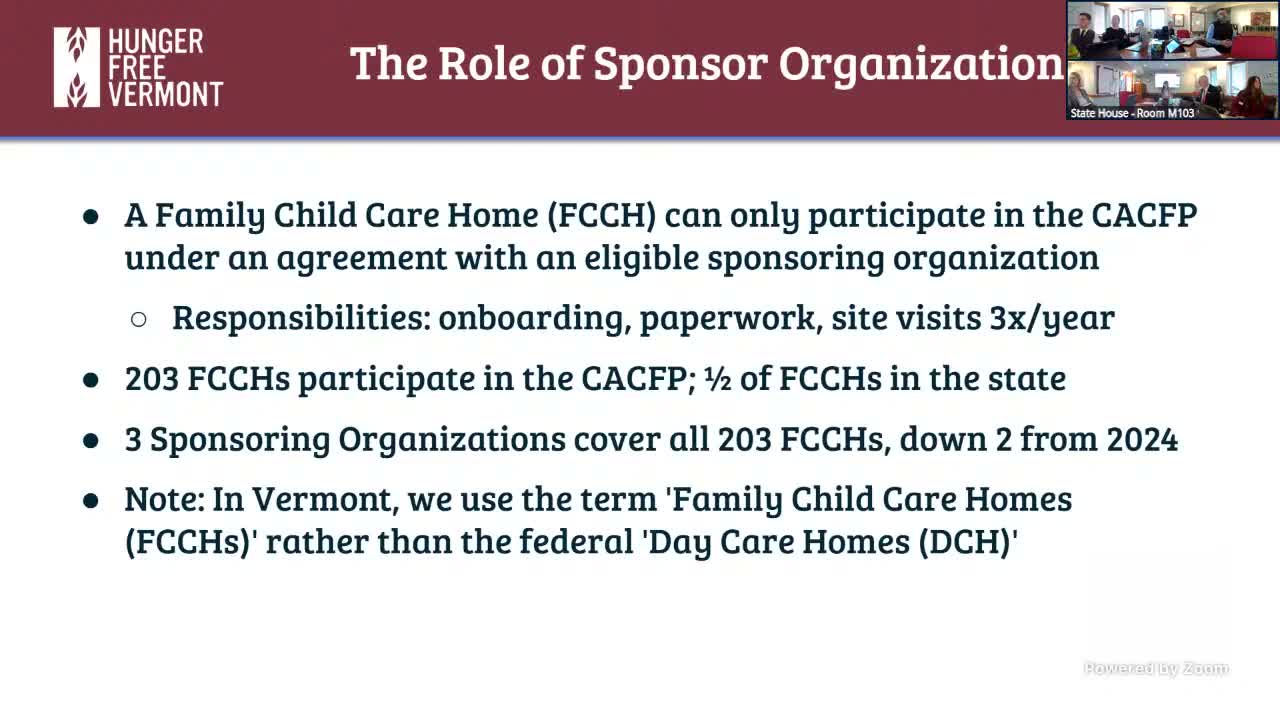
Presenters asked an appropriations committee to fund a $182,000 state appropriation intended to close an administrative funding gap that sponsoring organizations say is forcing some sponsors to stop administering the Child and Adult Care Food Program (CACFP) for family child care homes.
The request, introduced by an unidentified presenter, aims to subsidize sponsoring organizations that serve as intermediaries and fiscal agents for CACFP. The presenter said there are 203 family child care homes that participate in CACFP and that only three sponsoring organizations remain in the state: Brock Community Action, Capstone Community Action and Winston Prouty Center for Child Development. "If we continue to lose sponsoring organizations like we did in 2024, we'll just reduce our capacity for these homes to be able to participate in the program at all," the presenter said.
Why it matters: sponsors perform oversight, training, unannounced site visits and certification required for homes to receive federal reimbursement. Witnesses told the committee the federal administrative allotment does not cover the workload; two sponsors left in 2024 because reimbursement levels did not cover operating costs, and presenters warned that losing more sponsors would shrink participation and could lead some family child care homes to close or stop offering meals through CACFP.
In testimony, Amy Fleming, nutrition and education department manager at Brock Community Action in Rutland, said her organization faced "a 40 almost $41,000 shortfall in administrative funding just to operate the program" last year and called the state appropriation "a lifeline." Fleming said Brock sponsors homes in Addison, Rutland and Bennington counties and that the appropriation allowed her agency to redirect other subsidized funds back into direct services.
Fleming provided financial figures to illustrate the gap: "Last year, we drew down a total of $265,804 in reimbursement dollars that was paid directly to the child care providers. Our admin dollars were $68,403," she said, and added that Brock's operating budget was just over $109,000. Fleming also described the program’s per-home administrative reimbursement structure: $150 per home per month for the first 50 homes, with higher per-home amounts at larger tiers.
Committee members pressed for more detailed accounting of federal funds drawn down statewide; a member said it was important to know whether a $182,000 state appropriation would be matched or offset by federal reimbursements. Presenters said staff are preparing a report with clearer breakout figures and that they would provide it to committee members when complete.
Program operations and capacity constraints were discussed in detail. Fleming said Brock is effectively a staff-of-one for CACFP administration and that Capstone — which covers more counties — has two staff. She described federal monitoring requirements that require sponsors to visit each home at least three times a year, with at least one meal observation, and said travel and timing make visits labor-intensive. Fleming said modest administrative funding could free time for recruitment and allow sponsors to pursue homes that do not currently participate.
Next steps: the presenters reiterated the $182,000 request and handed over to Brock to supply follow-up material. Committee members thanked witnesses and one member asked a staffer (Matt) to maintain a list of budget requests to ensure follow-up; no formal vote or appropriation decision was recorded during this session.
The request, introduced by an unidentified presenter, aims to subsidize sponsoring organizations that serve as intermediaries and fiscal agents for CACFP. The presenter said there are 203 family child care homes that participate in CACFP and that only three sponsoring organizations remain in the state: Brock Community Action, Capstone Community Action and Winston Prouty Center for Child Development. "If we continue to lose sponsoring organizations like we did in 2024, we'll just reduce our capacity for these homes to be able to participate in the program at all," the presenter said.
Why it matters: sponsors perform oversight, training, unannounced site visits and certification required for homes to receive federal reimbursement. Witnesses told the committee the federal administrative allotment does not cover the workload; two sponsors left in 2024 because reimbursement levels did not cover operating costs, and presenters warned that losing more sponsors would shrink participation and could lead some family child care homes to close or stop offering meals through CACFP.
In testimony, Amy Fleming, nutrition and education department manager at Brock Community Action in Rutland, said her organization faced "a 40 almost $41,000 shortfall in administrative funding just to operate the program" last year and called the state appropriation "a lifeline." Fleming said Brock sponsors homes in Addison, Rutland and Bennington counties and that the appropriation allowed her agency to redirect other subsidized funds back into direct services.
Fleming provided financial figures to illustrate the gap: "Last year, we drew down a total of $265,804 in reimbursement dollars that was paid directly to the child care providers. Our admin dollars were $68,403," she said, and added that Brock's operating budget was just over $109,000. Fleming also described the program’s per-home administrative reimbursement structure: $150 per home per month for the first 50 homes, with higher per-home amounts at larger tiers.
Committee members pressed for more detailed accounting of federal funds drawn down statewide; a member said it was important to know whether a $182,000 state appropriation would be matched or offset by federal reimbursements. Presenters said staff are preparing a report with clearer breakout figures and that they would provide it to committee members when complete.
Program operations and capacity constraints were discussed in detail. Fleming said Brock is effectively a staff-of-one for CACFP administration and that Capstone — which covers more counties — has two staff. She described federal monitoring requirements that require sponsors to visit each home at least three times a year, with at least one meal observation, and said travel and timing make visits labor-intensive. Fleming said modest administrative funding could free time for recruitment and allow sponsors to pursue homes that do not currently participate.
Next steps: the presenters reiterated the $182,000 request and handed over to Brock to supply follow-up material. Committee members thanked witnesses and one member asked a staffer (Matt) to maintain a list of budget requests to ensure follow-up; no formal vote or appropriation decision was recorded during this session.
Don't Miss a Word: See the Full Meeting!
Go beyond summaries. Unlock every video, transcript, and key insight with a Founder Membership.
✓
Get instant access to full meeting videos
✓
Search and clip any phrase from complete transcripts
✓
Receive AI-powered summaries & custom alerts
✓
Enjoy lifetime, unrestricted access to government data
30-day money-back guarantee
