Ellington School District presents 2.93% proposed budget; board and public question medical fund, outplacements and utilities
January 11, 2026 | Ellington School District, School Districts, Connecticut
This article was created by AI summarizing key points discussed. AI makes mistakes, so for full details and context, please refer to the video of the full meeting. Please report any errors so we can fix them. Report an error »
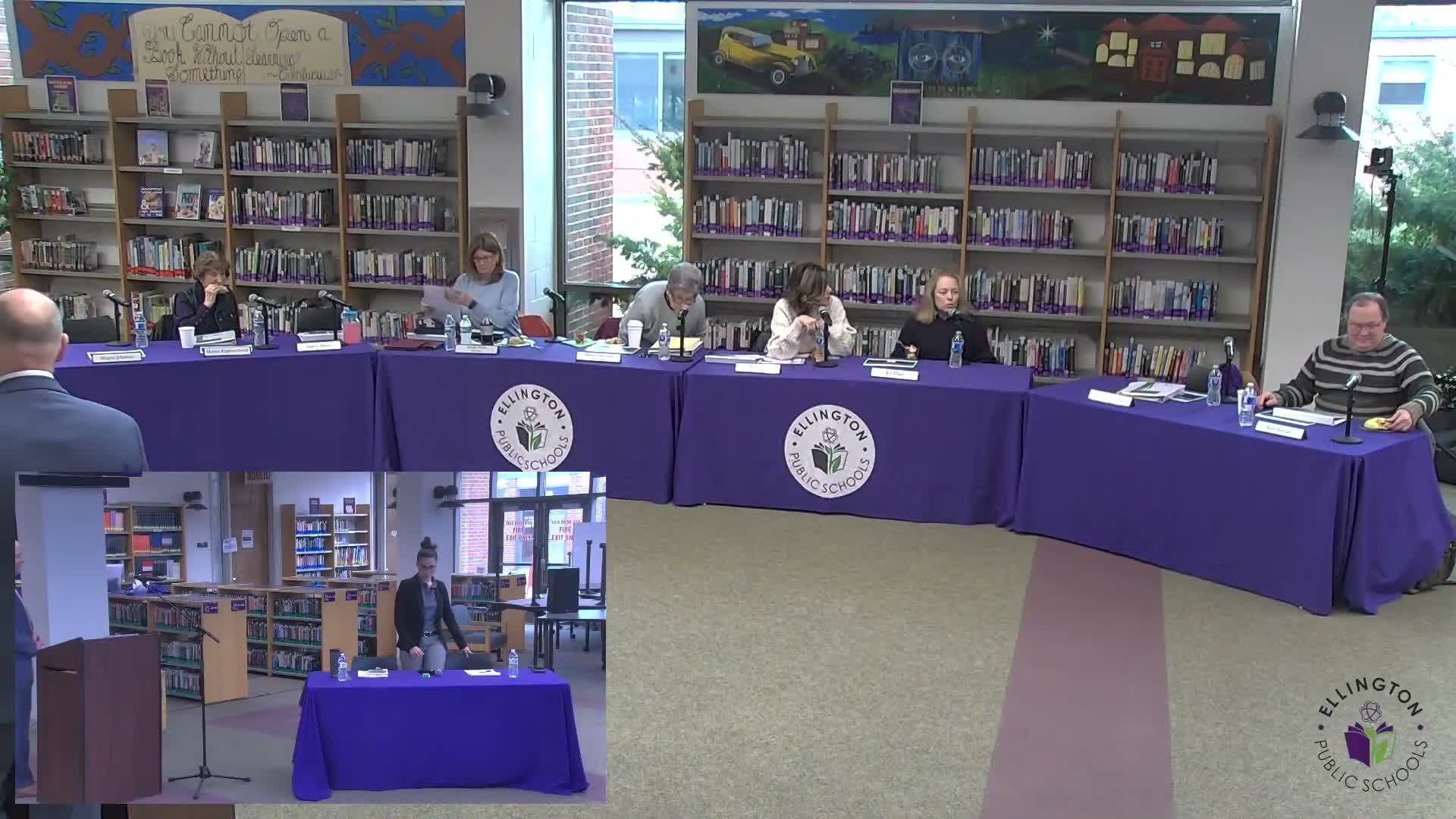
The Ellington School District presented the superintendent's proposed budget in a public session focused on line-item changes, risks and community impacts. Oliver Barton opened the meeting and walked through key context; Alicia, the district's budget presenter, then detailed the accounts that produced the roughly $1,400,000 increase — a 2.93% rise overall.
Alicia told the board, "So we know that the increase is about 1,400,000.0," and said the largest driver is contractual salary increases. She described pre-submission cuts that reduced an initial proposed increase of about 4.95% down to the current 2.93% and said the district added no general-fund positions except for a few roles funded by grants or repurposed resources.
The presentation flagged several risks. On health insurance, Alicia said she kept medical and dental funding flat for next year; she added that Brown & Brown projects about a $400,000 reduction to the medical fund and that the general-fund impact of that drawdown would be roughly $183,000 if realized. On special education, the budget removes some outplacement contingency, a large-cost item, and relies on the district's unexpended fund to absorb unanticipated placements.
Board members pressed for detail on several fronts. Questions included the composition of stipend increases, the one remaining year on the district's bus contract with First Student and whether other vendors had been evaluated, and where choice-program (magnet) funds appear in the budget book (Alicia pointed to page 85). In response to a question about savings from in‑district placements, the board cited Dr. Laporte's calculation of roughly $2,488,248 in savings from serving certain students in-district rather than outplacing them.
On utilities and construction, presenters noted that high electric usage at Windermere is driven by ongoing construction; Alicia said she reduced next year's Windermere electric estimate expecting operational efficiency once the building work is complete. She warned that utilities were budgeted based on the current year's costs and that increases in rates or delivery fees would create budget risk.
Public commenters and board members also discussed broader topics: enrollment projections from NESDEC (a regional study that projected a long-term decline in students), the district's return on investment compared with peers, and the capacity for staff to pursue grant funding (staff and teachers have secured some grants, but the district does not currently fund a dedicated grantwriter position).
Oliver Barton and staff outlined the calendar: the finance committee will review the budget in the coming week and the board will have the opportunity to vote to adopt the budget at a subsequent Board of Education meeting. A budget public hearing is scheduled in April at the high school auditorium. No formal adoption of the budget occurred during this informational session.
The meeting ended with a motion to adjourn (mover: Miriam; second: Lenora), a voice vote and the meeting was closed.
What to watch next: the finance-committee review and the board meeting where the Board of Education may vote to adopt the budget; the district's assumptions about medical fund balances, excess-cost grant reimbursement rates (Alicia said the budget assumes a 70% reimbursement rate), and the outcome of upcoming contract negotiations for paraprofessionals and maintenance/custodial staff.
Alicia told the board, "So we know that the increase is about 1,400,000.0," and said the largest driver is contractual salary increases. She described pre-submission cuts that reduced an initial proposed increase of about 4.95% down to the current 2.93% and said the district added no general-fund positions except for a few roles funded by grants or repurposed resources.
The presentation flagged several risks. On health insurance, Alicia said she kept medical and dental funding flat for next year; she added that Brown & Brown projects about a $400,000 reduction to the medical fund and that the general-fund impact of that drawdown would be roughly $183,000 if realized. On special education, the budget removes some outplacement contingency, a large-cost item, and relies on the district's unexpended fund to absorb unanticipated placements.
Board members pressed for detail on several fronts. Questions included the composition of stipend increases, the one remaining year on the district's bus contract with First Student and whether other vendors had been evaluated, and where choice-program (magnet) funds appear in the budget book (Alicia pointed to page 85). In response to a question about savings from in‑district placements, the board cited Dr. Laporte's calculation of roughly $2,488,248 in savings from serving certain students in-district rather than outplacing them.
On utilities and construction, presenters noted that high electric usage at Windermere is driven by ongoing construction; Alicia said she reduced next year's Windermere electric estimate expecting operational efficiency once the building work is complete. She warned that utilities were budgeted based on the current year's costs and that increases in rates or delivery fees would create budget risk.
Public commenters and board members also discussed broader topics: enrollment projections from NESDEC (a regional study that projected a long-term decline in students), the district's return on investment compared with peers, and the capacity for staff to pursue grant funding (staff and teachers have secured some grants, but the district does not currently fund a dedicated grantwriter position).
Oliver Barton and staff outlined the calendar: the finance committee will review the budget in the coming week and the board will have the opportunity to vote to adopt the budget at a subsequent Board of Education meeting. A budget public hearing is scheduled in April at the high school auditorium. No formal adoption of the budget occurred during this informational session.
The meeting ended with a motion to adjourn (mover: Miriam; second: Lenora), a voice vote and the meeting was closed.
What to watch next: the finance-committee review and the board meeting where the Board of Education may vote to adopt the budget; the district's assumptions about medical fund balances, excess-cost grant reimbursement rates (Alicia said the budget assumes a 70% reimbursement rate), and the outcome of upcoming contract negotiations for paraprofessionals and maintenance/custodial staff.
Don't Miss a Word: See the Full Meeting!
Go beyond summaries. Unlock every video, transcript, and key insight with a Founder Membership.
✓
Get instant access to full meeting videos
✓
Search and clip any phrase from complete transcripts
✓
Receive AI-powered summaries & custom alerts
✓
Enjoy lifetime, unrestricted access to government data
30-day money-back guarantee
